
Starting a new venture is a thrilling yet challenging endeavor, especially for entrepreneurs navigating the complexities of funding, product development, and market competition. Among the myriad of challenges faced by startups, securing funding can often be the most daunting. However, there’s a silver lining that many entrepreneurs overlook: the Research and Development (R&D) Tax Credit. If you’re in the initial stages of your startup journey, learning about how to leverage this benefit could provide the financial cushion you need to innovate and grow your business.
Understanding the R&D Tax Credit: A Primer
Introduced to encourage innovation, the R&D tax credit allows businesses to reduce their tax liability based on qualified research expenses. Originally established in the 1980s, the tax credit has evolved, and its definition of eligible activities is broader than many entrepreneurs realize.
Who Qualifies for the R&D Tax Credit?
The R&D Tax Credit is not exclusively for large corporations or established tech companies. Startups from various sectors can qualify, including:
- Tech Startups: Software development, app creation, or hardware innovation.
- Manufacturing: Businesses improving product processes or creating new materials.
- Biotechnology: Statistical analysis of experiments or clinical trials.
- Engineering: Innovating new designs or methods for construction.
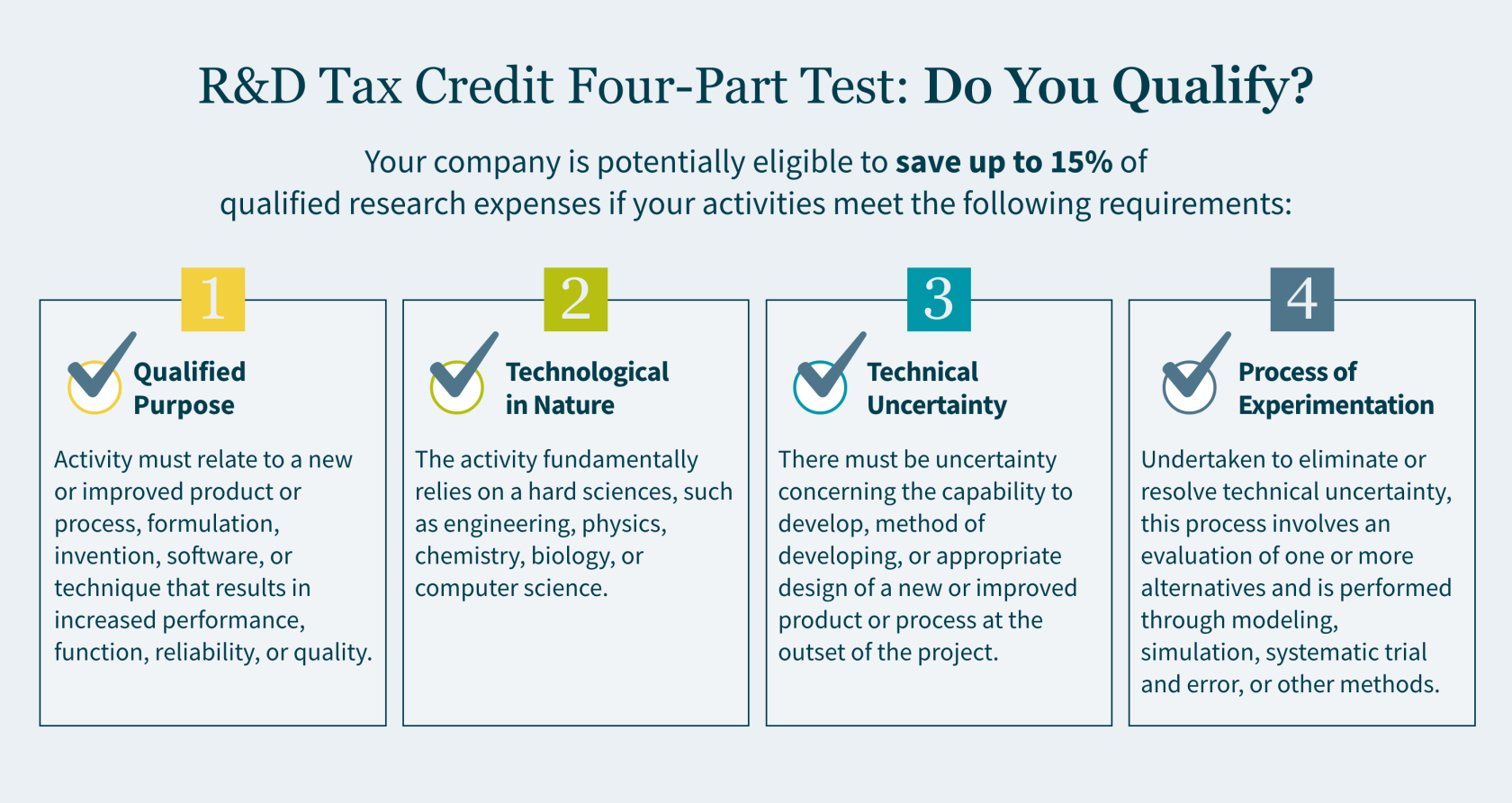
To qualify for the R&D Tax Credit, the research must aim to create or improve a product, process, or software. It must also meet the four-part test established by the IRS, which includes:
-
Permitted Purpose: The research must aim to develop or improve a product or process.
-
Technological Uncertainty: The company must confront uncertainty about whether the desired outcome can be achieved.
-
Process of Experimentation: The research must involve a systematic process to evaluate and test different alternatives.
-
Qualified Activities: The work must relate directly to the purposes mentioned above, involving engineering, design, development, or testing.
Common Misconceptions
Many startups dismiss the possibility of claiming the R&D Tax Credit because they believe their activities aren’t “scientific” enough. However, any process of innovation that aims to create or enhance a product or service can potentially qualify. For instance, if you’re developing an app and face challenges in user experience design, the iterative process might qualify.
Steps to Claim the R&D Tax Credit
Now that you understand what the R&D Tax Credit is and who qualifies, let’s explore how your startup can effectively leverage this tax incentive.
1. Identify Eligible Expenses
The first step in taking advantage of the R&D Tax Credit is identifying which expenses are considered qualified. According to IRS guidelines, you can include:
- Wages for employees involved in qualified research activities.
- Supplies used in the experimentation process.
- Rental or lease costs for computers used in research.
- Contract research expenses incurred from third parties.
Furthermore, if your team is composed of software developers, engineers, or any individuals performing qualifying work, their salaries can be included. Keep meticulous records of these expenses as they will be crucial for your application.
2. Document Your R&D Processes
To prevent headaches later, ensure that you document all your R&D activities thoroughly. This should include:
- The objectives of your R&D projects.
- The nature of the projects and the challenges faced.
- How those challenges were addressed through experimentation.
Good documentation acts as both a roadmap for your research efforts and evidence should you need to defend your claim during an audit.
3. Calculate Your Credit
To maximize the benefits of the R&D Tax Credit, accurately calculate how much you can claim. The credit can be a percentage of your qualified research expenses. Currently, the federal credit allows for up to:
- 20% on research expenses incurred over a specified base amount.
Additionally, many states offer their own versions of the R&D tax credit, which can vary in percentage, eligibility, and additional incentives. Utilize tax calculators or consult with a tax professional who specializes in R&D credits to ensure you’re not leaving money on the table.

- Overcome negative thought patterns, reduce stress, and live a worry-free life
- Overthinking is the biggest cause of unhappiness
- Don't get stuck in a never-ending thought loop
- Stay present and keep your mind off things that don't matter, and never will
- Break free of your self-imposed mental prison
4. File Your Claim
To file your claim for the R&D Tax Credit, use IRS Form 6765. This form allows you to evaluate and report your credit. While the form may seem complex, there are resources available to help navigate it.
It’s often advisable to work with a CPA or a tax professional experienced with R&D credits. They can not only assist in correctly filling out the form but also advise on maximizing your credit through meticulous attention to detail and current regulations.
5. Stay Informed
Tax regulations, including the R&D tax credit, can be fluid. It’s essential to keep abreast of current laws, as changes can affect how much your startup can claim. Join industry groups, follow publications, and consider attending seminars or workshops where tax professionals outline recent developments relevant to startups.
Benefits Beyond Tax Savings
While the foremost advantage of the R&D Tax Credit is the tax relief it provides, the benefits often extend further:
Attracting Investment
Investors often seek out startups that demonstrate a commitment to innovation. By taking advantage of the R&D Tax Credit, you build credibility around your endeavors. This might not only keep your startup viable but can also attract funding by showcasing your potential for growth and development.
Stimulating Innovation
Having access to the R&D Tax Credit incentivizes startups to invest more heavily in research and experimentation. This, in turn, fosters a culture of innovation within your team. The result? Improved products and services that can better meet market demands.
Strengthening Your Startup’s Financial Health
Tight budgets often plague startups. The R&D Tax Credit can free up essential resources, allowing for the reinvestment of funds into other areas of your business, such as marketing, hiring, and scaling.
Real-World Examples of Startups Leveraging R&D Tax Credits
Tech Startup Case Study: App Innovators
Consider a small tech startup that creates a mobile application aimed at improving mental health. Initially, they faced hurdles in developing user-friendly features that adequately accommodated different user needs. By documenting their efforts in addressing these challenges—an iterative coding process, user testing, and algorithm adjustments—they successfully claimed a portion of their development costs as R&D credits. This claimed credit directly supported future iterations of the app, leading to a more polished product and higher user satisfaction.
Manufacturing Startup Case Study: Sustainable Materials
A startup specializing in sustainable materials developed a new production process to reduce waste. Their efforts involved experimenting with varying material combinations and testing the efficacy of alternative sources. By diligently tracking their attempts and associated costs, they were able to claim substantial credits that not only alleviated financial pressures but encouraged further research into more sustainable practices.
Are You Ready to Take Advantage of the R&D Tax Credit?
In summary, the R&D Tax Credit presents a vast opportunity for startups willing to innovate. By educating yourself on its intricacies, accurately documenting your work, and consulting with tax professionals, you can effectively take advantage of this valuable incentive.
As you embark on your entrepreneurial journey, don’t overlook the financial tools available to help you pave the way to success. With a little diligence, you may find that the R&D Tax Credit not only provides much-needed financial relief but also catapults your startup into an exciting phase of innovation and growth. Embrace the possibilities, keep innovating, and watch your startup thrive!


