
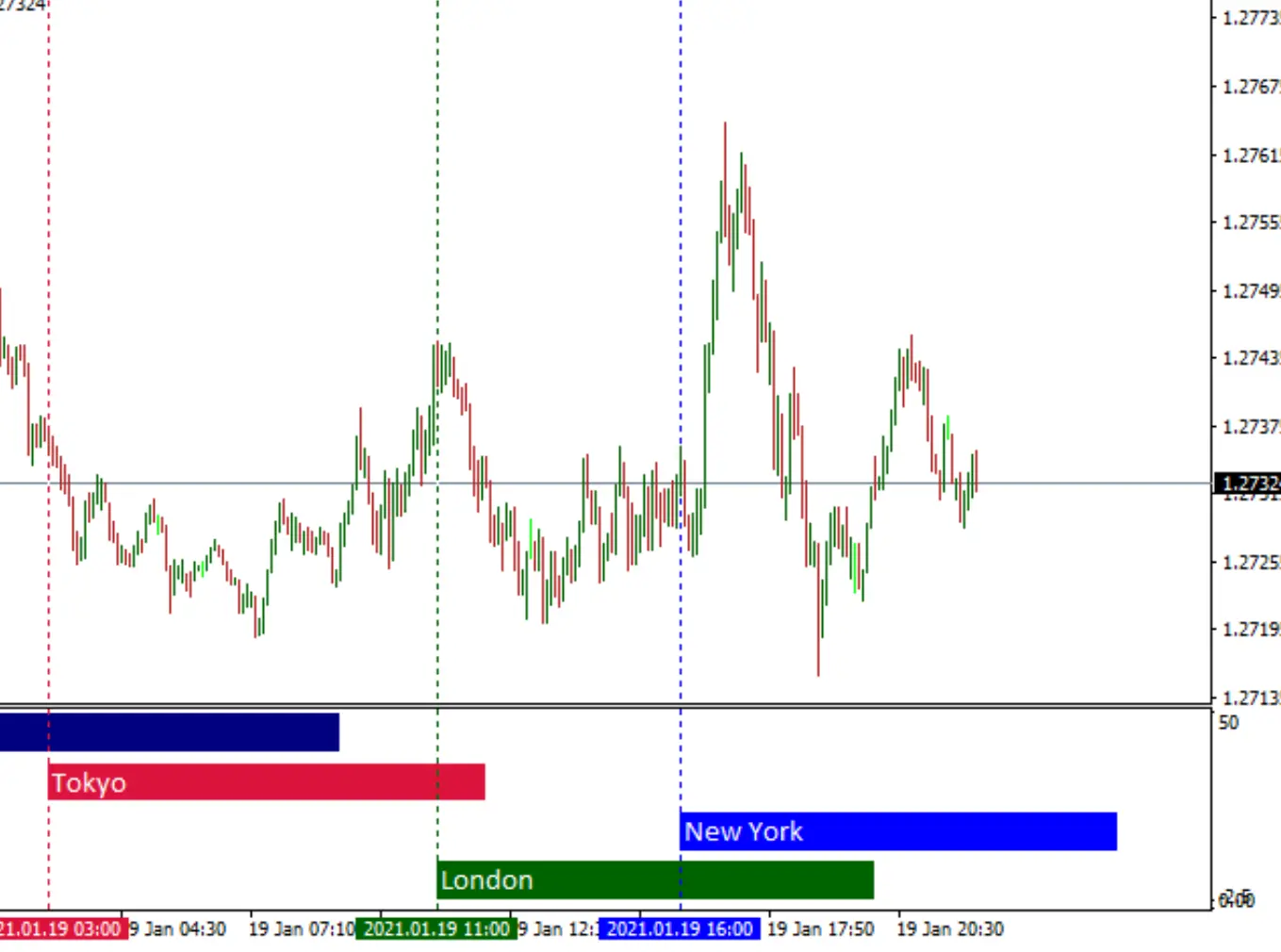
The foreign exchange (forex) market is the largest and most liquid market in the world, with over $7.5 trillion traded daily. It operates 24 hours a day, five days a week, across global time zones. For U.S. traders, understanding when liquidity and volatility peak can dramatically improve execution, reduce costs, and enhance performance.
In 2025, as the Federal Reserve adjusts interest rates and inflation moderates, currency movements remain tied to macroeconomic policy and global capital flows. Knowing when the major trading sessions overlap helps identify the best times to trade pairs like EUR/USD, GBP/USD, and USD/JPY.
Forex never sleeps, but profits depend on trading when liquidity and volatility align.
Key Insights
- The forex market runs 24 hours, Monday through Friday, following global trading sessions.
- The London–New York overlap (8:00 a.m.–11:00 a.m. ET) is the most active period.
- U.S. traders should watch Federal Reserve announcements, which often drive dollar volatility.
- Volume is lowest during the Asia–U.S. gap between 5:00 p.m. and 7:00 p.m. ET.
- Understanding session timing improves trade entry, exit, and risk control.
How the Forex Market Works
Forex trading involves exchanging one currency for another in pairs (e.g., EUR/USD). The first is the base currency, and the second is the quote currency. Prices fluctuate based on supply, demand, and macroeconomic factors such as interest rates, GDP growth, and inflation.
Unlike stock exchanges, the forex market is decentralized and operates electronically through banks, brokers, and financial institutions worldwide.
The Federal Reserve’s Financial Stability Overview notes that global currency flows influence credit conditions and asset prices, making FX volatility a key component of financial stability monitoring.
The Four Major Trading Sessions
| Session | Region | Approx. U.S. Eastern Time (ET) | Major Centers |
|---|---|---|---|
| Sydney | Australia | 5:00 p.m. – 2:00 a.m. | Sydney, Wellington |
| Tokyo | Asia | 7:00 p.m. – 4:00 a.m. | Tokyo, Singapore, Hong Kong |
| London | Europe | 3:00 a.m. – 11:00 a.m. | London, Frankfurt, Zurich |
| New York | North America | 8:00 a.m. – 5:00 p.m. | New York, Toronto |
The market is open continuously from Sunday evening (5:00 p.m. ET) to Friday afternoon (5:00 p.m. ET).
Each session has its own character:
- Asian session: Stable, low volatility.
- European session: Large institutional flows.
- U.S. session: Economic data and Fed-driven volatility.
The London–New York Overlap: Prime Time for Trading
The London–New York overlap between 8:00 a.m. and 11:00 a.m. ET is the most liquid part of the day, accounting for roughly 60% of total forex volume.
This is when:
- Major U.S. and European banks are active simultaneously.
- Economic data (e.g., CPI, GDP, jobless claims) are released.
- Spreads tighten and execution speed improves.
For professional traders and institutions, this window represents the best opportunity to capitalize on predictable liquidity and macro news momentum.
Morning volatility also links directly to broader market movements that influence asset correlations, as covered in Understanding the Beta Coefficient: How U.S. Investors Measure Market Risk and Volatility.
Periods of Low Volatility
When trading sessions do not overlap—especially between the New York close and Sydney open (5:00–7:00 p.m. ET)—volume falls sharply.
During this window:
- Bid–ask spreads widen.
- Liquidity thins.
- Algorithmic traders often dominate.
Casual investors should avoid placing large orders or tight stop-losses in these hours.
The Role of U.S. Economic Data
U.S. macroeconomic releases drive the U.S. dollar index (DXY) and major currency pairs.
Key data includes:
- Nonfarm payrolls (NFP) – first Friday each month.
- Consumer Price Index (CPI) – monthly inflation gauge.
- FOMC statements and rate decisions.
Currency volatility typically spikes 30–60 minutes before and after these events. The Federal Reserve uses such data to calibrate policy, which in turn moves interest rate differentials—one of the most powerful drivers of forex pricing.
How to Match Trading Style with Session Hours
| Trader Type | Best Session(s) | Currency Pairs | Volatility Level |
|---|---|---|---|
| Day Trader | London–New York overlap | EUR/USD, GBP/USD | High |
| Swing Trader | London or New York | USD/JPY, AUD/USD | Medium |
| Scalper | European open | EUR/GBP, EUR/USD | Very high |
| Carry Trader | Asia session | AUD/JPY, NZD/JPY | Low–moderate |
Carry traders—those earning from interest differentials—prefer quieter Asian hours, while short-term traders seek volatility in the overlapping periods.
Global Bank Influence
Large U.S. and European banks such as J.P. Morgan, Citigroup, and Deutsche Bank dominate forex flows. Their institutional algorithms create patterns tied to specific times:
- London Fix (11:00 a.m. ET): Benchmark rate used by funds for daily settlement.
- New York Cut (10:00 a.m. ET): Option expirations that can cause sudden price spikes.
These predictable “time windows” offer tactical opportunities but require discipline and risk management.
Weekend Gaps and After-Hours Risk
Although trading stops Friday at 5:00 p.m. ET, global events—elections, geopolitical tensions, or unexpected data—can move currencies over the weekend. Prices often reopen on Sunday with a gap, creating sudden losses for traders holding positions.
The SEC and CFTC caution investors that stop-loss orders cannot protect against gap risk in the forex market, emphasizing prudent position sizing.
Using ETFs and Regulated Alternatives
Retail investors who want currency exposure without leverage can use currency ETFs like:
- Invesco UUP (U.S. Dollar Index Bullish Fund)
- FXE (Euro ETF)
- FXY (Japanese Yen ETF)
These products provide transparent, SEC-regulated alternatives to leveraged forex accounts while maintaining exposure to currency trends.
For valuation-based comparison of equities affected by exchange-rate shifts, see Understanding the P/E Ratio: How U.S. Investors Use Price-to-Earnings to Value Stocks in 2025.
Forex Market and Risk Metrics
Currency pairs exhibit different levels of beta relative to the stock market.
For example:
- USD/JPY often rises with equities (positive beta).
- EUR/USD tends to move inversely during risk-off periods.
These correlations are central to multi-asset strategies discussed in the Federal Reserve’s stability reports and echoed in Morningstar’s macro analysis, which links currency volatility to global risk appetite.
Best Practices for U.S. Forex Traders
- Trade during major overlaps to minimize spreads.
- Monitor economic calendars to anticipate volatility.
- Use limit orders in low-liquidity periods.
- Manage leverage—a 1% move can wipe out a 50× leveraged account.
- Combine technical and macro analysis for better timing.
Patience and discipline outweigh speed in determining consistent profitability.
Conclusion
The forex market offers unmatched opportunity and flexibility, but timing defines success. Trading during high-liquidity windows—especially the London–New York overlap—enhances execution and aligns with major price drivers.
“In currency trading, time is as valuable as price—liquidity rewards patience.”
For U.S. investors, staying aligned with Federal Reserve policy cycles and market hours is essential to managing volatility, understanding risk, and identifying moments when the world’s most traded market is truly awake.
Disclaimer:
The information in this article is for educational and informational purposes only and does not constitute financial advice. Always consult a qualified financial advisor before making investment decisions. Past performance is not indicative of future results, and all investments carry risk. TheMarketCapitalist.com assumes no responsibility for losses resulting from use of this information.


