
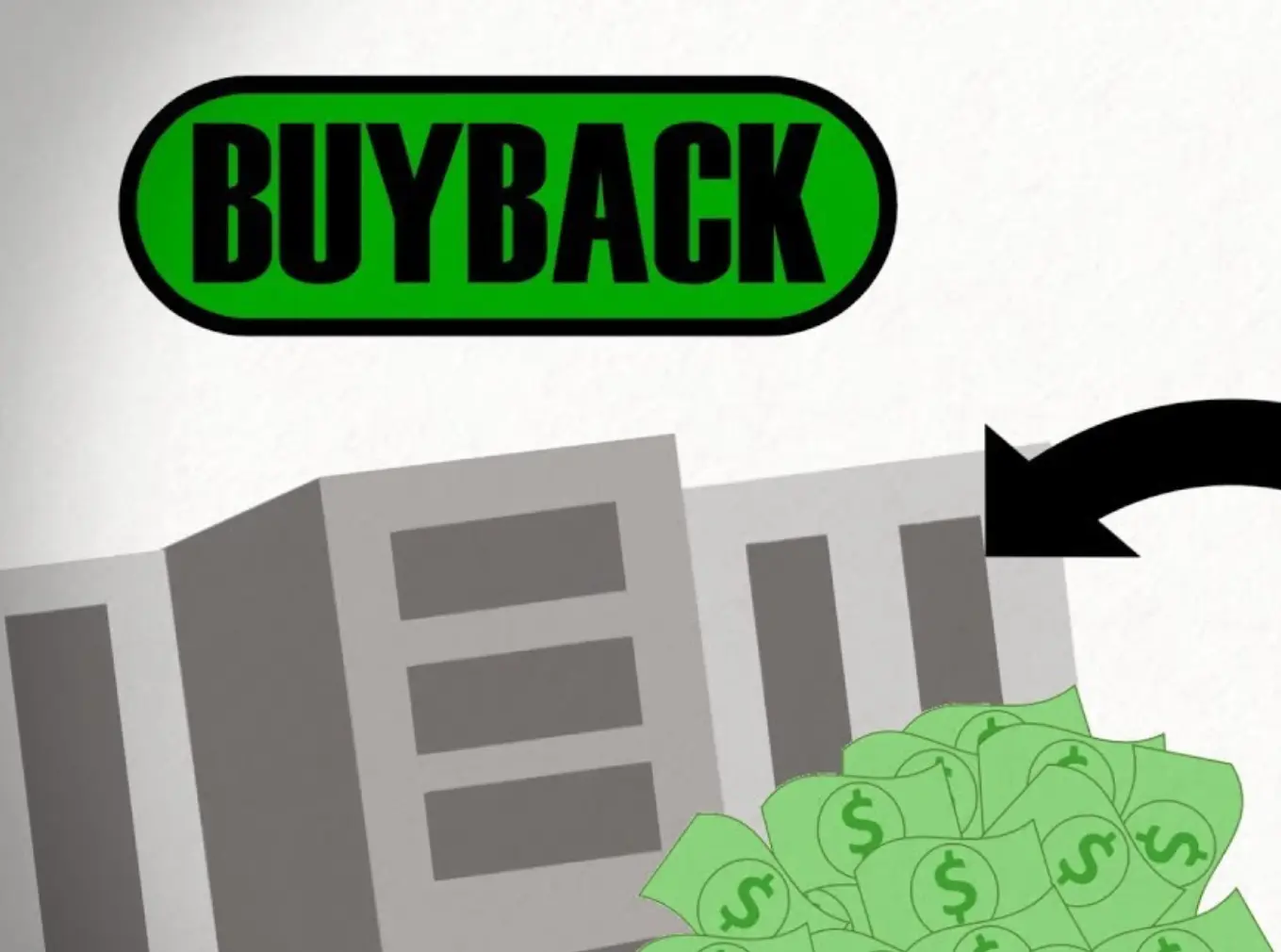
Stock buybacks, or share repurchases, occur when a company uses its cash reserves to buy back its own shares from the open market. This reduces the number of outstanding shares, increasing earnings per share (EPS) and often boosting stock prices.
In 2025, U.S. corporations continue to deploy trillions in repurchase programs, driven by record cash balances, slower capital expenditure, and the tax advantages of returning capital via buybacks rather than dividends. But regulators and economists warn that excessive buybacks can weaken long-term growth and financial resilience.
A buyback tells you what management believes: if they can’t find better opportunities than their own stock, they’ll buy it.
Key Insights
- Buybacks reduce share count, boosting EPS and stock value.
- In 2024, S&P 500 companies spent over $900 billion on repurchases.
- Apple, Alphabet, and Meta lead U.S. buybacks by volume.
- Critics say buybacks distort valuation and reward shareholders at the expense of investment.
- The 1% federal excise tax on buybacks, introduced in 2023, modestly slowed but did not reverse the trend.
How Buybacks Work
A company may repurchase its shares through:
- Open-market operations — gradual purchases on stock exchanges.
- Tender offers — the firm offers to buy shares directly from investors at a premium.
- Accelerated share repurchase (ASR) — executed via investment banks under structured contracts.
The purchased shares are either retired or held as treasury stock, reducing the number of shares used to calculate EPS.
Example:
If a company has 1 billion shares and earns $5 billion in net income, EPS = $5.
If it repurchases 100 million shares, EPS rises to $5.56—even if total profit is unchanged.
1.
Reducing share count inflates EPS, improving valuation multiples like the P/E ratio.
As discussed in Understanding the P/E Ratio: How U.S. Investors Use Price-to-Earnings to Value Stocks in 2025, this artificial EPS growth can make stocks appear stronger than they are.
2.
Signal Confidence
Management often uses buybacks to signal belief that the stock is undervalued.
3.
Flexible Capital Return
Unlike dividends, buybacks are discretionary and don’t commit to recurring payments.
4.
Offset Dilution
Buybacks counterbalance share issuance from employee stock options and executive compensation plans.
5.
Tax Efficiency
Capital gains from buybacks are taxed only upon sale, whereas dividends are taxed immediately.
According to the Federal Reserve’s Financial Stability Overview, this differential has encouraged firms to favor repurchases over dividends since 2010.
The Scale of U.S. Buybacks
| Year | Total S&P 500 Buybacks (USD) | YoY Change |
|---|---|---|
| 2021 | $882 billion | +70% |
| 2022 | $922 billion | +5% |
| 2023 | $896 billion | −3% |
| 2024 | $940 billion | +5% |
Morningstar projects $960 billion for 2025, despite higher financing costs, as firms deploy excess liquidity amid slower capex.
Leading Sectors (2025 Projection)
| Sector | Share of Total Buybacks |
|---|---|
| Technology | 38% |
| Financials | 20% |
| Healthcare | 13% |
| Consumer Discretionary | 10% |
Apple alone repurchased over $77 billion in 2024—more than the GDP of several small nations.
The FDIC’s Quarterly Banking Profile notes that major U.S. banks, constrained by CET1 ratio requirements, reduced repurchases by 12% in 2024 to preserve capital buffers under stress test guidelines.
Economic and Market Effects
1.
Short-Term Price Support
Buybacks create consistent demand for shares, often stabilizing prices during volatility.
2.
Earnings Inflation
Companies can meet or exceed analyst EPS targets purely through repurchases, not organic growth.
3.
Reduced Investment
Critics argue that excessive buybacks divert funds from innovation, wages, or expansion.
A study by the Federal Reserve Bank of New York in 2024 found that 43% of public companies reduced R&D spending during major buyback cycles.
The 1% Buyback Tax
Effective January 2023, the Inflation Reduction Act imposed a 1% excise tax on net share repurchases.
While it slightly trimmed volumes, analysts agree the impact is minor—many corporations simply increased authorizations to offset the cost.
Morningstar estimates that every 1% tax adds only $0.10 per share reduction in EPS benefit for large-cap firms.
Buybacks and Market Valuation
Buybacks directly influence valuation ratios:
\text{P/E Adjusted} = \frac{\text{Price per Share}}{\text{EPS after Buyback}}
Reducing share count increases EPS, lowering the P/E ratio and often attracting momentum-driven investors.
However, as Understanding the Beta Coefficient: How U.S. Investors Measure Market Risk and Volatility explains, buyback-heavy firms can exhibit higher beta when funded through debt—introducing long-term volatility.
The Debt-Funded Buyback Debate
Between 2015 and 2022, ultra-low interest rates encouraged corporations to issue cheap debt to finance buybacks.
Now, with 5% yields, that model is less sustainable.
The Federal Reserve’s 2025 Stability Report warns that “debt-funded repurchases increase systemic vulnerability when rates rise and cash flows weaken.”
Examples:
- IBM cut repurchases 70% in 2024 to reduce leverage.
- ExxonMobil maintained strong buybacks, backed by energy cash flow.
Buybacks are politically sensitive. Critics, including the SEC Chair Gary Gensler, argue they inflate executive pay tied to stock performance.
Proposals to increase the buyback tax to 4% are under Congressional discussion in 2025.
Meanwhile, institutional investors defend repurchases as a legitimate capital management tool when done responsibly.
Case Study: Apple Inc.
Apple’s repurchase program—over $650 billion since 2012—is the largest in history.
By steadily shrinking its float, Apple boosted EPS by over 40% without proportional profit growth.
Its massive cash flow allows buybacks without compromising innovation or solvency.
Morningstar’s Corporate Capital Allocation Report (2025) calls Apple’s program “a textbook example of sustainable repurchases funded by organic cash, not leverage.”
Outlook for 2025
Analysts expect:
- Continued large-cap buybacks, led by tech and healthcare.
- Moderation among financials due to capital regulation.
- ESG scrutiny, as stakeholders demand more disclosure on buyback motives.
The Federal Reserve continues to monitor systemic implications, noting that sustained buyback levels above $1 trillion annually could affect long-term equity supply and market liquidity.
Conclusion
Buybacks are neither inherently good nor bad—they’re a tool.
When executed with discipline, they enhance shareholder value. When abused, they mask stagnation.
“Dividends reward the past. Buybacks bet on the future.”
For U.S. investors in 2025, analyzing why a company buys back stock is more important than how much it buys.
Disclaimer:
The information in this article is for educational and informational purposes only and does not constitute financial advice. Always consult a qualified financial advisor before making investment decisions. Past performance is not indicative of future results, and all investments carry risk. TheMarketCapitalist.com assumes no responsibility for losses resulting from use of this information.


