
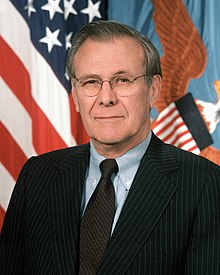
Donald Rumsfeld, an American politician and businessman, had an impressive net worth of $200 million at the time of his death in June 2021. He is best known for his tenure as the Secretary of Defense, serving under Presidents Gerald Ford and George W. Bush. Rumsfeld’s career spanned both the public and private sectors, contributing significantly to his wealth accumulation.
Early Life and Education
Donald Rumsfeld was born on July 9, 1932, in Evanston, Illinois. He attended Princeton University, graduating in 1954 with a degree in political science. Rumsfeld’s early career included a stint in the U.S. Navy, where he served as an aviator and flight instructor from 1954 to 1957. His military service laid the foundation for his later roles in defense and government.
Political Career
Rumsfeld’s political career began in earnest in 1962 when he was elected to the U.S. House of Representatives from Illinois’ 13th district. He served three terms in Congress, during which he earned a reputation for his work on defense and economic issues. In 1969, Rumsfeld joined the Nixon administration as the Director of the Office of Economic Opportunity and Counselor to the President. He also served as the United States Permanent Representative to NATO from 1973 to 1974.
In 1974, Rumsfeld became White House Chief of Staff under President Gerald Ford, a position he held until 1975 when he was appointed Secretary of Defense. At just 43 years old, Rumsfeld became the youngest person to ever hold the position. His tenure was marked by efforts to modernize the U.S. military and improve its readiness during the Cold War.
Business Ventures and Wealth Accumulation
Rumsfeld’s significant wealth came from his ventures in the private sector, particularly his leadership roles in major corporations. After leaving his first stint as Secretary of Defense in 1977, Rumsfeld transitioned to the business world. He served as CEO and Chairman of G.D. Searle & Company, a pharmaceutical company, from 1977 to 1985. During his tenure, he successfully turned the company around, leading to its eventual sale to Monsanto.
From 1990 to 1993, Rumsfeld was Chairman and CEO of General Instrument Corporation, a company specializing in broadband and satellite technology. He continued to build his business portfolio by serving as Chairman of Gilead Sciences, Inc., from 1997 until 2001. Gilead Sciences developed antiviral drugs, including treatments for influenza, which contributed significantly to the company’s growth and Rumsfeld’s personal wealth.
Rumsfeld also served as an advisor to Nvidia Corp and held substantial investments in various venture capital and private equity partnerships. His real estate holdings were estimated to be worth between $7 million and $23 million.
Wealth Disclosures and Financial Management
When Rumsfeld was appointed Secretary of Defense again in 2001, his financial disclosures revealed a net worth ranging between $50 million and $210 million. His wealth included complex private investment partnerships, which were not easily liquidated. This complexity delayed his divestiture of assets to avoid conflicts of interest, leading him to spend $60,000 on accountants’ fees to manage the process.
By June 2021, Rumsfeld had sold between $20 million and $90 million worth of assets to comply with ethics regulations. He ultimately placed $50 million in a blind trust and invested $55 million in tax-free municipal bonds. His 2004 financial disclosure listed his net worth at $137 million, which dipped to $115 million in 2005, and finally settled at $127 million by the end of his tenure in 2006.
Second Tenure as Secretary of Defense
Rumsfeld’s second tenure as Secretary of Defense, from 2001 to 2006, was one of the most pivotal periods in recent American history. He played a crucial role in the U.S. response to the September 11, 2001, terrorist attacks, overseeing the wars in Afghanistan and Iraq. Rumsfeld was a vocal advocate for the belief that Iraq possessed weapons of mass destruction, a claim that was later discredited.
His tenure was marked by significant military and political challenges, including the protracted conflicts in the Middle East and the controversy over detainee treatment at Guantanamo Bay and Abu Ghraib prison. Despite being a polarizing figure, Rumsfeld’s influence on U.S. defense policy was profound.
Post-Government Career and Legacy
After resigning from his position in late 2006, Rumsfeld published his autobiography, “Known and Unknown: A Memoir,” which offered insights into his lengthy career in public service and business. He also established the Rumsfeld Foundation, which focuses on supporting leadership and public service initiatives, particularly in Central Asia and the Caucasus.
Donald Rumsfeld’s legacy is a complex one, marked by significant achievements and controversial decisions. His contributions to U.S. defense policy and his success in the private sector underscore a career that had a lasting impact on both fields.
Conclusion
Donald Rumsfeld’s net worth of $200 million at the time of his death in 2021 reflects a life of substantial achievement and influence. From his early days in Congress to his pivotal role in U.S. defense policy, and his success in the private sector, Rumsfeld’s career was multifaceted and impactful. His financial acumen and strategic investments contributed to his considerable wealth, making him one of the most financially successful politicians of his time.


