
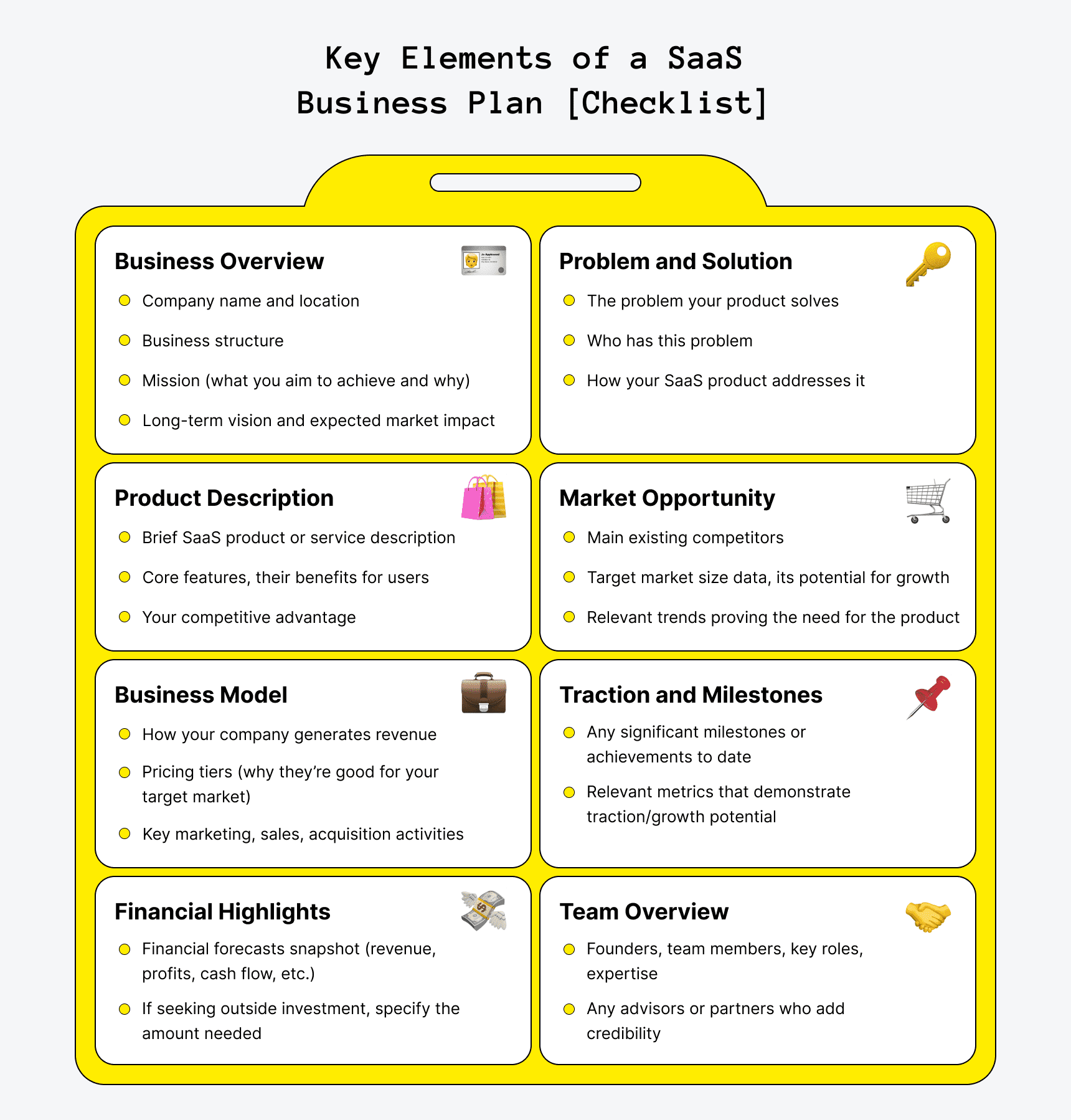
As the Software as a Service (SaaS) industry continues to gain momentum, investors are becoming increasingly discerning about the businesses they choose to fund. A solid business plan is crucial for attracting investment, especially in an ever-competitive market. As we stride into 2024, certain components in a SaaS business plan are more vital than ever for capturing investor attention. This article will explore the key components investors expect to see in SaaS business plans in 2024, providing insights that entrepreneurs and startups can use to sharpen their strategies and improve their chances of securing funding.
1. Clear Value Proposition
At the heart of every successful SaaS business is a compelling value proposition. Investors want to see how your product solves specific problems or fulfills needs in a way that is distinctly beneficial compared to existing solutions. In 2024, the value proposition must not only articulate the immediate benefits but should also reflect an understanding of market trends, user pain points, and the potential for scalability.
For example, if your SaaS solution automates a previously manual process, quantifying the time saved and efficiency gained can enhance your proposition’s appeal. Use data and testimonials to support your claims and create a narrative around how your solution stands out in the crowded SaaS landscape.
2. Comprehensive Market Analysis
An extensive market analysis should be a foundational element of your SaaS business plan. Investors are keen on understanding the market landscape — including the size of your target market, potential customer segments, and competitive analysis. By clearly identifying who your customers are, their demographics, and purchasing behaviors, you can demonstrate your ability to capture and retain them.
In 2024, emphasis should be placed on emerging trends such as AI and machine learning integrations, as well as a shift toward remote work solutions. Highlighting growth metrics and industry benchmarks will not only validate your market potential but will also give investors confidence in your ability to navigate a rapidly evolving marketplace.
3. Robust Revenue Model
Investors want to see a clear and sustainable revenue model that outlines how your business plans to achieve profitability. Common SaaS revenue models include subscription-based, freemium, and tiered pricing structures. In 2024, there is an increasing trend toward user-centric pricing that aligns with customer value received, so it’s important to thoroughly explain how your pricing strategy correlates with user adoption and retention metrics.
Moreover, consider detailing your customer acquisition costs, lifetime value of a customer (LTV), and the potential for upselling or cross-selling additional products or services. A well-defined revenue model should project both short-term and long-term financial success while providing contingency plans for market fluctuations.
4. Scalable Growth Strategy
A clearly defined growth strategy is essential for attracting investment in a saturated market. Investors look for businesses with significant scaling potential. As you map out your growth strategy, consider how you plan to acquire customers, the channels you will leverage, and how you will retain customers post-acquisition.
In 2024, omni-channel marketing strategies that incorporate social media, content marketing, search engine optimization (SEO), and paid ads will remain vital. Additionally, providing annual and quarterly growth forecasts, and detailing how investments will drive customer acquisition and retention, can make a compelling case for your overall strategy.
5. Product Development Roadmap
A detailed product development roadmap is an important component of your SaaS business plan. Investors want to know your plans for feature releases and how you’ll continue to innovate and maintain your competitive edge. In 2024, the emphasis on security enhancements, data privacy, and integration capabilities will be factors that potential funders will prioritize.
Outline your short-term and long-term goals for product development, including timelines for new features, scalability plans, and how you will address feedback from existing customers. By actively illustrating a commitment to evolving your product, you reassure investors that your SaaS solution will remain relevant and competitive.

- Overcome negative thought patterns, reduce stress, and live a worry-free life
- Overthinking is the biggest cause of unhappiness
- Don't get stuck in a never-ending thought loop
- Stay present and keep your mind off things that don't matter, and never will
- Break free of your self-imposed mental prison
6. Strong Team Composition
Your team is one of your most valuable assets. Investors want to see that you have a capable and experienced team that can execute the vision laid out in your business plan. In 2024, diversity in team composition is increasingly being recognized as an important factor for success, bringing varied perspectives and skills to the table.
Highlight the expertise of your founding team, key hires, and advisory board members. Be transparent about their backgrounds and how their experiences contribute to the overall governance and operation of your SaaS company. This will help instill confidence in investors, demonstrating that you have the right talent to back your ambitious plans.
7. Customer Success and Support Strategy
In the SaaS model, customer success is paramount for retention and long-term contracts. Investors are keen on business plans that have clearly defined strategies for engaging and supporting customers. A well-thought-out customer success plan should illustrate how you’ll onboard new users, offer ongoing support, and maintain customer engagement.
Consider employing customer feedback loops, satisfaction surveys, and proactive support teams as part of your strategy. In 2024, providing real-time analytics, chatbots for basic queries, and personalized support will likely be keys to a successful customer success strategy. Investors appreciate knowing that you are prioritizing not just selling your product, but also enhancing the user experience.
8. Financial Projections and Funding Requirement
A robust financial summary is crucial for any business plan. Investors will closely scrutinize your financial projections — they want to see realistic forecasts for revenue, expenses, and cash flow over the next three to five years. Include a breakdown of your funding requirements, specifically how you plan to allocate the funds received from investors.
In 2024, it’s imperative to present well-researched projections that cover various scenarios, including best-case and worst-case outcomes. This demonstrates to investors that you are not only optimistic about the future but also prepared for possible challenges.
9. Exit Strategy
Lastly, every investor is concerned about the return on their investment, which is why a clear exit strategy is essential. Investors want to understand how and when they can expect to see a return, whether through an acquisition, an initial public offering (IPO), or other methods. In 2024, highlighting potential acquisition targets, market trends toward mergers and acquisitions, and exit multiples could significantly enhance your plan’s appeal.
Detailing your understanding of industry dynamics and potential exit opportunities can reassure investors that you have not only thought deeply about your business’s future but also about their financial interests.
Conclusion
Navigating the competitive landscape of SaaS in 2024 requires a well-structured business plan that aligns with investor expectations. By focusing on the key components mentioned above — from a compelling value proposition to a clear exit strategy — entrepreneurs can enhance their chances of securing the funding needed to pursue their vision.
The SaaS industry is continuously evolving, making it essential for businesses to remain proactive and adaptable. By staying informed about industry trends and incorporating investor feedback into your business planning, you can position your SaaS startup for sustained success. The time to refine your business plan is now; the future of your SaaS venture depends on it.


