
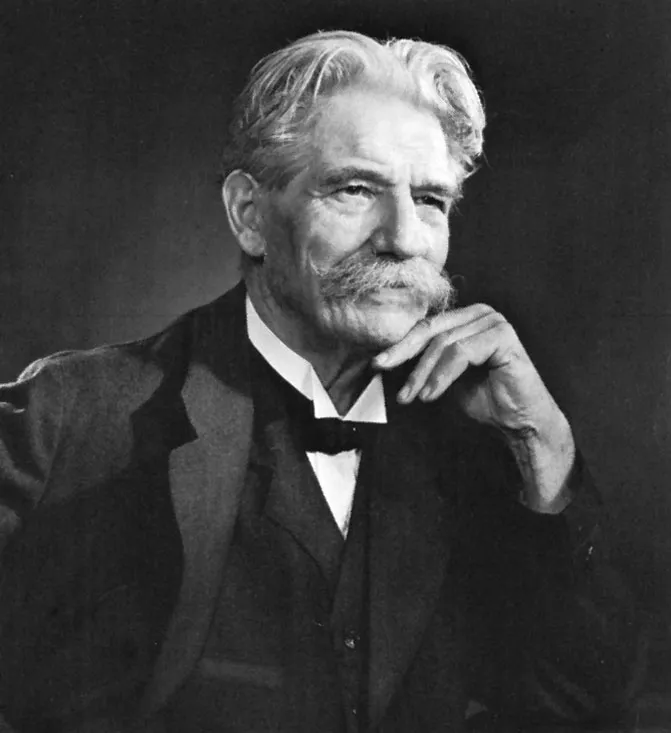
Albert Schweitzer, born on January 14, 1875, in Kaysersberg, Alsace, then part of the German Empire, is a figure whose name resonates across multiple disciplines, from theology and philosophy to music and medicine. A true polymath, Schweitzer’s life was a testament to his deep commitment to humanitarianism, intellectual rigor, and artistic excellence. This article delves into the life of Albert Schweitzer, exploring his age, rise to fame, and the key highlights of his remarkable career.
Early Life and Education
Albert Schweitzer was born into a family that valued education and culture. His father was a Lutheran pastor, which influenced Schweitzer’s early religious education and instilled in him a lifelong commitment to faith and service. Growing up in a small village, Schweitzer was exposed to both the French and German cultures, which later shaped his cosmopolitan outlook.
He attended the University of Strasbourg, where he demonstrated his intellectual versatility by pursuing degrees in philosophy and theology. Schweitzer earned his doctorate in philosophy in 1899 with a thesis on Immanuel Kant’s religious philosophy. In 1900, he was ordained as a Lutheran pastor and began teaching at the theological college in Strasbourg, eventually becoming a professor of New Testament studies.
However, Schweitzer’s interests were not confined to theology and philosophy. He was also an accomplished musician, particularly known for his expertise in playing the organ. His passion for music led him to study under the renowned composer and organist Charles-Marie Widor in Paris. Schweitzer’s profound love for music, especially the works of Johann Sebastian Bach, would remain a central theme throughout his life.
Theological Contributions and Musical Legacy
Albert Schweitzer’s contributions to theology were groundbreaking. His book, “The Quest of the Historical Jesus,” published in 1906, challenged contemporary views on the life and teachings of Jesus Christ. Schweitzer argued that Jesus’ teachings were deeply rooted in the eschatological beliefs of his time, a perspective that was revolutionary and controversial. This work established Schweitzer as a leading figure in biblical scholarship.
Simultaneously, Schweitzer was making significant contributions to the world of music. His work “J.S. Bach, the Musician-Poet” is considered one of the most important studies of Bach’s music. Published first in French in 1905 and later in German in 1908, this book analyzed Bach’s compositions not just as musical pieces but as profound expressions of faith and emotion. Schweitzer’s deep understanding of Bach’s work was not just academic; he was also an interpreter of Bach’s music, giving organ concerts that were widely acclaimed.
Schweitzer’s love for Bach’s music was rooted in his belief that music could be a powerful force for good in the world. He viewed Bach as a spiritual guide, whose music could uplift the soul and bring people closer to God. This belief was reflected in Schweitzer’s own performances and writings, where he sought to convey the spiritual depth of Bach’s compositions to a broader audience.
A Turn Towards Medicine and Missionary Work
Despite his success in theology and music, Albert Schweitzer felt a calling to serve humanity in a more direct and practical way. In 1905, he made a life-changing decision to study medicine, with the intention of becoming a medical missionary in Africa. This decision was driven by his deep Christian faith and his belief in the ethical imperative to help those in need.
Schweitzer enrolled in the University of Strasbourg’s medical school and earned his medical degree in 1911. After completing his studies, he specialized in tropical medicine in Paris, preparing himself for the challenges he would face in Africa. This was an unusual path for someone of his stature and accomplishments, but it reflected Schweitzer’s commitment to living out his ethical beliefs.
In 1913, Albert Schweitzer and his wife, Hélène Bresslau, a trained nurse, traveled to Lambaréné in what is now Gabon, Central Africa. There, Schweitzer established a hospital using funds he had raised from his musical performances and lectures. The hospital was rudimentary at first, built from materials he had shipped from Europe and constructed with the help of local workers. Schweitzer’s medical work in Africa was challenging and often dangerous, but he was driven by his belief in the sanctity of life and his commitment to alleviating suffering.
The Impact of World War I
When World War I broke out in 1914, Schweitzer, being a German citizen in a French colony, was interned as an enemy alien by the French authorities. He and his wife spent most of the war in detention in France, during which time Schweitzer wrote extensively on the philosophy of civilization. His experiences during the war deepened his philosophical reflections on the nature of civilization, ethics, and the role of humanity in the world.
It was during this period that Schweitzer developed his famous ethical philosophy of “Reverence for Life.” He articulated this philosophy in his book “Philosophy of Civilization,” published in 1923. Schweitzer argued that the decline of modern civilization was due to the absence of a genuine ethics grounded in respect for all living things. He believed that true civilization could only be achieved when humanity embraced a philosophy of life that recognized the intrinsic value of every living being.
Post-War Humanitarian Efforts and Recognition
After World War I, Albert Schweitzer returned to Lambaréné, where he rebuilt and expanded his hospital, turning it into a major medical center for the region. Schweitzer’s work attracted international attention, and he became a symbol of humanitarianism and selfless service. His hospital treated thousands of patients each year, and Schweitzer himself performed countless surgeries, often under difficult conditions.
Despite the hardships, Schweitzer continued to engage with the world beyond Africa. He traveled to Europe periodically to give lectures and organ concerts, raising funds for his hospital and spreading his message of Reverence for Life. He also wrote prolifically, authoring books and essays on a wide range of topics, including ethics, theology, and music.
In 1952, Albert Schweitzer was awarded the Nobel Peace Prize in recognition of his tireless humanitarian work and his contributions to the promotion of peace and understanding. Schweitzer used the prize money to build a leper colony at his hospital in Lambaréné, fulfilling a long-held dream to provide care for those suffering from this debilitating disease. The colony, named “Village of Light,” opened in 1954 and became a beacon of hope for leprosy patients in the region.
Philosophy of Reverence for Life
The concept of Reverence for Life is central to understanding Albert Schweitzer’s legacy. Schweitzer believed that all life is sacred and that humans have a moral responsibility to respect, protect, and nurture life in all its forms. This philosophy was a radical departure from the anthropocentric views that dominated much of Western thought at the time. Schweitzer’s ideas challenged people to think beyond their immediate interests and consider the broader impact of their actions on the world around them.
Schweitzer’s philosophy was not just theoretical; it was deeply practical. It informed his approach to medicine, his interactions with people, and his views on social and environmental issues. He was a vocal advocate for animal welfare, environmental conservation, and the ethical treatment of all living beings. His work in Africa, where he treated humans and animals with equal care and respect, was a living embodiment of his beliefs.
Later Life and Enduring Legacy
Albert Schweitzer continued his work in Lambaréné well into his old age. Despite health challenges and the physical toll of his work, he remained active, overseeing the hospital and continuing to write and speak on issues of ethics and civilization. Schweitzer’s commitment to his work was unwavering, and he remained in Africa until his death.
Schweitzer passed away on September 4, 1965, at the age of 90, in his beloved Lambaréné. He was buried there, beside his wife, Hélène, who had died in 1957. Schweitzer’s death marked the end of a life dedicated to service, but his legacy continues to inspire generations of humanitarians, medical professionals, and scholars.
Albert Schweitzer’s life is a powerful example of how one person can make a profound impact on the world through dedication, compassion, and a commitment to ethical principles. His work in Africa saved countless lives, and his philosophy of Reverence for Life has influenced ethical thought and action across the globe.
Conclusion
Albert Schweitzer was more than just a doctor, theologian, or musician; he was a visionary who believed in the power of humanity to create a better world. His life was a testament to the idea that true greatness comes from serving others and living in accordance with deeply held ethical beliefs. As we reflect on Schweitzer’s life and legacy, it is clear that his contributions to medicine, philosophy, and humanitarianism will continue to resonate for many years to come.
Schweitzer’s philosophy of Reverence for Life remains as relevant today as it was during his lifetime. In a world facing complex ethical challenges, from environmental degradation to social inequality, Schweitzer’s message reminds us of the importance of compassion, respect, and responsibility toward all forms of life. His work serves as a beacon of hope and a call to action for those who seek to make a positive difference in the world.


