
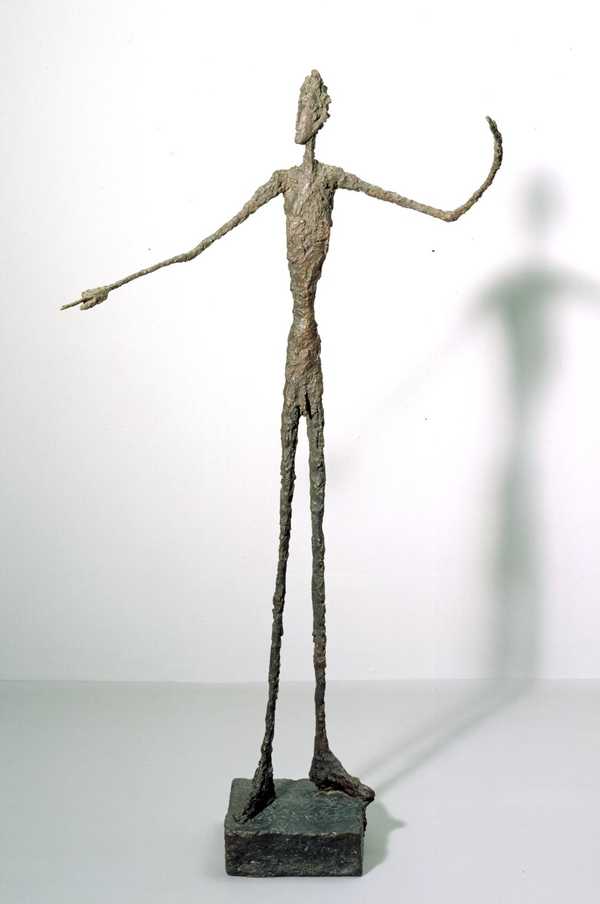
Alberto Giacometti, born on October 10, 1901, in Borgonovo, Switzerland, is one of the most influential sculptors and painters of the 20th century. Renowned for his slender, elongated human figures, Giacometti’s work is a profound exploration of the human condition, identity, and existentialism. His artistic journey, marked by relentless experimentation and a quest for the essence of humanity, has left an indelible mark on modern art. This article delves into the life of Alberto Giacometti, exploring his rise to fame, artistic milestones, and the lasting legacy he has left behind.
Early Life and Artistic Roots
Alberto Giacometti was born into a family deeply embedded in the world of art. His father, Giovanni Giacometti, was a notable Neo-Impressionist painter who greatly influenced Alberto’s early artistic development. Growing up in the picturesque Val Bregaglia region of Switzerland, Giacometti was exposed to the arts from a young age. His early interest in drawing and sculpture was encouraged by his father, who became his first teacher.
Giacometti’s formal education began at the École des Beaux-Arts and the École des Arts et Metiers in Geneva. These institutions provided him with a solid foundation in traditional art techniques, but it was his self-directed studies and experiences that truly shaped his artistic vision. A key moment in his early career was his time in Rome in 1921, where he immersed himself in the study of classical and Renaissance art. The works of masters like Tintoretto and Giotto left a lasting impression on him, inspiring his desire to create art that was both deeply rooted in tradition and strikingly original.
Paris and the Surrealist Movement
In 1922, Giacometti moved to Paris, the epicenter of the avant-garde art world at the time. He studied under the sculptor Antoine Bourdelle, who was a student of Auguste Rodin, and began experimenting with different artistic styles, including Cubism. However, it was his involvement with the Surrealist movement that would bring him widespread recognition.
Giacometti’s surrealist works, characterized by their abstract forms and dream-like quality, quickly gained attention. His participation in the Salon des Tuileries in 1927 marked the beginning of his rise to fame. He became associated with key figures in the Surrealist movement, such as André Breton, the movement’s founder, as well as artists like Joan Miró and Max Ernst, and writers like Paul Eluard and Georges Bataille. Giacometti’s work during this period was deeply influenced by his interest in the subconscious mind and the concept of the “surreal,” which aimed to unlock the power of the imagination.
Despite his success within the Surrealist circle, Giacometti eventually began to feel constrained by the movement’s emphasis on the irrational and the dream-like. He sought to reconnect with the tangible reality of the human figure, leading him to break away from Surrealism in the early 1930s. This marked a significant turning point in his career, as he embarked on a new phase of artistic exploration focused on the human form and its existential significance.
The Search for the Human Essence
The 1930s were a period of intense personal and artistic transformation for Giacometti. After the death of his father in 1933, Giacometti withdrew from the Parisian art scene to concentrate on an exploration of the human figure. His work from this period is characterized by a relentless pursuit of what he termed “absolute resemblance,” a quest to capture the essence of a person in his sculptures.
Giacometti’s focus on the human head and gaze during this period was particularly significant. He believed that the eyes were the “seat of thought” and concentrated on creating sculptures that captured the intensity and depth of the human gaze. This obsession with the human form led to the creation of some of his most iconic works—thin, elongated figures that seem to defy physical constraints, embodying a sense of isolation and introspection.
His relationship with existentialist philosopher Jean-Paul Sartre during this time also had a profound impact on his work. Sartre’s philosophy, which emphasized the individual’s existence as a free and responsible agent determining their own development through acts of will, resonated deeply with Giacometti. Sartre later wrote about Giacometti’s work, describing it as an attempt to capture the “existence” of his subjects rather than their mere appearance.
World War II and Post-War Success
The outbreak of World War II forced Giacometti to leave Paris and return to Switzerland, where he spent the war years in relative isolation in Geneva. This period was marked by further introspection and a deepening of his artistic exploration. Despite the hardships of the war, Giacometti continued to create, focusing more intensely on the themes of survival, existence, and the fragility of life—concepts that would become central to his post-war work.
After the war, Giacometti returned to Paris in 1946 and resumed his artistic career with renewed vigor. The post-war period was one of extraordinary productivity and success for Giacometti. It was during this time that he developed the signature style that would define his career: the elongated, almost skeletal figures that seem to emerge from a void, isolated yet powerful in their starkness.
These figures, such as his famous “Walking Man” series, became symbols of the existential condition, embodying the loneliness, anxiety, and determination of the human spirit in the face of a chaotic and uncertain world. Giacometti’s work from this period resonated with the mood of post-war Europe, and he quickly gained international acclaim. In 1962, he was awarded the Grand Prize for Sculpture at the Venice Biennale, solidifying his reputation as one of the most important sculptors of the 20th century.
Artistic Legacy and Influence
Alberto Giacometti’s influence on modern art cannot be overstated. His work represents a bridge between traditional sculpture and the avant-garde movements of the 20th century, blending classical techniques with a modernist sensibility that continues to inspire artists today. His exploration of the human condition, particularly his focus on isolation, identity, and existence, has had a profound impact on both visual art and philosophy.
Giacometti’s works are characterized by their raw, unpolished surfaces, which give his sculptures a sense of immediacy and emotional intensity. His figures, often depicted in mid-stride or in moments of quiet contemplation, seem to be caught between motion and stillness, embodying the tension between existence and nothingness. This focus on the fragility and transience of life has made Giacometti’s work particularly resonant in the context of existential philosophy, where questions of meaning, identity, and the nature of existence are central.
Beyond the art world, Giacometti’s work has had a lasting influence on popular culture. His sculptures have been featured in numerous exhibitions and are held in major collections around the world, including the Museum of Modern Art in New York and the Tate Gallery in London. His influence can also be seen in the work of contemporary artists and in various media, from literature to film, where his stark, haunting figures continue to evoke the complexities of the human experience.
One of the most notable testaments to Giacometti’s enduring legacy is the record-breaking sale of his bronze sculpture “L’Homme qui marche I” (The Walking Man I) at a Sotheby’s auction in 2010, where it fetched approximately €75 million. This sale underscored the timeless appeal of Giacometti’s work and his place as a central figure in the history of modern art.
Conclusion
Alberto Giacometti’s life and work are a testament to the power of art to explore and express the deepest aspects of the human condition. From his early days in Switzerland to his rise to international fame, Giacometti’s relentless pursuit of the essence of humanity has left a profound and lasting impact on the world of art. His figures, with their elongated forms and introspective gazes, continue to speak to the universal themes of existence, identity, and the struggle to find meaning in a complex and often overwhelming world.
As one of the most significant artists of the 20th century, Giacometti’s legacy is not only preserved in his iconic sculptures and paintings but also in the continuing influence he has on contemporary art and thought. His work challenges us to look beyond the surface and to consider the deeper realities of our own existence, making him a timeless figure whose art will continue to resonate for generations to come.


