
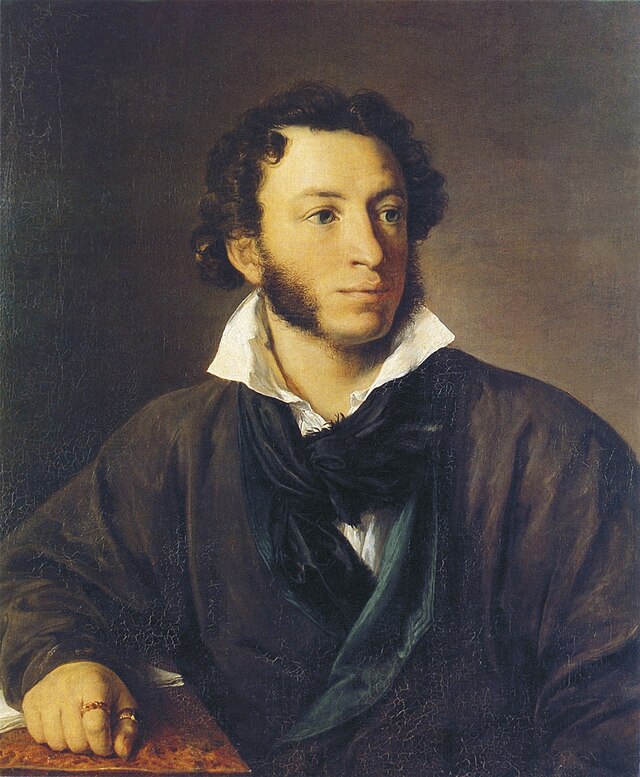
Aleksandr Sergeyevich Pushkin, born on June 6, 1799 (May 26 in the Julian calendar, then used in Russia) in Moscow, is widely regarded as the father of Russian literature. A poet, playwright, and novelist, Pushkin’s work laid the foundation for the Russian literary tradition, influencing countless authors and shaping the national identity. His life, marked by both creative genius and personal turmoil, offers a compelling story of artistic brilliance against the backdrop of Russia’s complex social and political landscape.
Early Life and Literary Influences
Aleksandr Pushkin was born into a family of minor nobility, with deep roots in Russian history. His upbringing was steeped in literature and intellectualism. His paternal uncle, Vasily Pushkin, was a noted poet, and his father often engaged with prominent literary figures such as Nikolai Karamzin and Vasily Zhukovsky. This intellectual environment provided young Pushkin with access to a wealth of books, particularly in French, which greatly influenced his early literary development.
Despite being surrounded by literary figures, Pushkin’s childhood was emotionally distant. He was primarily raised by tutors and nannies, the most notable being Arina Rodionovna, who played a significant role in nurturing his love for Russian folklore. Arina’s storytelling, rich with the themes and characters of Russian folk tales, would later deeply influence Pushkin’s own writing, particularly his fairy tales and narrative poems.
Pushkin’s education took a more formal turn in 1811 when he was enrolled at the prestigious Imperial Lyceum in Tsarskoye Selo (now Pushkin, a suburb of St. Petersburg). The Lyceum was an elite school that catered to the sons of Russian nobility and prepared them for service to the state. It was here that Pushkin’s poetic talent began to flourish. He wrote his first major works while still a student, earning the admiration of his teachers and peers. His early poetry was heavily influenced by French literature, particularly the works of Voltaire and Molière, but he soon began to develop his own voice, blending classical themes with Russian cultural motifs.
Early Literary Career and Exile
After graduating from the Lyceum in 1817, Pushkin began working at the Ministry of Foreign Affairs in St. Petersburg. However, his true passion lay in poetry, and he quickly became involved in the vibrant literary and social circles of the capital. Pushkin’s early works, such as the poem Ruslan and Ludmila (1820), a fantastical epic based on Russian folklore, established him as a leading figure in Russian literature.
However, Pushkin’s outspoken political views soon brought him into conflict with the authorities. He was an ardent supporter of social reform and expressed his revolutionary ideas through his poetry, which often critiqued the autocratic Russian government. His poem Ode to Liberty (1820), for example, praised the idea of political freedom and condemned tyranny, leading to his surveillance by the Tsar’s secret police.
In 1820, Pushkin was exiled to the southern parts of the Russian Empire, beginning a period of wandering that would last several years. He spent time in the Caucasus, Crimea, and Moldova, where he continued to write prolifically. This period of exile was crucial to his development as a writer, as it exposed him to the diverse cultures and landscapes of the Russian Empire, enriching his literary imagination. During this time, he produced some of his most celebrated works, including The Prisoner of the Caucasus (1821), The Fountain of Bakhchisarai (1822), and The Gypsies (1824), all of which reflect the influence of his southern exile.
Pushkin’s time in exile also deepened his sense of alienation and rebellion, themes that would recur throughout his work. Despite the constraints placed upon him by the government, he continued to push the boundaries of Russian literature, blending romanticism with realism and infusing his works with a distinctly Russian sensibility.
Return to Moscow and Continued Struggles
In 1823, Pushkin was allowed to move to Odessa, where he enjoyed a more cosmopolitan lifestyle. However, his stay in Odessa was cut short in 1824 when he was dismissed from government service for expressing atheistic views in a private letter that was intercepted by the authorities. This incident led to his forced relocation to his family’s estate at Mikhailovskoye, near Pskov, where he spent two years under close surveillance.
The period at Mikhailovskoye was one of intense creativity for Pushkin. Isolated from the literary and social life of the cities, he immersed himself in his work, producing some of his most important and enduring creations. It was here that he began writing his masterpiece, Eugene Onegin (1823-1831), a novel in verse that would later be hailed as the pinnacle of Russian literature. Eugene Onegin is a complex work that explores themes of love, honor, and the clash between individual desires and societal expectations, all set against the backdrop of Russian society in the early 19th century.
Pushkin’s forced isolation did not prevent him from staying informed about the political developments of the time. He closely followed the Decembrist uprising of 1825, a failed revolt led by Russian army officers who sought to limit the power of the Tsar and introduce constitutional reforms. Although Pushkin was not directly involved in the uprising, his sympathies were well known, and the failure of the Decembrists had a profound impact on him. The rebellion and its aftermath influenced much of his later work, including his historical writings and his treatment of themes such as justice, tyranny, and the individual’s role in society.
Reconciliation with the Tsar and Marriage
In 1826, following the ascension of Tsar Nicholas I, Pushkin was summoned to Moscow. The new Tsar, recognizing Pushkin’s literary genius, offered him a form of clemency and personal supervision, allowing him to return to St. Petersburg under the condition that the Tsar himself would review all of Pushkin’s works before publication. While this arrangement provided Pushkin with a certain degree of protection, it also placed him under constant scrutiny, restricting his creative freedom.
Despite these limitations, Pushkin continued to write prolifically. In 1830, he married Natalia Goncharova, one of the most beautiful women of her time. The marriage brought Pushkin both joy and anguish. Natalia was frequently the subject of court gossip due to her beauty and her perceived flirtations, which placed a considerable strain on their marriage. The pressures of court life, coupled with his ongoing financial difficulties, contributed to Pushkin’s growing sense of frustration and disillusionment.
The year 1830 also marked another period of intense creativity for Pushkin. During a cholera quarantine at his family estate in Boldino, he produced an extraordinary body of work in just a few months, known as the “Boldino Autumn.” This prolific period saw the completion of The Tales of Belkin, The Little Tragedies (a series of short dramatic works), and several major poems, including The Bronze Horseman (1833), a narrative poem that explores the tension between individual agency and historical forces, set against the backdrop of St. Petersburg.
The Tragic End: Duel and Death
Despite his literary success, Pushkin’s personal life continued to be tumultuous. His marriage was marred by persistent rumors about Natalia’s infidelities, particularly with the French officer Georges-Charles de Heeckeren d’Anthès. The situation reached a breaking point in January 1837 when Pushkin challenged d’Anthès to a duel to defend his honor.
On January 27, 1837, Pushkin and d’Anthès met for their duel in the outskirts of St. Petersburg. Pushkin was gravely wounded in the encounter, and two days later, on January 29, 1837, he died from his injuries at the age of 37. His death was a profound loss to Russian literature, cutting short the life of a man whose contributions had already laid the foundations for an entire literary tradition.
Pushkin’s death sent shockwaves through Russian society. He was mourned not just as a literary genius but as a symbol of Russian national identity. His funeral, held in secret to avoid unrest, was attended by close friends and family, and his body was quietly buried at the Svyatogorsky Monastery near his family estate.
Literary Legacy and Historical Significance
Aleksandr Pushkin’s literary legacy is immense. Often referred to as the “Sun of Russian Poetry,” he is credited with shaping the modern Russian language and establishing many of the themes and stylistic features that would define Russian literature for generations. His works are characterized by their linguistic precision, emotional depth, and a profound understanding of the human condition.
Pushkin’s influence extends far beyond the realm of poetry. His novel Eugene Onegin is considered a seminal work in Russian literature, blending elements of romance, satire, and social commentary. The novel’s exploration of the Russian soul and its nuanced portrayal of the tension between tradition and modernity have made it a touchstone for subsequent Russian writers, including Fyodor Dostoevsky and Leo Tolstoy.
In addition to his poetry and prose, Pushkin made significant contributions to Russian drama. His play Boris Godunov (1825) is a historical tragedy that delves into the complexities of power, legitimacy, and the moral dilemmas faced by those in authority. The play has been adapted into operas and remains a staple of Russian theater.
Pushkin’s impact on Russian culture cannot be overstated. He is often regarded as the founder of Russian realism, a literary movement that sought to depict life in a truthful, unidealized manner. This movement would later be expanded by writers such as Nikolai Gogol, Ivan Turgenev, and Anton Chekhov, all of whom drew inspiration from Pushkin’s work.
Beyond literature, Pushkin’s life and works have become integral to Russian national identity. His ability to articulate the aspirations and struggles of the Russian people, combined with his tragic death at a young age, has cemented his status as a cultural icon. Monuments to Pushkin can be found in cities across Russia, and his works are taught in schools as essential components of Russian cultural heritage.
Conclusion
Aleksandr Pushkin remains a towering figure in world literature. His ability to capture the essence of Russian life, combined with his mastery of language and form, has earned him a place among the greatest writers in history. Pushkin’s works continue to be read, studied, and admired not only in Russia but around the world, where they are celebrated for their universal themes and timeless beauty.
Pushkin’s life, marked by both extraordinary achievement and personal tragedy, serves as a reminder of the enduring power of literature to transcend time and place. His contributions laid the groundwork for the golden age of Russian literature, inspiring generations of writers and artists to explore the depths of the human experience.
As we reflect on the life and legacy of Aleksandr Pushkin, we are reminded of the profound impact that a single individual can have on the cultural and intellectual life of a nation. Pushkin’s voice, filled with passion, wit, and wisdom, continues to resonate across the centuries, offering insights into the complexities of life, love, and the human spirit.


