
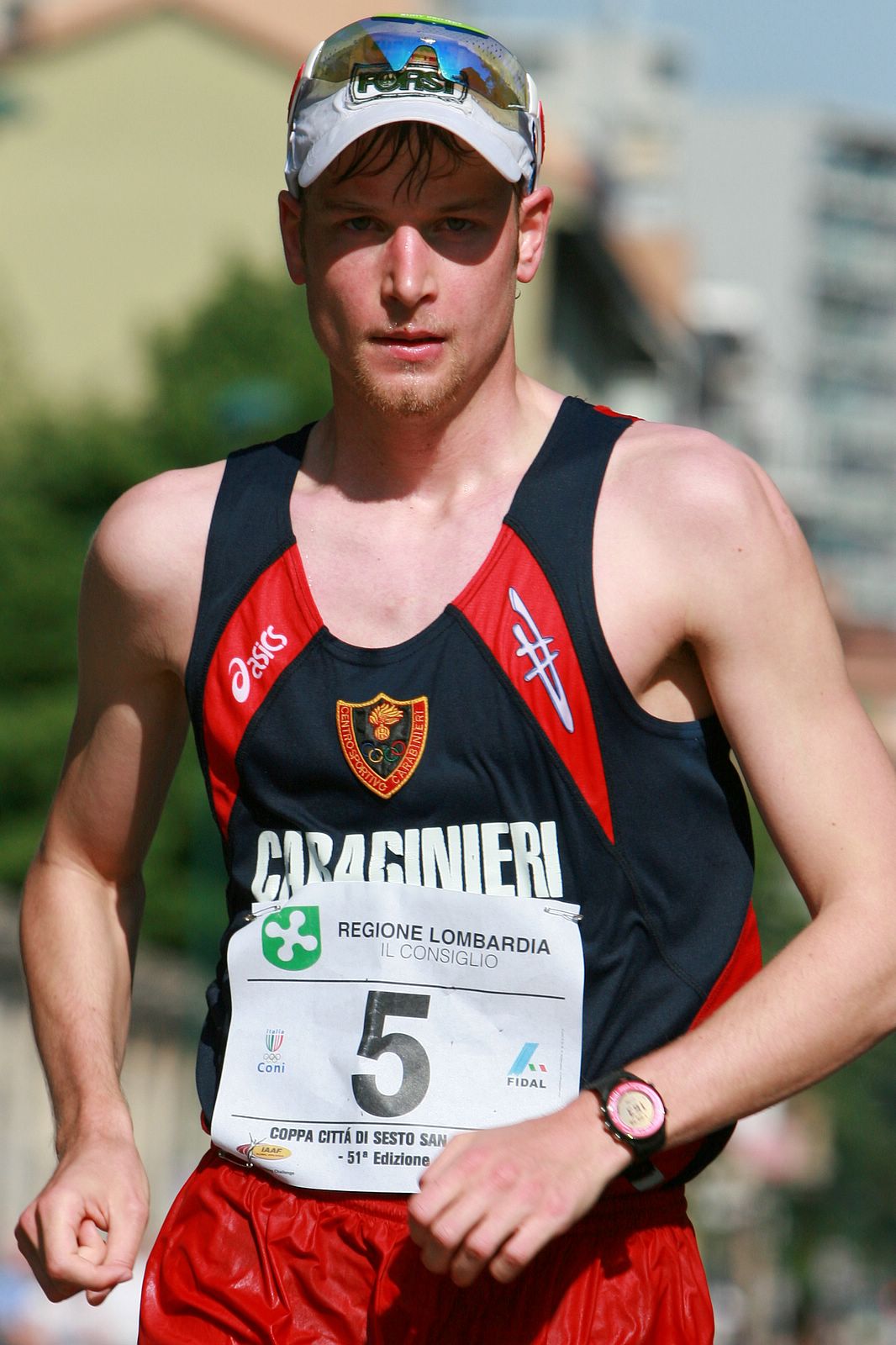
Alex Schwazer, born on December 26, 1984, in Vipiteno, Trentino-Alto Adige, Italy, is an Italian racewalker who became a national hero after winning a gold medal at the 2008 Beijing Olympics. However, his career has been marked by extraordinary highs and devastating lows, making him one of the most complex figures in the world of athletics.
Early Life and Introduction to Athletics
Alex Schwazer was born in a region known for its stunning landscapes and rich cultural heritage. Vipiteno, located in the northern part of Italy, provided Schwazer with an environment conducive to outdoor activities. Schwazer’s early athletic endeavors included middle-distance running, but it wasn’t until he discovered racewalking in his teenage years that he found his true calling.
By the time Schwazer was in his late teens, he had already made a name for himself in Italian athletics. He showed promise early on, and it wasn’t long before he transitioned from middle-distance running to racewalking, a sport that would eventually bring him international acclaim.
Early Success and Rise to Fame
Schwazer’s rise in the world of athletics was swift. At the age of 21, he won his first Italian championship in the 50-kilometer racewalk in 2005. This victory marked the beginning of a series of successes that would soon establish him as one of the world’s top racewalkers. That same year, Schwazer secured a bronze medal at the World Championships in Helsinki, setting a new Italian record with a time of 3 hours, 41 minutes, and 54 seconds.
Schwazer continued to improve, and in 2007, he broke his own national record by completing a 50-kilometer race in 3 hours, 36 minutes, and 4 seconds. This achievement further cemented his reputation as a formidable competitor on the global stage.
The 2008 Beijing Olympics: A Golden Moment
The pinnacle of Alex Schwazer’s career came at the 2008 Beijing Olympics. Competing in the 50-kilometer racewalk, Schwazer dominated the event, winning the gold medal with a time of 3 hours, 37 minutes, and 9 seconds, which also set a new Olympic record. This victory was a monumental achievement, not only for Schwazer but also for Italian athletics, as it marked Italy’s first Olympic gold medal in racewalking in nearly half a century.
The image of Schwazer entering the Beijing National Stadium, proudly draped in the Italian flag, became iconic. However, this moment of triumph was not without controversy. Schwazer faced criticism from the Schützen, a group of German-speaking Tyroleans, for his overt display of Italian patriotism—a reflection of the complex cultural dynamics in his home region.
Post-Olympic Struggles and the 2012 Doping Scandal
Despite his Olympic success, the years following Beijing were fraught with challenges for Schwazer. In 2009, during the World Championships in Berlin, Schwazer was forced to withdraw from the 50-kilometer race due to severe stomach pains. This setback was the beginning of a difficult period for the athlete, both physically and mentally.
In 2010, Schwazer set a new national record in the 20-kilometer racewalk with a time of 1 hour, 18 minutes, and 24 seconds, surpassing the previous record held by Maurizio Damilano. However, despite this success, he was unable to capture gold at the 2010 European Championships in Barcelona, finishing second behind Russian athlete Stanislav Emeljanov. Emeljanov’s victory was later overshadowed by doping allegations, leading to Schwazer being retrospectively awarded the gold medal in 2014.
Schwazer’s career took a dramatic turn for the worse in 2012. Just days before the London Olympics, it was revealed that Schwazer had tested positive for erythropoietin (EPO) during an out-of-competition doping test conducted by the World Anti-Doping Agency (WADA). The news shocked the sports world, and Schwazer was immediately excluded from the Italian Olympic team.
The doping scandal had severe consequences for Schwazer’s career and personal life. He was suspended by the Italian National Olympic Committee (CONI) and later faced legal repercussions. Schwazer’s relationship with his then-girlfriend, Italian figure skater Carolina Kostner, also suffered as a result of the scandal. Kostner was later suspended for 16 months for allegedly helping Schwazer evade doping controls.
The Fallout: Suffering and Redemption
Following the doping scandal, Schwazer faced a public and personal crisis. The media scrutiny was intense, and Schwazer found himself at the center of a national scandal. The Italian confectionery giant Ferrero, which had been one of his main sponsors, chose not to renew their contract with the athlete, reflecting the deep impact the scandal had on his public image.
In April 2013, the Italian National Anti-Doping Tribunal handed Schwazer a three-year and six-month ban from athletics. This ban effectively ended his hopes of competing in the 2016 Rio Olympics. Schwazer also faced legal action in Italy, eventually agreeing to an eight-month suspended sentence and a €6,000 fine.
The fallout from the doping scandal was not limited to Schwazer alone. Carolina Kostner’s involvement led to her own legal troubles, with the Italian anti-doping authorities extending Schwazer’s suspension by an additional three months in 2015 due to his attempts to evade doping controls with Kostner’s assistance.
The Attempted Comeback and New Allegations
Despite the seemingly insurmountable challenges, Alex Schwazer was determined to make a comeback. In March 2015, he announced his intention to return to competitive racewalking, enlisting the help of Sandro Donati, a renowned anti-doping advocate in Italy. With Donati’s guidance, Schwazer aimed to redeem himself and qualify for the 2016 Rio Olympics.
In May 2016, Schwazer made a stunning return to the sport, winning the 50-kilometer racewalk at the World Race Walking Team Championships in Rome. His victory earned him a spot on the Italian team for the Rio Olympics, seemingly marking a successful comeback.
However, Schwazer’s return to competition was short-lived. In June 2016, it was revealed that Schwazer had tested positive for doping again, this time in a sample taken in January of that year. Schwazer vehemently denied the allegations, claiming that he was the victim of a conspiracy to sabotage his career.
The new doping allegations led to an eight-year ban, effectively ending Schwazer’s career as a competitive athlete. The ban was confirmed just days before the Rio Olympics, crushing any hope Schwazer had of returning to the Olympic stage.
The Aftermath and Legal Battles
In the wake of the second doping scandal, suspicions of foul play began to emerge. Investigations conducted by Italian media outlets, including La Repubblica, suggested that Schwazer may have been the target of a conspiracy aimed at preventing his return to competition. These suspicions led to an official investigation by the Carabinieri’s scientific unit (RIS) in Parma, under the direction of a public prosecutor.
In February 2021, an Italian court dismissed the criminal charges against Schwazer, ruling that there was insufficient evidence to prove that he had committed a doping offense in 2016. This decision was a significant moment in Schwazer’s ongoing fight to clear his name, although the ban imposed by the athletics governing body remained in place.
Personal Life and Legacy
Despite the turmoil in his professional life, Alex Schwazer found some stability in his personal life. In March 2017, he became a father when his partner, Kathrin Freund, gave birth to their daughter, Ida. The birth of his daughter marked a new chapter in Schwazer’s life, one focused on family and personal growth.
In November 2021, Schwazer published his autobiography, “Dopo il traguardo” (“After the Finish Line”), in which he detailed his experiences, struggles, and the impact of the doping scandals on his life. The book provided an intimate look at Schwazer’s journey, offering insights into the pressures of elite athletics and the consequences of poor decisions.
In September 2023, Schwazer made a surprising move by participating as a contestant on the 17th season of the Italian reality show “Grande Fratello” (Big Brother). His appearance on the show marked a new phase in his public life, one that focused on reconnecting with the Italian public and sharing his story of redemption.
Conclusion: The Complex Legacy of Alex Schwazer
Alex Schwazer’s story is one of immense talent, dramatic downfall, and an ongoing struggle for redemption. His rise from a small town in northern Italy to the pinnacle of Olympic glory is a testament to his dedication and skill as an athlete. However, his career has been overshadowed by the doping scandals that ultimately led to his downfall.
Schwazer’s legacy in the world of athletics is complex. He remains a symbol of both the heights that can be achieved through hard work and the perils of succumbing to the pressures of competition. His story serves as a cautionary tale about the consequences of doping in sports, as well as the challenges of navigating the intense scrutiny that comes with being a public figure.
As Alex Schwazer continues to rebuild his life and public image, his journey offers valuable lessons about resilience, accountability, and the possibility of redemption. While his athletic career may be over, Schwazer’s impact on the world of sports and his ongoing battle to clear his name ensure that his story will continue to resonate for years to come.


