
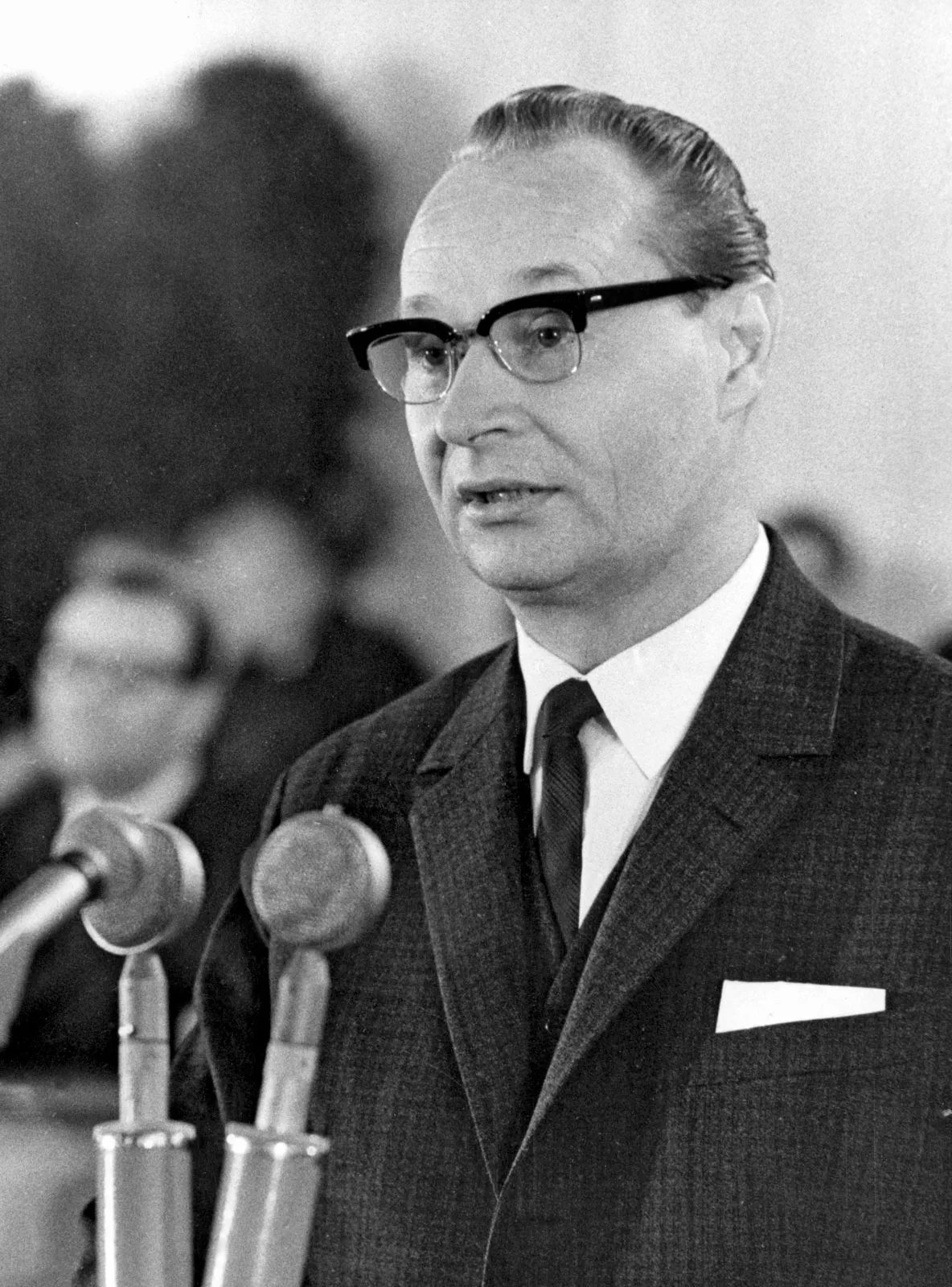
Alexander Dubček, a prominent figure in 20th-century European politics, is best known for his role in the “Prague Spring” of 1968, a period marked by attempts to reform the Communist regime in Czechoslovakia. Born on November 27, 1921, in Uhrovec, Czechoslovakia (now part of Slovakia), Dubček’s life is a compelling story of idealism, political reform, and the struggle for democracy under the shadow of Soviet influence. His legacy continues to resonate in discussions of political reform and human rights in Eastern Europe.
Early Life and Political Beginnings
Dubček’s early life was significantly shaped by his family’s political leanings. When he was just four years old, his family moved to the Soviet Union, where he spent much of his childhood. This early exposure to communism profoundly influenced his political ideology. In 1939, at the age of 18, Dubček returned to Czechoslovakia and began working as a factory worker, a common starting point for many Communist Party members of the time.
During World War II, Dubček became involved in the Slovak resistance against Nazi occupation, a formative experience that reinforced his commitment to Communist ideals. His participation in the Slovak National Uprising of 1944, a significant anti-Nazi resistance movement, further established his credentials within the Communist Party of Czechoslovakia (PCC).
Rise to Power
Dubček’s rise within the ranks of the Communist Party was steady. By 1951, he had been elected as a deputy in the National Assembly. His political acumen and dedication to Communist ideals eventually led to his appointment as the First Secretary of the Slovak Communist Party in 1963. This position placed him in a powerful role within the broader framework of the PCC, which governed Czechoslovakia.
However, Dubček was not content with the status quo. He was deeply critical of the authoritarian nature of the Soviet model of communism, which dominated the political landscape of Eastern Europe at the time. His vision for Czechoslovakia involved a “socialism with a human face,” a form of governance that would combine the social and economic benefits of socialism with greater political freedoms and human rights.
The Prague Spring
The year 1968 marked the pinnacle of Dubček’s political career and his most significant contribution to history. On January 5, 1968, he was elected as the First Secretary of the Communist Party of Czechoslovakia, replacing Antonín Novotný, who had been closely aligned with Soviet hardliners. Dubček’s election signaled the beginning of what would later be known as the “Prague Spring,” a period of political liberalization and reform.
Dubček’s reform agenda aimed to democratize the political system while maintaining the socialist framework. Key reforms included the loosening of restrictions on the press, speech, and travel, as well as the introduction of a more open and responsive government. These changes were revolutionary in the context of Eastern Europe, where Soviet-style communism dominated and dissent was often brutally suppressed.
The Prague Spring garnered widespread support within Czechoslovakia. Intellectuals, students, and workers alike embraced Dubček’s vision of a more open and humane socialism. However, the movement also attracted significant attention—and concern—from the Soviet Union and other Eastern Bloc countries. They feared that Dubček’s reforms could inspire similar movements in their own countries, threatening the stability of the Soviet-controlled bloc.
The Soviet Invasion
The success of the Prague Spring was short-lived. On the night of August 20-21, 1968, Soviet-led Warsaw Pact forces invaded Czechoslovakia to crush the reform movement. Dubček and other leaders were arrested and taken to Moscow, where they were pressured into reversing the reforms. The invasion marked a devastating blow to the hopes of a more democratic and liberal socialism in Eastern Europe.
Dubček was forced to publicly renounce the reforms and endorse the Soviet line, a humiliating turn of events for a leader who had become a symbol of hope and change. Although he was allowed to remain in office for a short time, by April 1969, he was removed from his position as First Secretary and replaced by Gustav Husák, a more compliant leader who would oversee the “normalization” of Czechoslovakia—essentially a return to the repressive policies that had preceded the Prague Spring.
Later Life and Legacy
After his removal from power, Dubček was relegated to a series of minor positions and was eventually expelled from the Communist Party in 1970. For the next two decades, he lived in relative obscurity, working as a manual laborer in a forestry company in Slovakia. Despite his fall from grace, Dubček remained a symbol of resistance against totalitarianism, both within Czechoslovakia and internationally.
The fall of communism in Eastern Europe in 1989, often referred to as the “Velvet Revolution,” brought Dubček back into the political spotlight. During the revolution, which was largely non-violent, Dubček was hailed as a hero. On December 29, 1989, he was elected Chairman of the Federal Assembly (the Czechoslovak parliament), a role in which he served during the country’s transition to democracy.
One of Dubček’s last significant acts in this role was his opposition to a law that aimed to punish all former members of the Communist Party indiscriminately. He feared that such a law would create a climate of revenge and division in the newly democratic Czechoslovakia, a country he hoped would embrace reconciliation and unity.
Historical Context and Influence
Understanding Dubček’s life and legacy requires an appreciation of the broader historical context in which he operated. The mid-20th century was a period of intense ideological conflict, with the Cold War dividing the world into capitalist and communist blocs. Czechoslovakia, like many Eastern European countries, found itself firmly within the Soviet sphere of influence after World War II, with its political system closely aligned with Moscow’s directives.
Dubček’s vision of “socialism with a human face” was a direct challenge to the rigid, authoritarian model imposed by the Soviet Union. His reforms were not an outright rejection of socialism but an attempt to create a more democratic and humane version of it. This nuanced approach set him apart from both hardline communists and staunch anti-communists, placing him in a unique position within the political landscape of the time.
The Prague Spring, although ultimately crushed by Soviet military force, had a lasting impact on the global perception of communism and the possibilities for reform within socialist systems. Dubček’s efforts demonstrated that there was a significant desire for change within Eastern Europe, even if that change was not immediately achievable. The events of 1968 also exposed the limits of Soviet control and foreshadowed the eventual collapse of communism in the region two decades later.
The Legacy of Alexander Dubček
Alexander Dubček’s legacy is complex and multifaceted. To some, he is a tragic figure—a leader whose dreams of reform were brutally crushed by an overpowering adversary. To others, he is a symbol of hope and resistance, someone who dared to envision a better, more just society even under the most challenging circumstances.
Dubček’s vision of socialism was one that prioritized human dignity, freedom, and democracy—values that continue to resonate today. His willingness to stand up to the Soviet Union, despite the enormous risks, has earned him a place in history as one of the most courageous and principled leaders of the 20th century.
In the years since his death on November 7, 1992, in a car accident under mysterious circumstances, Dubček’s contributions to the fight for democracy and human rights have been increasingly recognized. His name is often invoked in discussions about the potential for reform within authoritarian systems and the importance of maintaining hope and integrity in the face of overwhelming odds.
Conclusion
Alexander Dubček’s life and career offer valuable lessons for contemporary politics. His commitment to reform, even in the face of immense opposition, demonstrates the power of ideas and the importance of leadership in shaping the course of history. While his dream of a more humane socialism was not realized during his lifetime, the values he championed—freedom, democracy, and human rights—continue to inspire movements for change around the world.
Dubček’s story is a reminder that even in the darkest times, the pursuit of justice and human dignity is worth the struggle. His legacy lives on in the continued fight for these principles, both in Eastern Europe and beyond.


