
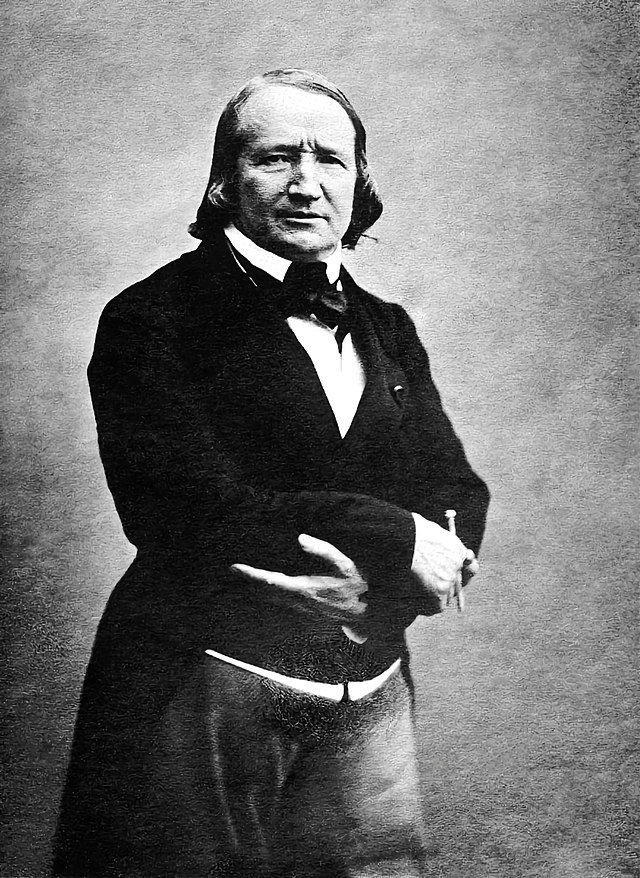
Alfred de Vigny, born on March 27, 1797, in Loches, France, is a prominent figure in French literature. His life and works are deeply intertwined with the social, political, and literary movements of his time. This article delves into the life of Alfred de Vigny, his journey to fame, and the highlights of his literary career, while providing a nuanced understanding of his contributions to literature and exploring the historical context that shaped his works.
Early Life and Aristocratic Roots
Alfred Victor de Vigny was born into an aristocratic family during a period of significant social upheaval in France. His father, a veteran of the Seven Years’ War, and his much younger mother provided Alfred with a unique upbringing. His early education was heavily influenced by his mother, who drew inspiration from the writings of Jean-Jacques Rousseau, a prominent philosopher whose ideas were instrumental in shaping modern thought.
The French Revolution had a profound impact on the Vigny family, as it did on many noble families in France. The revolution led to a significant decline in the family’s fortunes, a common fate among the French aristocracy at the time. Despite these challenges, Vigny’s upbringing in an aristocratic environment profoundly influenced his worldview, which later found expression in his literary works.
Military Career and Early Literary Pursuits
In 1814, at the age of 17, Alfred de Vigny began his military career as a second lieutenant in the “Gendarmes Rouges” (Red Gendarmes). This was a time of great political turbulence in France, with the fall of Napoleon Bonaparte and the restoration of the Bourbon monarchy under King Louis XVIII. Vigny continued his military service, rising to the rank of captain by 1823. He participated in the French campaign during the Spanish War and was stationed at the frontier.
However, Vigny’s passion for literature was evident even during his military service. He began writing poetry in 1815, and by 1822, he had published his first collection of poems, simply titled “Poèmes.” This collection marked the beginning of his literary career, showcasing his deep interest in both French history and biblical themes. In 1826, he published a revised and expanded edition of this collection, titled “Poèmes Antiques et Modernes,” which included notable works such as “Moïse” (Moses), “Éloa,” “Le Déluge” (The Deluge), and “Le Cor” (The Horn).
The Romantic Movement and Literary Success
In the late 1820s, Alfred de Vigny became an active participant in the Romantic Movement, which was sweeping through Europe. He joined the “Cenacle,” a circle of Romantic intellectuals who gathered at the home of Victor Hugo, another towering figure of French literature. This group was at the forefront of the Romantic Movement in France, advocating for a new approach to literature that emphasized emotion, individualism, and a break from the classical traditions that had dominated French literature for centuries.
Vigny’s involvement in the Romantic Movement led to some of his most significant literary achievements. In 1826, he published “Cinq-Mars,” a historical novel that dramatized the life of Henri de Cinq-Mars, a young nobleman who plotted against Cardinal Richelieu, the powerful chief minister of King Louis XIII. The novel was a success and established Vigny as a leading literary figure. In “Cinq-Mars,” Vigny took creative liberties with historical events, portraying the plot as motivated by personal ambition rather than loyalty to the king, reflecting his own aristocratic ideals.
In 1827, Vigny collaborated with Émile Deschamps to produce a French adaptation of Shakespeare’s “Romeo and Juliet.” Two years later, he adapted “Othello,” another Shakespearean tragedy, into “Le More de Venise” (The Moor of Venice). These adaptations further cemented his reputation as a versatile writer capable of bridging different literary traditions.
In 1831, Alfred de Vigny premiered his first original play, “La Maréchale d’Ancre,” a historical drama set during the reign of King Louis XIII. This period also marked the beginning of his relationship with Marie Dorval, a famous actress who became his muse and lover. Their tumultuous relationship, marked by intense passion and jealousy, had a profound impact on Vigny’s life and work.
Chatterton and the Theme of the Rejected Poet
One of Vigny’s most significant contributions to French Romantic literature is his play “Chatterton,” which premiered in 1835. The play was inspired by the tragic life of Thomas Chatterton, an English poet who died by suicide at a young age after struggling to gain recognition for his work. In “Chatterton,” Vigny explores the theme of the poet as an outcast in modern society, a theme that resonated deeply with the Romantic Movement’s emphasis on the individual’s struggle against societal norms.
Marie Dorval starred as Kitty Bell in the play, bringing the character to life with her powerful performance. “Chatterton” was a critical success and is considered one of the most important works of French Romantic drama. The play’s exploration of the poet’s alienation and the sacrifices required to pursue artistic integrity struck a chord with audiences and critics alike.
Personal Struggles and Later Life
Despite his literary success, Alfred de Vigny’s personal life was marked by disappointment and tragedy. His marriage to Lydia Bunbury, an Englishwoman whom he married in 1825, proved to be a source of deep dissatisfaction. Lydia, who was uninterested in literature and became physically obese, failed to provide the intellectual companionship that Vigny sought. His relationship with Marie Dorval also became increasingly stormy, characterized by jealousy and emotional turmoil. These personal difficulties took a toll on Vigny’s creative output, leading to a period of relative obscurity in his later years.
After the death of his mother in 1838, Vigny inherited the Maine-Giraud estate in Angoulême, where he retreated to write some of his most famous poems. It was during this period that he composed “La Mort du Loup” (The Death of the Wolf) and “La Maison du Berger” (The House of the Shepherd). Marcel Proust, one of the most influential writers of the 20th century, later praised “La Maison du Berger” as the finest poem of the 19th century.
Philosophical Reflections and Final Works
In 1845, after several unsuccessful attempts, Alfred de Vigny was elected to the prestigious Académie Française, an institution dedicated to preserving the French language and literature. However, his reception into the Académie was marred by hostility from some of its members, including the influential politician Louis-Mathieu Molé.
During the final years of his life, Vigny ceased publishing new works, although he continued to write privately. His diary, later published as “Journal d’un Poète” (Journal of a Poet), offers deep insights into his philosophical reflections and personal struggles. Modern scholars consider the journal a significant contribution to understanding Vigny’s complex personality and worldview.
Vigny saw himself not merely as a literary author but as a philosopher deeply concerned with the human condition. He was one of the first French writers to explore Buddhism, reflecting his interest in philosophical and spiritual questions beyond the Western tradition. His philosophy, marked by a pessimistic and stoic outlook, emphasized the importance of fraternity among people and the enduring values of culture, knowledge, and solidarity.
In his later years, Vigny spent considerable time working on a second volume of poetry, “Les Destinées” (The Destinies), which he completed shortly before his death. The volume concludes with “L’Esprit Pur” (The Pure Spirit), a poignant reflection on the human soul and Vigny’s final message to the world. “Les Destinées” was published posthumously in 1864, cementing Vigny’s legacy as one of the great poets of his time.
Death and Legacy
Alfred de Vigny passed away on September 17, 1863, in Paris, after a prolonged battle with stomach cancer. He was 66 years old. His death marked the end of a life filled with literary achievement, personal struggle, and philosophical inquiry. Vigny was buried in the Montmartre Cemetery, one of Paris’s most famous resting places for artists and intellectuals.
After his death, Vigny’s literary reputation continued to grow. In 1867, four years after his passing, “Journal d’un Poète” was published, offering readers a glimpse into the mind of a writer whose work bridged the Romantic and modern worlds. His complete works were later published in multiple volumes, ensuring that his contributions to literature would be remembered and studied for generations to come.
Today, Alfred de Vigny is celebrated as a pioneering figure in French Romanticism. His works, characterized by their deep philosophical insights, historical consciousness, and emotional depth, continue to be read and analyzed by scholars and literature enthusiasts alike. Vigny’s exploration of the poet’s role in society, his reflections on military service, and his engagement with the spiritual and philosophical questions of his time make him a timeless figure in the world of literature.


