
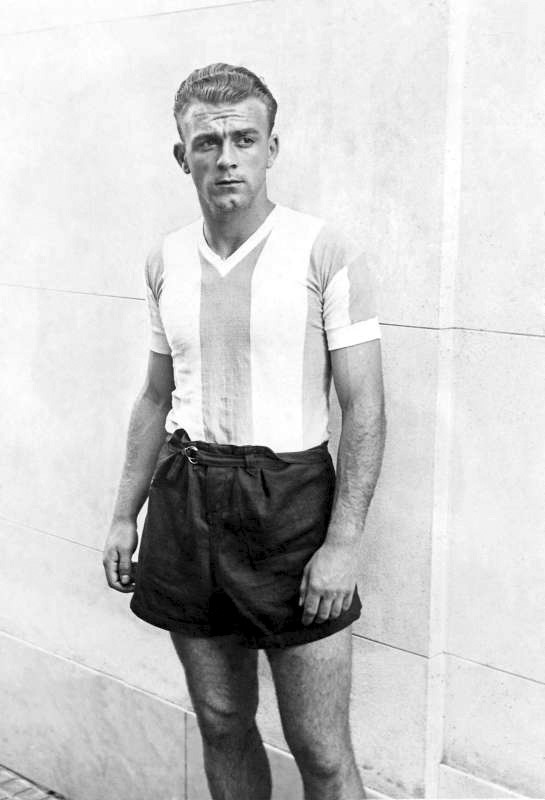
Alfredo Stéfano Di Stéfano Laulhé, born on July 4, 1926, in Buenos Aires, Argentina, is universally recognized as one of the greatest footballers of all time. His influence on the game is immeasurable, earning him a place in the pantheon of football legends. Known as “La Saeta Rubia” (The Blond Arrow), Di Stéfano’s career was marked by extraordinary achievements, spanning multiple countries and continents. This article delves into the life of Alfredo Di Stéfano, exploring his age, rise to fame, and the key moments that defined his illustrious career.
Early Life and Entry into Football
Alfredo Di Stéfano was born into a family of mixed heritage in the Barracas neighborhood of Buenos Aires. His father, Alfredo, was of Italian descent, hailing from Capri, while his mother, Eulalia Laulhé Gilmont, had Irish and French ancestry. Growing up in a multicultural environment, Di Stéfano was exposed to the vibrant football culture of Argentina from a young age.
He began playing football as a child, quickly demonstrating a natural talent for the game. At just 15 years old, Di Stéfano joined the youth ranks of River Plate, one of Argentina’s most prestigious football clubs. His prodigious abilities saw him promoted to the first team by the following year, and he contributed to River Plate’s championship victories in 1945 and 1947. These early successes laid the foundation for what would become a legendary career.
In 1947, Di Stéfano made his debut for the Argentine national team, playing a crucial role in their Copa América victory that year. He scored six goals in the tournament, establishing himself as one of the brightest young talents in South American football. His performances for both club and country attracted attention from across the continent, and it wasn’t long before he was offered the chance to showcase his skills on a bigger stage.
Move to Colombia and the Millionarios Era
In 1949, Di Stéfano moved to Colombia to join the Bogota-based club Millonarios. This transfer marked the beginning of a remarkable chapter in his career. During his four years with Millonarios, Di Stéfano played 182 games and scored an astonishing 157 goals. His incredible goal-scoring ability helped the club secure three Colombian league titles and a Colombian Cup, solidifying his status as one of the most prolific forwards of his era.
The combination of speed, technical skill, and tactical intelligence that Di Stéfano displayed in Colombia made him a standout figure in South American football. His performances caught the attention of European clubs, and it was only a matter of time before he made the move to Europe.
The Real Madrid Era: A Legacy of Greatness
In 1953, Alfredo Di Stéfano was signed by Real Madrid, a move that would forever change the course of football history. His debut for the Spanish giants came on September 23, 1953, in a match against Nancy, which ended in a 4-2 defeat. However, this initial setback did nothing to diminish Di Stéfano’s impact on the team.
Over the next decade, Di Stéfano would lead Real Madrid to unprecedented success, helping the club win eight La Liga titles and an incredible five consecutive European Cups (now known as the UEFA Champions League) between 1956 and 1960. Di Stéfano’s influence on these victories cannot be overstated; he scored in each of the five European Cup finals, a record that remains unbroken to this day.
In addition to his team achievements, Di Stéfano’s individual accolades were numerous. He won the Ballon d’Or twice, in 1957 and 1959, and was the top scorer in La Liga on five occasions. His versatility as a player—capable of playing in various positions, including forward, midfielder, and even defender—made him a unique and invaluable asset to Real Madrid.
During his time at Real Madrid, Di Stéfano formed a legendary partnership with fellow footballing greats such as Ferenc Puskás, Francisco Gento, and Raymond Kopa. Together, they built a team that dominated European football and set new standards for excellence in the sport.
International Career: A Tale of Three Nations
Di Stéfano’s international career is one of the most intriguing aspects of his footballing journey, as he played for three different national teams: Argentina, Colombia, and Spain. His international debut came with Argentina in 1947, where he won the Copa América. However, due to political and footballing circumstances, he was unable to play in the FIFA World Cup for his country.
In the early 1950s, while playing in Colombia, Di Stéfano represented the Colombian national team in unofficial matches. These appearances, although not recognized by FIFA, further demonstrated his adaptability and talent on the international stage.
After acquiring Spanish citizenship in 1956, Di Stéfano became eligible to play for the Spanish national team. Despite his remarkable club success, his international career with Spain was marked by disappointment. Spain failed to qualify for the 1958 World Cup, and Di Stéfano was sidelined by injury during the 1962 World Cup, preventing him from showcasing his talents on football’s biggest stage.
Transition to Coaching and Later Life
After retiring from professional football in 1966, following two seasons with Espanyol, Di Stéfano transitioned to a coaching career. His first managerial role was with Elche in the 1967-68 season. Di Stéfano quickly proved that his footballing intellect translated well into management, leading Boca Juniors to the Argentine championship in 1969.
Throughout the 1970s and 1980s, Di Stéfano coached several clubs, including Valencia, where he won the Spanish league title in 1971, and River Plate, where he secured the Metropolitano championship in 1981. He also had two stints as the manager of Real Madrid, the club where he had achieved so much success as a player. During his second tenure at Real Madrid, Di Stéfano led the team to victory in the Supercopa de España in 1990, marking his final major achievement as a coach.
Di Stéfano’s legacy as a coach, while not as illustrious as his playing career, was still significant. He was known for his tactical acumen and his ability to motivate players, traits that earned him respect in the footballing world.
Honors and Legacy
Alfredo Di Stéfano’s contributions to football have been widely recognized and celebrated. In 2000, he was named Honorary President of Real Madrid, a position that reflected his enduring connection to the club. In 2006, Real Madrid honored him by naming their reserve team’s stadium the Estadio Alfredo Di Stéfano.
Throughout his life, Di Stéfano received numerous accolades for his footballing achievements. Pelé included him in his list of the 125 greatest living footballers, and he was ranked sixth on World Soccer magazine’s list of the greatest players of the 20th century. The Association of Football Statisticians also recognized Di Stéfano’s greatness, placing him 22nd on their list of the 100 greatest footballers of all time.
Despite these honors, Di Stéfano remained humble, often deflecting praise and emphasizing the importance of teamwork. His philosophy of football, centered around versatility, intelligence, and hard work, has influenced generations of players and coaches.
Personal Life and Final Years
Alfredo Di Stéfano’s personal life was marked by both joy and tragedy. He was married to Sara Freites for many years, and the couple had six children together. Sadly, Sara passed away in 2005, leaving Di Stéfano widowed in his later years.
In 2013, at the age of 86, Di Stéfano made headlines when he announced his intention to marry Gina Gonzalez, a Costa Rican woman 50 years his junior. The relationship was controversial, particularly among Di Stéfano’s children, who opposed the marriage. Despite the familial discord, Di Stéfano’s wish to remarry highlighted his enduring spirit and zest for life.
Di Stéfano had struggled with heart problems since 2005, which ultimately led to his death on July 7, 2014, just days after his 88th birthday. He suffered a heart attack while walking near the Santiago Bernabéu Stadium in Madrid and passed away two days later. His death marked the end of an era, but his legacy in the world of football remains as strong as ever.
Conclusion
Alfredo Di Stéfano’s life and career are a testament to his unparalleled talent, versatility, and enduring impact on the game of football. From his early days in Argentina to his dominance in Europe with Real Madrid, Di Stéfano set new standards for what it meant to be a footballer. His influence extended beyond the pitch, as he became a symbol of excellence and a role model for future generations.
Di Stéfano’s story is not just about the trophies and accolades he won, but also about the way he played the game—with intelligence, creativity, and an unyielding commitment to his team. His contributions to football will be remembered for generations to come, and his name will forever be synonymous with greatness.
As we reflect on the life and career of Alfredo Di Stéfano, it is clear that he was more than just a footballer; he was a pioneer, a leader, and a legend whose influence transcends the sport. His legacy continues to inspire and will remain a cornerstone of football history for years to come.


