
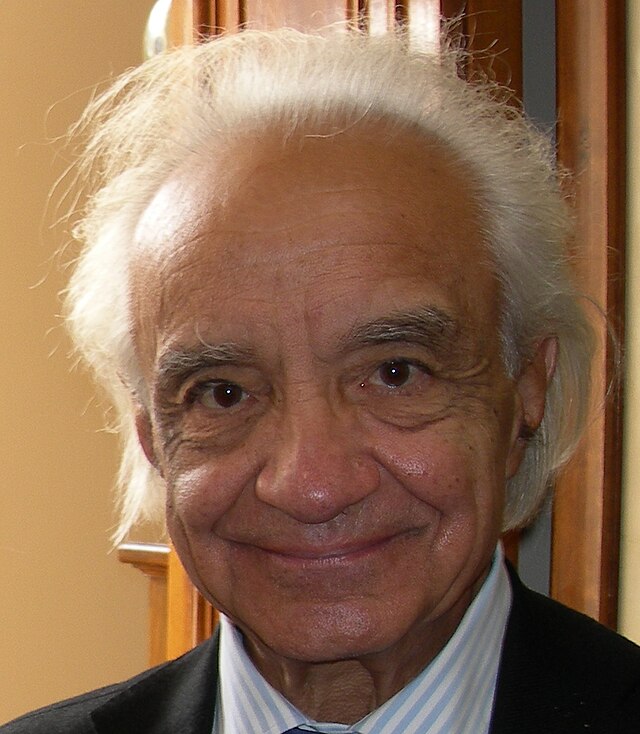
Antonino Zichichi, born on October 15, 1929, in Trapani, Sicily, is a towering figure in the field of nuclear physics and a distinguished science communicator. Over the decades, Zichichi has made substantial contributions to particle physics, particularly in the subnuclear realm, while also gaining fame for his public advocacy of science intertwined with faith.
Early Life and Education
Antonino Zichichi’s journey into the world of science began in his early years, growing up in Sicily. His innate curiosity and passion for understanding the universe led him to pursue studies in physics. After completing his initial education in Italy, he furthered his academic pursuits in Chicago, where he became involved with the Fermilab laboratories. It was during these formative years that Zichichi began to carve out his niche in the scientific community, focusing on the subnuclear aspects of particle physics.
Pioneering Contributions to Nuclear Physics
The 1960s were a particularly fruitful period for Zichichi. His work during this decade was not confined to the Italian scientific community but resonated globally. In 1963, Zichichi founded the Ettore Majorana Centre for Scientific Culture in Erice, Sicily. This center, named after the mysterious physicist Ettore Majorana, has since become a hub for scientific research and education, offering post-graduate specializations across a wide array of scientific disciplines. The center also provides scholarships, making it a significant contributor to the advancement of scientific knowledge.
In 1965, Zichichi’s reputation as a leading physicist was solidified when he led a research team at CERN in Geneva. This team made a groundbreaking discovery—the first example of nuclear antimatter. This discovery was part of a broader international effort, showcasing Zichichi’s ability to lead and collaborate on complex scientific projects.
Leadership in Scientific Institutions
Zichichi’s leadership capabilities were further recognized in 1977 when he was elected president of the Italian National Institute for Nuclear Physics (INFN), a position he held until 1982. His tenure at INFN was marked by significant advancements in nuclear physics research in Italy. The following year, in 1978, Zichichi was elected president of the European Physical Society, further cementing his status as a leading figure in the global scientific community.
One of Zichichi’s most significant contributions during this period was his work in the Gran Sasso laboratories. These laboratories, which he helped design, became crucial for Italy’s scientific endeavors, particularly in the study of neutrinos and other subatomic particles. His work at Gran Sasso exemplifies his long-standing commitment to advancing scientific research in Italy and beyond.
The Intersection of Faith and Science
Throughout his career, Zichichi has been vocal about his Christian faith, often emphasizing that science and religion are not mutually exclusive but can coexist harmoniously. This stance has sparked debates, particularly with more secular scientists. One notable critic is Piergiorgio Odifreddi, a prominent atheist and mathematician. Despite the criticism, Zichichi has remained steadfast in his belief that faith and science can inform and enrich one another.
His books, particularly those focused on Galileo Galilei, reflect this belief. In his 1988 and 2001 publications on Galileo, Zichichi challenges the widely held view that the Church opposed Galileo’s ideas during the 17th-century scientific revolution. He argues that the relationship between the Church and science has been more complex and less antagonistic than commonly portrayed.
In 1999, Zichichi published “Perché io credo in colui che ha fatto il mondo” (Why I Believe in the One Who Made the World), in which he delves deeper into the relationship between faith and science. In this book, he critiques the theory of evolution, arguing that it lacks a solid mathematical foundation. This work, along with his other writings, has made Zichichi a polarizing figure in both the scientific and religious communities.
Awards and Recognition
Zichichi’s contributions to science have not gone unnoticed. In 2000, he was awarded the Enrico Fermi Prize by the Italian Physical Society, a prestigious honor recognizing his significant impact on the field of physics. This award is a testament to his decades of work and the respect he commands within the scientific community.
Combatting Pseudoscience
In addition to his scientific research, Zichichi has also taken a strong stance against pseudoscience. In his 2002 book, “Il vero e il falso” (The True and the False), he addresses various superstitions, including astrology and numerology, debunking them from a scientific perspective. His rigorous approach to these topics reflects his commitment to promoting scientific literacy and critical thinking among the public.
In the same year, Zichichi was honored with the title of Knight of the Grand Cross of Merit of the Italian Republic, further recognizing his contributions not only to science but also to Italian society as a whole.
Later Years and Ongoing Influence
As Zichichi entered the 21st century, he continued to explore the interplay between science and religion. In 2005, he published “Tra Fede e Scienza” (Between Faith and Science), a book that examines the relationship between two popes—John Paul II and Benedict XVI—and their views on science. This book was well-received by those who support the idea of a Christian approach to science, further cementing Zichichi’s role as a leading voice in this ongoing dialogue.
Today, Antonino Zichichi is an emeritus professor of physics at the University of Bologna, where he continues to inspire new generations of scientists. His work has left an indelible mark on the field of nuclear physics, and his advocacy for the coexistence of faith and science has sparked important discussions that resonate far beyond the scientific community.
Conclusion
Antonino Zichichi’s life and career are a testament to the power of curiosity, dedication, and a willingness to explore the unknown. From his pioneering work in nuclear physics to his thought-provoking writings on the relationship between faith and science, Zichichi has made significant contributions to both the scientific community and society at large. His legacy is one of intellectual rigor, leadership, and an unyielding commitment to advancing human knowledge while respecting the spiritual dimensions of existence.
As he continues to influence the fields of physics and science communication, Zichichi remains a figure of great importance, not only in Italy but around the world. His story is a reminder of the profound impact that one individual can have on the world through a combination of scientific inquiry and a deep respect for the mysteries of life.


