
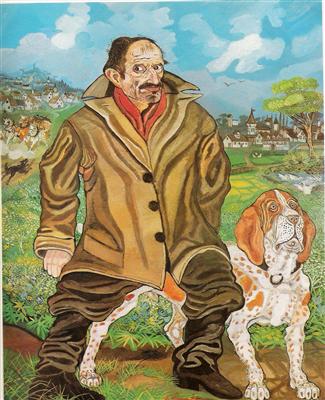
Antonio Ligabue is one of the most enigmatic and captivating figures in the world of art. Born on December 18, 1899, in Zurich, Switzerland, Ligabue’s life was marked by struggle, alienation, and an unyielding passion for art. His journey from obscurity to posthumous fame is a tale of resilience, genius, and the human spirit’s enduring capacity for expression, even in the face of overwhelming adversity.
Early Life and Struggles
Antonio Ligabue, originally named Antonio Laccabue, was born to Elisabetta Costa, a woman from Belluno, Italy, and Bonfiglio Laccabue, a man of Emilia-Romagna descent. However, the true identity of his father remains uncertain. Ligabue’s early life was marred by tragedy and hardship. Shortly after his birth, in September 1900, he was entrusted to the care of a Swiss couple, Elise Hanselmann and Johannes Valentin Goebel. The young Antonio’s life took a darker turn in 1913 when his mother, along with three of his siblings, died from food poisoning. This event profoundly affected Ligabue, leading him to harbor a deep-seated resentment towards his father, whom he blamed for the death of his mother. This animosity was so intense that he eventually changed his surname from Laccabue to Ligabue as an expression of his hatred.
Raised in a financially strained environment, Ligabue’s childhood was characterized by physical and emotional difficulties. Suffering from vitamin deficiencies and rickets, his physical development was stunted, resulting in an ungainly appearance that he would carry into adulthood. Moreover, Ligabue faced intellectual and emotional challenges. He struggled academically and socially, preferring the company of animals over his peers. His early education was marked by difficulties, leading him to be placed in a special needs class and later institutionalized in 1912 in a facility for boys with learning disabilities.
The Formative Years and First Forays into Art
Antonio Ligabue’s troubled youth set the stage for his later artistic endeavors. His time in various institutions, including one run by an evangelical priest in Marbach, was punctuated by behavioral issues, including cursing and outbursts. However, it was during these difficult years that Ligabue found solace in drawing, a skill that would later become his lifeline. Despite his challenges in reading, writing, and arithmetic, Ligabue’s ability to draw provided him with a means to cope with his frequent nervous breakdowns.
After being expelled from the institution for his unruly behavior, Ligabue embarked on a life marked by itinerancy and odd jobs, including work as an agricultural laborer. His volatile temperament led to a series of conflicts, including a violent altercation with his foster mother, Elise, which resulted in his hospitalization in a psychiatric clinic in 1919. Following this incident, Ligabue was expelled from Switzerland and sent to Gualtieri, Italy, the hometown of his adoptive father. This period of his life was marked by an intense sense of alienation, as he neither spoke nor understood Italian, further isolating him from the community.
The Turning Point: Discovering Art
The year 1928 was a turning point in Ligabue’s life. It was then that he met Renato Marino Mazzacurati, a founding member of the Roman School of Art, who recognized Ligabue’s raw talent. Mazzacurati introduced Ligabue to oil painting, a medium that would allow him to fully express his artistic vision. Ligabue’s works from this period reflect a unique blend of vivid colors and dynamic compositions, often depicting scenes of rural life, animals, and self-portraits.
By 1932, Ligabue had found a patron in Licinio Ferretti, an internationally renowned flautist and art collector. This relationship marked the beginning of Ligabue’s journey towards artistic maturity. Ferretti’s support provided Ligabue with the resources to dedicate himself entirely to painting. His works during this period are characterized by a striking combination of imagination and memory, often depicting rural landscapes with meticulous detail.
The Struggles of an Artist: Mental Health and Institutionalization
Despite the growing recognition of his artistic talents, Ligabue’s life was far from stable. His mental health continued to deteriorate, leading to multiple hospitalizations. In 1937, he was committed to a mental institution in Reggio Emilia for acts of self-harm. It was during this time that Ligabue’s art became even more intense, reflecting the inner turmoil and suffering he experienced. His stay in the institution lasted four years, ending only through the intervention of sculptor Andrea Mozzali, who took Ligabue into his home near Reggio Emilia.
World War II provided Ligabue with a brief respite from institutionalization, as he was employed as an interpreter for German troops. However, his volatile nature soon led to another incident in which he assaulted a German soldier, resulting in his re-internment in a mental hospital in 1945. Ligabue spent the next three years confined, yet continued to paint, producing works that caught the attention of critics and art dealers.
Rise to Fame: Recognition and Artistic Legacy
The post-war period marked the beginning of Ligabue’s rise to fame. As more critics, journalists, and art collectors began to take notice of his work, Ligabue was able to leave behind his life of poverty and dedicate himself entirely to painting. His unique style, characterized by vivid colors, expressive brushstrokes, and a deep connection to his subjects, resonated with the public and the art world alike.
In 1955, Ligabue held his first solo exhibition at the Millennial Fair in Gonzaga, near Mantua. This exhibition marked the beginning of a series of successful shows that would cement his reputation as one of Italy’s most important self-taught artists. The following year, he participated in the prestigious Suzzara Prize, further establishing his place in the Italian art scene.
Ligabue’s fame continued to grow, culminating in a highly publicized solo exhibition in 1961 at the La Barcaccia Gallery in Rome. However, his newfound success was marred by a series of health issues. In 1962, he suffered a motorcycle accident, and shortly thereafter, he was struck by hemiparesis, a condition caused by cerebrovascular disease that left him partially paralyzed.
Final Years and Posthumous Recognition
Antonio Ligabue’s final years were a period of declining health but also increased recognition of his work. Despite his physical limitations, Ligabue continued to paint, albeit with great difficulty. In 1965, just a few months before his death, Ligabue was baptized and confirmed, a significant event in the life of an artist often seen as an outsider and a rebel.
Ligabue passed away on May 27, 1965, in Gualtieri, Italy. He was buried in the local cemetery, but his legacy did not end with his death. Shortly after his passing, the IX Quadriennale di Roma dedicated a retrospective to his work, solidifying his place in the pantheon of great Italian artists.
The Artistic Style of Antonio Ligabue
Antonio Ligabue’s artistic style is often described as raw, expressive, and deeply personal. His works are characterized by a vibrant use of color and a dynamic, almost frenetic, energy. Ligabue’s subjects often included animals, which he depicted with a sense of empathy and understanding that likely stemmed from his own feelings of isolation and alienation. His self-portraits, in particular, reveal a man who saw himself as both a part of and apart from the world around him.
Ligabue’s art is a reflection of his life—intense, troubled, and deeply emotional. His works resonate with a sense of struggle, but also with a profound love for the natural world and a deep understanding of the human condition. His paintings often depict scenes of conflict and survival, themes that mirror his own life experiences.
Ligabue’s Place in Art History
Today, Antonio Ligabue is recognized as one of Italy’s most significant outsider artists. His works are celebrated for their raw emotional power and unique perspective. Ligabue’s art offers a window into the mind of a man who lived on the fringes of society but managed to create works of profound beauty and insight.
Ligabue’s life and art continue to inspire new generations of artists and art lovers. His story is one of resilience in the face of adversity, a testament to the power of art as a means of expression and communication. Ligabue’s legacy is not just in his paintings but in the way he lived his life—defiantly, passionately, and without compromise.
Conclusion
Antonio Ligabue’s life was a journey of hardship, creativity, and eventual recognition. From his troubled childhood in Switzerland to his rise as a celebrated artist in Italy, Ligabue’s story is one of perseverance and the enduring power of art. His works remain a powerful testament to his unique vision and his ability to transform personal suffering into universal themes of struggle, survival, and the beauty of life.
Antonio Ligabue may have lived a life on the margins, but his art has ensured that he will never be forgotten. His paintings, filled with color, energy, and emotion, continue to captivate audiences and secure his place as one of the most important figures in the history of Italian art.


