
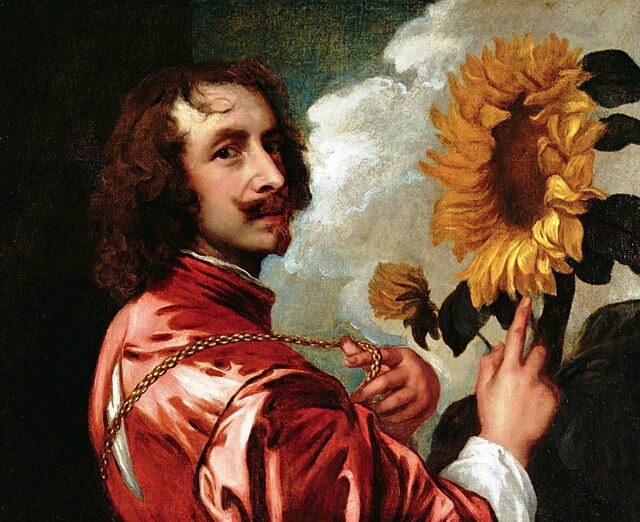
Early Life and Artistic Beginnings
Antoon van Dyck, often referred to as Anthony van Dyck, was born on March 22, 1599, in Antwerp, a city that was at the time one of the most important centers of art and culture in Europe. Van Dyck’s early exposure to the vibrant artistic environment of Antwerp played a significant role in shaping his future career as one of the most celebrated painters of the Baroque era.
From a young age, van Dyck demonstrated a prodigious talent for drawing and painting. Recognizing his potential, his parents arranged for him to apprentice with Hendrick van Balen, a prominent painter in Antwerp known for his religious and mythological scenes. Van Dyck’s time in van Balen’s studio provided him with a solid foundation in the technical aspects of painting, and it wasn’t long before he began to develop his own distinctive style.
By the age of 15, van Dyck had already opened his own studio, a remarkable achievement that underscored his exceptional abilities. It was during this period that he formed a close association with Jan Brueghel the Younger, another young painter from a well-known artistic family. Together, they began to experiment with new techniques and themes, laying the groundwork for what would become van Dyck’s signature style.
Apprenticeship with Peter Paul Rubens
In 1615, at the age of 16, van Dyck joined the studio of Peter Paul Rubens, who was not only the most famous painter in Antwerp but also one of the most influential artists in Europe. Rubens’ studio was a bustling workshop where many of the greatest artists of the time came to learn and collaborate. Under Rubens’ mentorship, van Dyck honed his skills in composition, color, and the dynamic portrayal of human figures.
Rubens recognized van Dyck’s immense talent and quickly elevated him to the position of his chief assistant. This role allowed van Dyck to work on some of Rubens’ most significant commissions, including large altarpieces and portrait cycles. The influence of Rubens on van Dyck’s work during this period is unmistakable, particularly in the grandeur and drama of his compositions.
Despite the strong influence of his mentor, van Dyck began to develop his own approach to painting. He started to focus more on portraiture, a genre that would eventually define his career. Van Dyck’s portraits were characterized by their elegance, sophistication, and a keen attention to the psychological depth of his subjects. His ability to capture the subtleties of expression and the texture of luxurious fabrics set him apart from his contemporaries and foreshadowed his later success as a court painter.
The Italian Sojourn
In 1621, van Dyck embarked on a journey to Italy, a rite of passage for many Northern European artists of the time. The Italian sojourn was crucial in shaping van Dyck’s artistic vision. He spent six years traveling through major Italian cities, including Genoa, Rome, Florence, Parma, Bologna, and Venice. This period allowed him to study the works of the Renaissance masters, such as Titian, Veronese, and Correggio, whose influence would be evident in van Dyck’s later works.
In Italy, van Dyck continued to refine his portraiture, drawing inspiration from the Venetian tradition of rich color and dramatic lighting. His portraits from this period are marked by a greater sense of intimacy and psychological depth, reflecting the influence of Titian in particular. Van Dyck’s ability to blend the grandeur of Rubens with the subtlety of Italian portraiture made his work highly sought after by the Italian nobility.
One of the most significant commissions van Dyck received during his time in Italy was from the Genoese aristocracy. His portraits of Genoese noblewomen, characterized by their elegance and detailed depiction of luxurious attire, became immensely popular and solidified his reputation as a leading portraitist. These works also marked a departure from the more symbolic and allegorical portraits of his earlier years, focusing instead on the individual personality and status of the sitter.
Return to Antwerp and Rise to Fame
In 1627, van Dyck returned to Antwerp, where he quickly re-established himself as one of the leading artists in the city. His reputation as a master portraitist had preceded him, and he was soon inundated with commissions from the local aristocracy, clergy, and wealthy merchants. Van Dyck’s portraits from this period continued to demonstrate his mastery of composition, color, and the depiction of luxurious fabrics and textures.
Van Dyck’s success in Antwerp also attracted the attention of the Archduchess Isabella Clara Eugenia, the regent of the Spanish Netherlands. She commissioned van Dyck to create a series of portraits of the members of her court, further enhancing his reputation and securing his position as the preeminent portraitist in the region.
In addition to his portrait work, van Dyck continued to produce religious and mythological paintings, often drawing on the influences of his time in Italy. These works were characterized by their dynamic compositions, dramatic use of light and shadow, and a heightened sense of emotional intensity. However, it was his portraits that continued to set him apart, combining the grandeur of Rubens with the psychological insight of the Italian masters.
The English Period: Court Painter to Charles I
In 1632, van Dyck moved to England, where he was appointed as the court painter to King Charles I. This period marked the pinnacle of van Dyck’s career and solidified his legacy as one of the greatest portraitists of all time. King Charles, a great patron of the arts, recognized van Dyck’s talent and bestowed upon him a knighthood, along with a generous pension and a residence in London.
Van Dyck’s portraits of King Charles I and his family are among his most famous works. These portraits not only captured the regal bearing and dignity of the monarch but also conveyed a sense of the king’s vulnerability and the impending troubles that would soon engulf his reign. Van Dyck’s ability to portray the complexities of his subjects’ characters, combined with his masterful use of color and composition, made these works some of the most iconic images of the Stuart court.
During his time in England, van Dyck also painted numerous portraits of the English nobility, often depicting them in elaborate, theatrical poses that emphasized their status and wealth. His influence on English portraiture was profound, and his style would continue to dominate the genre for decades after his death.
Van Dyck’s success at the English court was not without its challenges. The political tensions leading up to the English Civil War created a difficult environment for artists, and van Dyck struggled with the demands of his numerous commissions. Despite these challenges, he continued to produce some of his most memorable works during this period, including the famous triple portrait of Charles I, which was sent to Italy as a reference for a sculpture by Bernini.
Personal Life and Legacy
In 1640, van Dyck married Mary Ruthven, a Scottish noblewoman and lady-in-waiting to Queen Henrietta Maria. The marriage was a happy one, and the couple had one daughter, Justiniana. However, van Dyck’s health began to decline shortly after their marriage, and he passed away on December 9, 1641, at the age of 42. He was buried in St. Paul’s Cathedral in London, a testament to his status as one of the most important artists of his time.
Van Dyck’s influence on the world of art was profound and far-reaching. His portraits set a new standard for the genre, combining technical brilliance with a deep understanding of his subjects’ personalities. His work had a lasting impact on the development of portraiture in both England and Europe, influencing generations of artists who followed in his footsteps.
In addition to his portraits, van Dyck’s religious and mythological paintings are also highly regarded for their emotional intensity and dramatic compositions. His ability to convey complex narratives through his use of color, light, and composition made him one of the most versatile and accomplished artists of the Baroque era.
Today, van Dyck’s works can be found in major museums and collections around the world, including the Louvre, the Prado, and the National Gallery in London. His legacy as one of the greatest portraitists in the history of art is firmly established, and his influence continues to be felt in the world of art to this day.
Conclusion
Antoon van Dyck’s life and work exemplify the heights of artistic achievement during the Baroque period. From his early beginnings in Antwerp to his time as the court painter to King Charles I, van Dyck’s career was marked by a relentless pursuit of excellence and a deep understanding of the human condition. His portraits, characterized by their elegance, psychological depth, and technical mastery, remain some of the most celebrated works in the history of art.
Van Dyck’s ability to capture the essence of his subjects, whether they were kings, nobles, or ordinary people, set him apart as a true master of portraiture. His influence on the development of European art, particularly in the realm of portraiture, cannot be overstated, and his works continue to inspire and captivate audiences around the world.
As we reflect on van Dyck’s life and legacy, it is clear that his contributions to the world of art will endure for generations to come. His ability to convey the complexities of the human experience through his art ensures that his work remains as relevant and powerful today as it was during his lifetime.


