
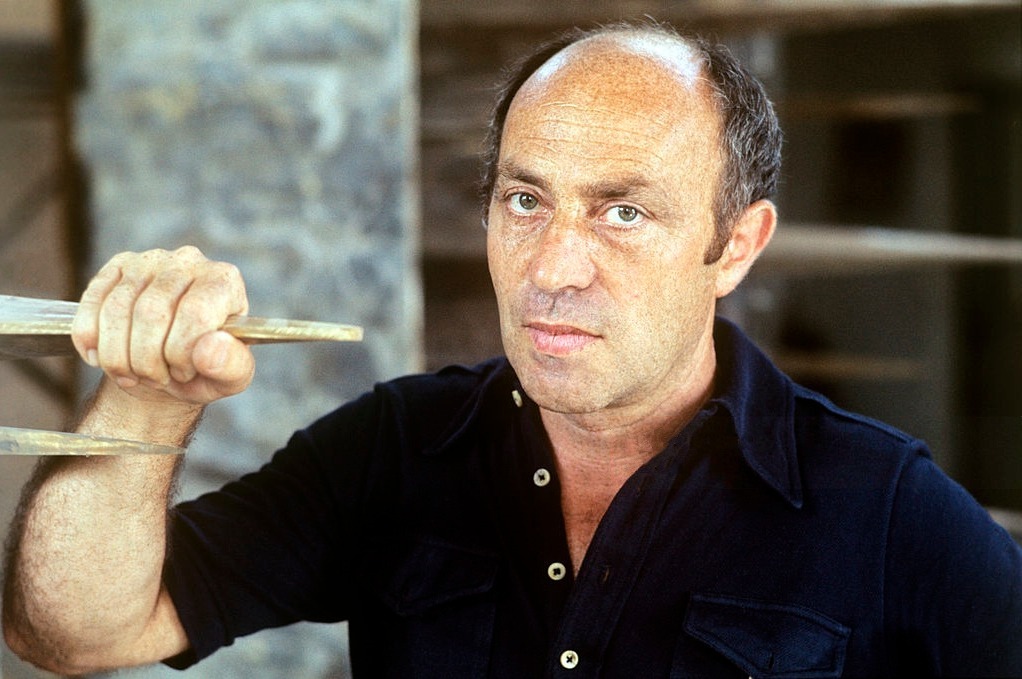
Introduction
Arnaldo Pomodoro, born on June 23, 1926, in Morciano di Romagna, Italy, is one of the most influential sculptors of the 20th and 21st centuries. Renowned for his monumental bronze sculptures that adorn public spaces around the world, Pomodoro has made an indelible mark on contemporary art with his distinctive style, characterized by geometric forms that often appear fractured or deconstructed. His works, which can be found in major cities from Milan to New York, have become iconic symbols of modern art, blending technical precision with profound conceptual depth.
Early Life and Education
Arnaldo Pomodoro was born into a family with strong ties to craftsmanship and the arts. His early years were spent in Orciano di Pesaro, in the Marche region, where his family moved shortly after his birth. Growing up in this environment, Pomodoro was exposed to the traditional artisanal techniques that would later influence his work as a sculptor.
Pomodoro’s formal education began in Rimini, where he attended secondary school and later an institute for technical studies, focusing on surveying. However, the outbreak of World War II disrupted his education, and he returned to Orciano, where he developed a deep interest in literature, particularly the works of contemporary Italian and foreign authors such as Elio Vittorini, Cesare Pavese, and Ernest Hemingway. These literary influences would later inform the narrative and symbolic elements of his sculptures.
After the war, Pomodoro obtained his diploma as a surveyor and enrolled in the Faculty of Economics and Commerce at the University of Bologna. Simultaneously, he began working at the Genio Civile in Pesaro, where he was involved in the reconstruction of public buildings damaged during the war. During this period, Pomodoro also attended the Institute of Art in Pesaro, where his interest in scenography and the visual arts deepened. He was particularly drawn to the works of classical and modern playwrights, which would later inspire his extensive work in stage design.
Early Artistic Career and Move to Milan
In 1953, Pomodoro left Pesaro for Como, where he worked for six months before moving to Milan, the city that would become his permanent home and the center of his artistic activities. In Milan, Pomodoro began to establish himself in the art world, initially working alongside his brother, Giò Pomodoro, who was also a talented sculptor. The brothers shared a studio and collaborated closely for a decade, during which time they developed their unique artistic styles.
Milan in the 1950s was a hub of artistic innovation, and Pomodoro quickly became involved in the vibrant cultural scene. His early works were characterized by their use of geometric forms and an interest in the tension between order and chaos, themes that would continue to define his work throughout his career. In 1957, Pomodoro made the pivotal decision to leave his job at the Genio Civile, dedicating himself entirely to his art. This period marked the beginning of his ascent in the international art world.
Rise to Fame: Monumental Sculptures and International Recognition
Pomodoro’s breakthrough came with his series of monumental bronze sculptures, which combined elements of geometry with a sense of deconstruction and inner turmoil. These works, such as the iconic “Sphere Within Sphere” (Sfera con sfera), displayed a mastery of form and a deep understanding of the symbolic potential of sculpture. The “Sphere Within Sphere” series, in particular, became emblematic of Pomodoro’s style, featuring a perfect, polished outer surface that appears to be cracked open, revealing a complex and intricate interior.
These sculptures resonated with audiences and critics alike, leading to numerous commissions for public works in major cities around the world. Notable examples include the installation of “Sphere Within Sphere” at the Vatican Museums, in the Cortile della Pigna, and at the United Nations Plaza in New York. These works have become cultural landmarks, admired not only for their aesthetic qualities but also for their metaphorical depth, often interpreted as representing the fragile balance between the known and the unknown, the external and the internal.
In addition to his public sculptures, Pomodoro’s works have been featured in prestigious exhibitions worldwide. His solo exhibitions have been held at renowned venues such as the Musée d’Art Moderne de la Ville de Paris, the Marlborough Gallery in New York, and the Hakone Open-Air Museum in Japan. His ability to create art that engages with both space and viewer, often in monumental scales, has solidified his reputation as a leading figure in contemporary sculpture.
Contributions to Stage Design and Teaching
Arnaldo Pomodoro’s talents were not confined to sculpture alone. He also made significant contributions to stage design, bringing his unique aesthetic to the world of theater. His work in scenography began in the 1980s, with notable projects including set designs for Rossini’s Semiramide at the Rome Opera House and Aeschylus’s Oresteia in Gibellina, Sicily. Pomodoro’s stage designs were characterized by their bold use of space and form, transforming theatrical performances into immersive visual experiences.
His engagement with theater reflects his broader interest in narrative and drama, which is evident in many of his sculptures. These works often seem to tell a story or evoke a sense of dynamic movement, qualities that translate naturally to the stage. Pomodoro’s scenographic work was widely acclaimed, earning him recognition not only as a sculptor but also as a visionary in the field of stage design.
Pomodoro’s influence extended to academia as well. He taught in various art departments at American universities, including Stanford University and the University of California, Berkeley. His teaching focused on imparting the principles of sculpture and design to a new generation of artists, emphasizing the importance of innovation, craftsmanship, and conceptual thinking. His contributions to education have helped shape the careers of many young sculptors, ensuring that his influence will continue to be felt for years to come.
Later Career and Ongoing Legacy
As Pomodoro’s career progressed, he continued to push the boundaries of his art, experimenting with new forms and materials while remaining true to the core themes that had defined his work from the beginning. In the 1990s and 2000s, he received numerous high-profile commissions, including the creation of the “Solar Disk” (Disco Solare) for the Palazzo della Gioventù in Moscow and “Papyrus,” a large-scale sculpture for the gardens of the new Post and Telecommunications building in Darmstadt, Germany.
Pomodoro’s work also garnered significant recognition and accolades. He was awarded the Praemium Imperiale for Sculpture by the Japan Art Association in 1990, one of the most prestigious international art prizes, highlighting his global impact on the field of sculpture. His other honors include the Grand Prix Henry Moore in Japan, the UBU Prize for stage design, and being named a Knight Grand Cross of the Order of Merit of the Italian Republic.
Throughout his career, Pomodoro remained committed to his artistic practice, continually exploring new ideas and pushing the boundaries of his medium. His studio in Milan, located near the Darsena of Porta Ticinese, became a hub of creativity, where Pomodoro worked on both large-scale public commissions and more intimate pieces.
Conclusion: The Enduring Impact of Arnaldo Pomodoro
Arnaldo Pomodoro’s career is a testament to the power of art to transcend boundaries—whether cultural, geographical, or conceptual. His sculptures, with their intricate forms and profound symbolism, invite viewers to explore the tension between surface and depth, between the visible and the hidden. These works, found in public spaces around the world, have become part of the cultural landscape, engaging with audiences on both an intellectual and emotional level.
Pomodoro’s influence extends beyond his sculptures. His work in stage design, his contributions to art education, and his ability to bridge the gap between traditional craftsmanship and modern innovation have made him a multifaceted artist whose legacy will continue to inspire future generations. His sculptures do not merely occupy space; they challenge us to think about space in new ways, to question what lies beneath the surface, and to appreciate the complexity of form and structure.
As he continues to create and exhibit new work, Arnaldo Pomodoro remains a vital force in contemporary art. His commitment to exploring the possibilities of sculpture, combined with his deep understanding of material and form, ensures that his art will continue to resonate with audiences around the world for many years to come.


