
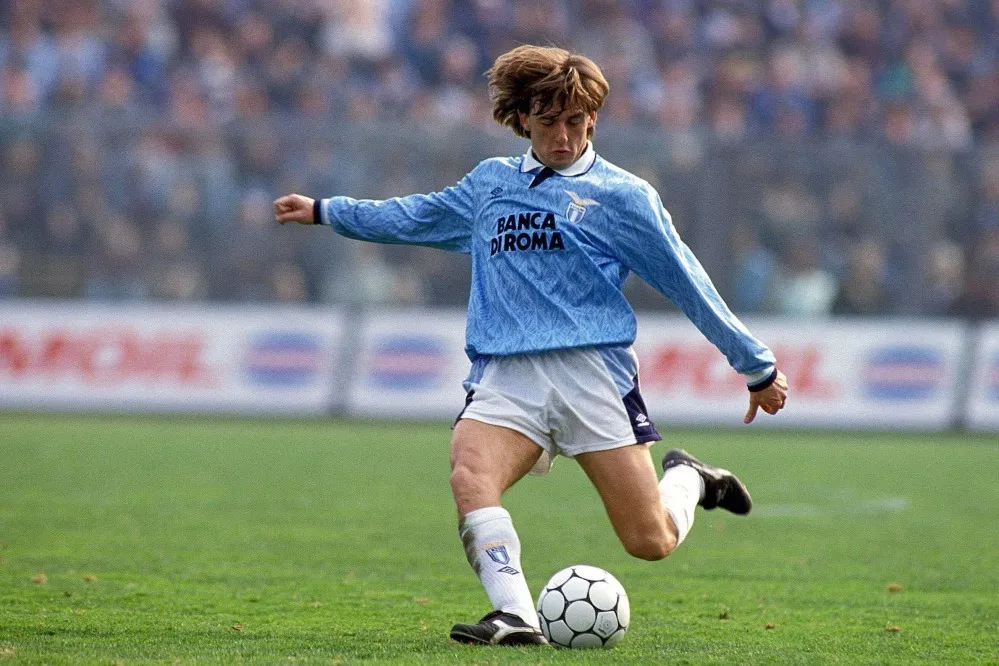
Beppe Signori, born Giuseppe Signori on February 17, 1968, in Alzano Lombardo, a small town in the province of Bergamo, Italy, is a name that resonates with football fans worldwide. Known for his exceptional goal-scoring abilities, quick pace, and sharp instincts on the field, Signori made a lasting impact on Italian football during the 1990s. As one of Serie A’s all-time top scorers, with 188 goals in 344 appearances, his legacy is firmly entrenched in the annals of Italian football history. This article delves into the life, career, and significant achievements of Beppe Signori, providing detailed insights into his rise to fame, challenges, and enduring legacy.
Early Life and Beginnings in Football
Beppe Signori’s passion for football began at a young age. Growing up in Alzano Lombardo, he joined the youth ranks of Inter Milan in 1978 when he was just ten years old. Despite his evident talent, Signori struggled to convince the club’s management of his potential, primarily due to his small stature. The Inter coaching staff deemed him too slight and fragile to succeed at the professional level, a decision that would later prove to be a significant oversight.
In 1983, at the age of 15, Signori made the decision to leave Inter’s youth academy and joined Leffe, a smaller club closer to his home. This move marked the beginning of his professional career. By the time he was 16, he had already made an impact, helping Leffe secure promotion from the Interregional league to Serie C2. In his first full season, Signori scored five goals in just eight appearances, earning a starting spot in the team for the following season.
Climbing the Ranks: From Serie C to Serie B
Signori’s performances at Leffe caught the attention of Piacenza, a club competing in Serie C1, which signed him for the 1985-86 season. However, the transition to a more competitive league proved challenging for the young striker. At 18, he struggled to adapt to the physical demands of Serie C1, managing only one goal during the season. Consequently, Piacenza loaned him to Trento, where he found more success, scoring three goals and regaining his confidence.
In 1988, Signori returned to Piacenza, who had since been promoted to Serie B. This was a pivotal moment in his career. As a winger and sometimes a midfielder, Signori showcased his versatility and skill, scoring five goals in 31 appearances during the 1988-89 season. His performances in Serie B were enough to catch the eye of Zdeněk Zeman, the coach of Foggia, who would play a crucial role in shaping Signori’s career.
The Rise to Stardom with Foggia
Zdeněk Zeman, known for his attacking philosophy, recognized the untapped potential in Signori. In 1989, Signori joined Foggia, a club with ambitions to rise through the ranks of Italian football. Under Zeman’s guidance, Signori was transformed from a winger into a prolific striker. This change in position allowed him to exploit his speed, positioning, and lethal finishing abilities.
Signori quickly became a key figure in what would later be known as the “Foggia dei Miracoli” (the Foggia of Miracles), a team that played an exciting brand of football and achieved remarkable success. Alongside Roberto Rambaudi and Francesco Baiano, Signori formed a formidable attacking trio, dubbed the “tridente delle meraviglie” (trident of wonders). The team achieved promotion to Serie A in 1991, and in his debut season in Italy’s top flight, Signori scored 11 goals in 34 appearances.
His performances with Foggia earned him a call-up to the Italian national team in 1992, marking the beginning of his international career. By this time, Signori had established himself as one of the most promising talents in Italian football.
The Move to Lazio: Establishing a Legacy
In the summer of 1992, Beppe Signori made a high-profile transfer to Lazio, a move that would define the peak of his career. Lazio, under the leadership of president Sergio Cragnotti, was building a team capable of challenging for the Serie A title. Signori was brought in to replace Ruben Sosa, who had moved to Inter, and he quickly proved to be more than a worthy successor.
Signori’s impact at Lazio was immediate and profound. He made his debut for the club in a Serie A match against Sampdoria at the Stadio Luigi Ferraris, where he scored twice. This performance set the tone for what would become a prolific spell at the Roman club. During his time with Lazio, Signori became one of the most feared strikers in Europe, winning the Serie A Capocannoniere (top scorer) award three times—in 1993, 1994, and 1996.
In total, Signori scored 107 goals in 127 appearances for Lazio, making him the third-highest scorer in the club’s history, behind only Silvio Piola and Giorgio Chinaglia. His ability to score from open play, as well as his expertise in taking free kicks and penalties, made him a fan favorite and an icon of the club.
International Success and Controversy
Signori’s success at Lazio coincided with his participation in the Italian national team, particularly during the 1994 FIFA World Cup in the United States. Italy, under coach Arrigo Sacchi, reached the final of the tournament, where they faced Brazil. Although Signori did not play in the final—partly due to a disagreement with Sacchi over his position on the field—Italy finished as runners-up after losing in a penalty shootout. Despite not playing in the decisive match, Signori’s contributions throughout the tournament were significant, and he returned to Italy as a national hero.
However, his relationship with the national team was complicated. Signori was often used out of position by Sacchi, who preferred to deploy him as a left-winger rather than in his natural role as a striker. This decision limited his effectiveness and led to frustration on both sides. As a result, despite his undeniable talent, Signori’s international career was somewhat limited, with only 28 caps and 7 goals to his name.
Later Career: Bologna and Beyond
By the late 1990s, injuries and managerial changes at Lazio began to affect Signori’s playing time. In 1998, after several seasons of consistent goal-scoring, he was loaned to Sampdoria, where he struggled to regain his form, partly due to a persistent hernia problem. He managed to score three goals during his brief spell at the Genoese club, but it was clear that his time at the top level of Italian football was coming to an end.
In 1999, Signori found a new lease on life with Bologna. At 30 years old, he revitalized his career, becoming the focal point of Bologna’s attack. Over six seasons with the club, he scored 67 Serie A goals, along with 14 goals in European competitions and 2 in the Coppa Italia. His leadership and experience helped Bologna achieve several respectable finishes in the league, and he became a beloved figure among the club’s supporters.
In 2004, at the age of 36, Signori decided to leave Italian football and had brief stints with Greek club Iraklis and Hungarian side Sopron before retiring from professional football in 2006.
Post-Retirement and Legal Troubles
Following his retirement, Beppe Signori transitioned into a career as a football pundit and commentator. He worked with RaiUno, providing analysis during the 2006 FIFA World Cup, and later with RadioUno and Mediaset Premium. His insights and experience as a top-level footballer made him a respected voice in Italian football media.
However, in June 2011, Signori’s reputation was tarnished when he was arrested on charges of being involved in a match-fixing scandal related to illegal betting. The accusations alleged that Signori had been part of a network that manipulated football matches to influence betting outcomes. Although he was released from custody after two weeks, the scandal had a significant impact on his public image and led to a lengthy legal battle.
Signori maintained his innocence throughout the proceedings, and in 2021, after years of legal wrangling, he was cleared of all charges related to the case. Despite the damage to his reputation, Signori remains a beloved figure among many football fans, particularly those who remember his contributions on the field.
Legacy and Impact on Italian Football
Beppe Signori’s legacy as one of Serie A’s greatest goal-scorers is secure. His achievements on the field, particularly his remarkable goal-scoring record with Lazio and Bologna, ensure that he is remembered as one of the most talented strikers of his generation. Signori’s style of play, characterized by his speed, technical ability, and clinical finishing, set him apart from his peers and made him a nightmare for defenders.
His story is also one of resilience, overcoming early doubts about his physical attributes to become a dominant force in Italian football. Signori’s career serves as a reminder that talent and determination can prevail even in the face of skepticism and adversity.
While his later years were marred by legal issues, Beppe Signori’s contributions to football continue to be celebrated. His influence on the pitch, particularly during the 1990s, left an indelible mark on Italian football, and his name remains synonymous with goal-scoring excellence.
Conclusion
Beppe Signori’s journey from a young footballer dismissed by Inter’s youth academy to one of Serie A’s most prolific scorers is a testament to his talent, determination, and love for the game. His legacy as a player who brought joy to fans and fear to opponents is cemented in the history of Italian football. Despite the challenges he faced off the field, Signori’s impact on the sport remains profound, and his story continues to inspire aspiring footballers worldwide.


