
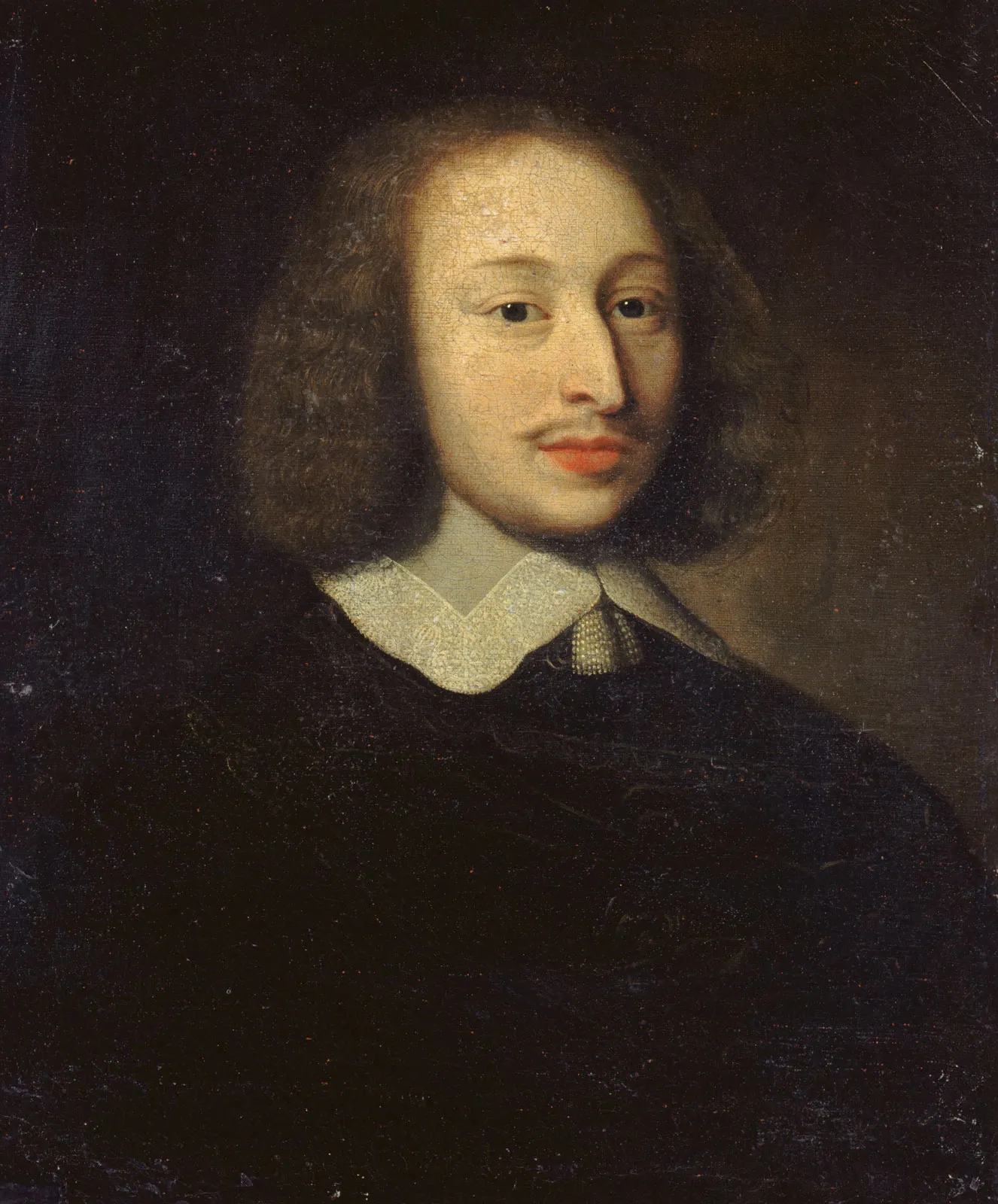
Blaise Pascal, born on June 19, 1623, in Clermont-Ferrand, France, is a towering figure in the history of science and philosophy. His contributions spanned various fields, including mathematics, physics, and theology, marking him as one of the most influential intellectuals of the 17th century. This detailed exploration delves into Pascal’s life, his groundbreaking achievements, and the profound impact of his work.
Early Life and Education
Blaise Pascal was born into a well-to-do family. His father, Étienne Pascal, was an accomplished tax collector and a man of intellectual curiosity. Recognizing his son’s prodigious talent early on, Étienne took an active role in Blaise’s education. Pascal was introduced to advanced mathematical concepts at a young age, and by the age of 16, he had already made significant strides in geometry, authoring a treatise on conic sections. Although this work has since been lost, it set the stage for his future achievements.
Pascal’s early exposure to mathematical circles was instrumental in shaping his intellectual trajectory. His family’s move to Rouen, Normandy, due to his father’s appointment as the King’s tax collector, provided Pascal with further opportunities to engage with contemporary scientific ideas.
Mathematical and Scientific Contributions
The Pascaline
One of Pascal’s most notable achievements was the invention of the Pascaline, an early mechanical calculator. Developed between 1642 and 1645, this device was designed to assist his father with tax calculations. The Pascaline is considered one of the first successful attempts at creating a calculating machine, predating similar inventions by other pioneers. This innovation laid the groundwork for future developments in computational technology.
Pascal’s Theorem
Pascal’s contributions to geometry are equally remarkable. His theorem, introduced in 1639, is a fundamental result in projective geometry. It states that if a hexagon is inscribed in a conic section, the three intersection points of the opposite sides of the hexagon lie on a straight line, known as the Pascal line. This theorem not only showcased Pascal’s mathematical prowess but also influenced subsequent developments in geometry.
Hydrostatics and the Barometer
In addition to his work in mathematics, Pascal made significant contributions to physics. In 1648, he conducted a famous experiment with his brother-in-law, which demonstrated that atmospheric pressure decreases with altitude. This experiment supported the theory of the barometer, originally proposed by Evangelista Torricelli, and provided empirical evidence for the concept of atmospheric pressure.
The Cycloid
Pascal’s fascination with curves led him to study the cycloid, the curve traced by a point on the circumference of a rolling circle. His work on the cycloid, published in 1658, was a precursor to the development of integral calculus. Pascal’s research in this area helped lay the foundation for future advancements in mathematical analysis.
Religious and Philosophical Reflections
Conversion and Spiritual Quest
Pascal’s life was deeply intertwined with his spiritual and philosophical explorations. His initial conversion to Jansenism, a religious movement within Catholicism, occurred around 1646, amidst a period of ill health. This conversion marked a shift in Pascal’s focus from scientific pursuits to theological and existential questions.
Pascal’s philosophical reflections culminated in his famous work, “Pensées” (Thoughts), published posthumously in 1669. In “Pensées,” Pascal explored themes of faith, reason, and the human condition. One of his most famous arguments is the “wager” or “Pascal’s Wager,” which posits that it is rational to believe in God, even in the absence of conclusive evidence, because the potential gains of faith (eternal life) far outweigh the finite losses.
The Spirit of Geometry vs. The Spirit of Finesse
In “Pensées,” Pascal distinguishes between two modes of understanding: the “esprit de géométrie” (spirit of geometry) and the “esprit de finesse” (spirit of finesse). The former represents a logical, mathematical approach to understanding, while the latter involves intuition and sensitivity to the nuances of human experience. Pascal’s insight into these two modes of thought reflects his belief in the limits of rationality and the importance of embracing the complexities of human existence.
The Problem of the Infinite
Pascal also grappled with the concept of the infinite. In his work, he discussed the paradoxes and philosophical implications of the infinite, exploring the tension between the finite and the infinite. This contemplation of the infinite demonstrates Pascal’s deep engagement with both scientific and metaphysical questions.
Legacy and Influence
Blaise Pascal’s influence extends far beyond his lifetime. His contributions to mathematics and science have had a lasting impact on various fields. The Pascaline paved the way for the development of modern computing, while his work on the cycloid and probability theory influenced subsequent mathematicians and scientists.
In philosophy and theology, Pascal’s “Pensées” remains a seminal work, offering profound insights into the nature of belief, reason, and human existence. His exploration of the limits of human understanding and the role of faith continues to resonate with scholars and readers today.
Pascal’s legacy is also reflected in the naming of the Pascal programming language, which honors his contributions to the development of computing. His ideas on probability theory laid the groundwork for modern statistical methods, and his work on the cycloid influenced the development of calculus.
Personal Life and Death
Pascal’s life was marked by both intellectual brilliance and personal challenges. He struggled with severe headaches and health issues throughout his life, which eventually led to his premature death on August 19, 1662, at the age of 39. His health problems were attributed to various causes, including tuberculosis and cancer, but his exact illness remains a subject of historical speculation.
Pascal’s final years were spent in relative seclusion, focusing on his religious and philosophical writings. Despite his declining health, Pascal remained dedicated to his intellectual pursuits until his death. He was buried at the church of Saint-Étienne-du-Mont in Paris, leaving behind a legacy that continues to inspire and challenge contemporary thinkers.
Conclusion
Blaise Pascal’s life and work represent a remarkable intersection of science, mathematics, and philosophy. His innovative contributions, including the Pascaline and Pascal’s Theorem, laid the foundation for future developments in technology and mathematics. His philosophical reflections, particularly in “Pensées,” offer profound insights into the nature of faith, reason, and the human condition.
Pascal’s legacy endures through his impact on various fields and his continued influence on contemporary thought. His exploration of the limits of human understanding and his contributions to the development of modern computing and probability theory ensure that his work remains relevant and significant in the 21st century.
Understanding Pascal’s life and achievements provides a window into the intellectual and spiritual climate of the 17th century, highlighting the enduring relevance of his ideas in the ongoing quest to comprehend the complexities of human existence.


