
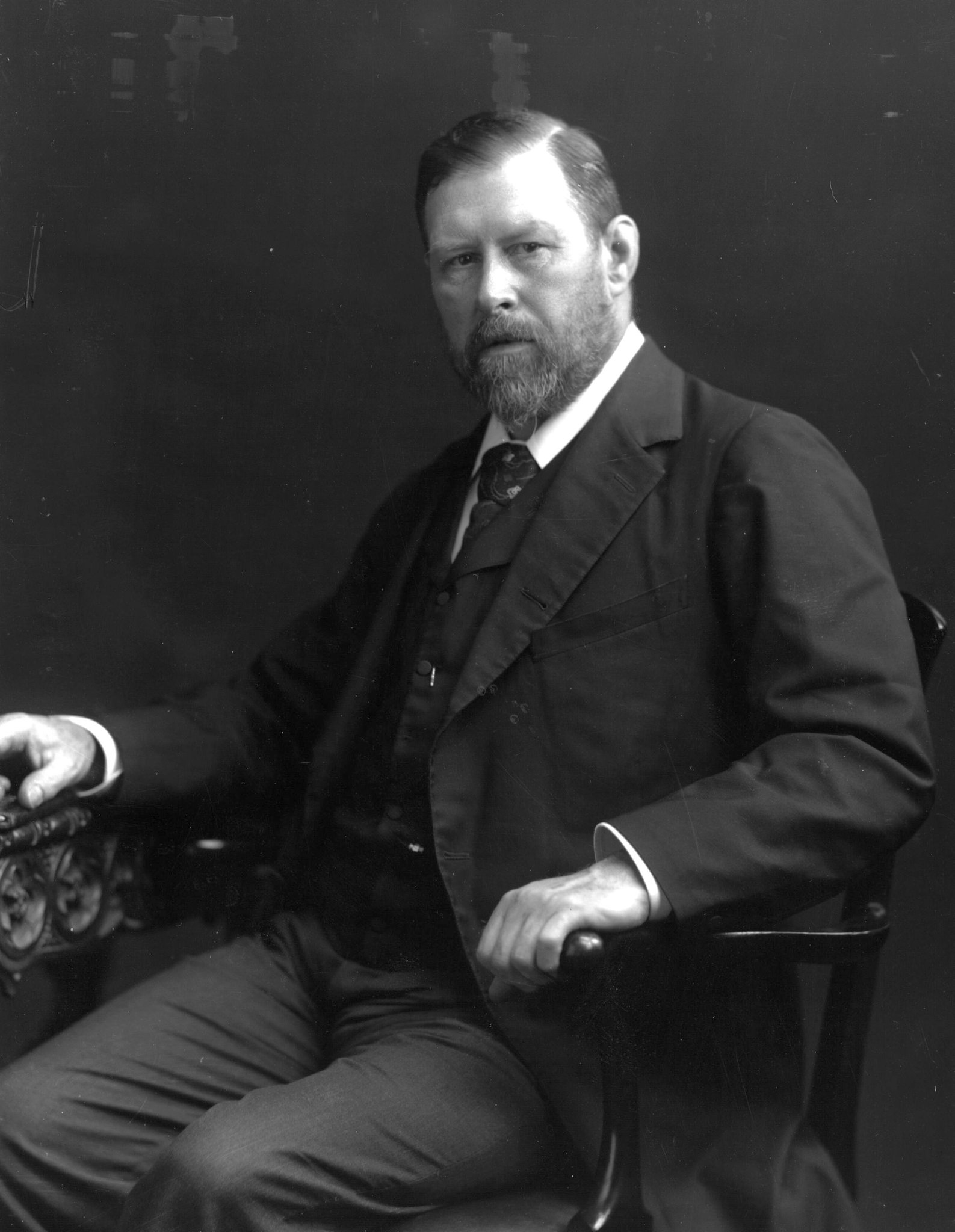
Bram Stoker, born as Abraham Stoker on November 8, 1847, in Dublin, Ireland, is one of the most influential figures in the realm of horror literature. Although he is best known for his creation of Dracula, one of the most iconic characters in popular culture, Stoker’s life and career encompass much more than this singular achievement. His journey from a sickly child to a celebrated author and theater manager is a story of perseverance, creativity, and the lasting impact of his work on both literature and the broader cultural landscape.
Early Life and Education
Bram Stoker was the third of seven children in a family with deep roots in Irish history. His father, Abraham Stoker, was a civil servant working at the Dublin Castle, a position that provided the family with a stable middle-class lifestyle. However, Bram’s early years were marked by severe health issues. For the first seven years of his life, he was bedridden due to an unknown illness that rendered him weak and isolated. This prolonged period of confinement fostered in Stoker a deep inner world, where he developed a vivid imagination and a strong will to overcome adversity.
Contrary to the expectations for someone who would become a literary giant, Stoker’s formal education was not centered on the humanities. He attended the prestigious Trinity College in Dublin, where he excelled in mathematics and science, ultimately graduating with honors in 1870. His academic success in these disciplines demonstrated his analytical mind and attention to detail—qualities that would later contribute to his meticulous approach to writing.
Despite his scientific training, Stoker harbored a growing passion for literature and the arts. During his time at Trinity College, he became involved in the university’s literary and debating societies, where he began to explore his interests in storytelling and drama. These experiences would lay the groundwork for his later career in both theater and writing.
Early Career and Foray into Journalism
After graduating from Trinity College, Stoker initially followed a conventional career path, taking a position as a civil servant in the Irish civil service, much like his father. However, his love for literature and theater soon led him to a side career as a theater critic for the Dublin Evening Mail, a publication co-owned by the famous author Sheridan Le Fanu, a master of Gothic fiction. Stoker’s work as a critic was characterized by his rigorous standards and his ability to capture the essence of theatrical performances in his reviews.
Stoker’s involvement in the Dublin theater scene brought him into contact with some of the most important figures in the world of theater at the time. His most significant connection was with the actor Henry Irving, one of the most celebrated Shakespearean actors of the 19th century. Stoker was so impressed by Irving’s performance in Hamlet that he sought to meet the actor, a meeting that would change the course of his life.
Life in London and the Lyceum Theatre
In 1878, Bram Stoker married Florence Balcombe, a renowned beauty who had previously been courted by Oscar Wilde. Shortly after their marriage, the couple moved to London, where Stoker became the business manager of Henry Irving’s Lyceum Theatre, one of the most prestigious theaters in the city. This position placed Stoker at the center of London’s cultural life, where he managed the day-to-day operations of the theater and traveled extensively with Irving on his tours of America and Europe.
Stoker’s work at the Lyceum Theatre was demanding, requiring a blend of organizational skills, diplomacy, and a deep understanding of the theatrical world. He thrived in this environment, earning a reputation as a capable and dedicated manager. His close relationship with Irving, whom he admired greatly, provided Stoker with unique insights into the world of performance and the psychology of actors—insights that would later inform his creation of the character Dracula.
The Birth of Dracula
Bram Stoker’s magnum opus, Dracula, was published in 1897, after several years of meticulous research and writing. The novel was inspired by a variety of sources, including Stoker’s extensive reading of Eastern European folklore and history, as well as his fascination with the Gothic genre, which had been popularized by writers such as Mary Shelley and Edgar Allan Poe.
The character of Count Dracula, the enigmatic and sinister vampire, was a synthesis of various influences. Stoker drew on the historical figure of Vlad the Impaler, a 15th-century Romanian prince known for his brutal methods of warfare, as well as on the figure of the vampire in European folklore—a creature that embodied fears of death, disease, and the unknown.
Stoker’s portrayal of Dracula as an aristocratic but malevolent being, who preys on the living to sustain his undead existence, captured the imagination of readers and tapped into the anxieties of the Victorian era. The novel’s epistolary format, told through letters, diary entries, and newspaper articles, added to its sense of realism and immediacy, drawing readers into the nightmarish world that Stoker had created.
Although Dracula received mixed reviews upon its initial publication, it gradually gained recognition as a masterpiece of Gothic fiction. The novel’s themes of power, corruption, sexuality, and the clash between modernity and ancient evil resonated with readers, and it has since become one of the most adapted and influential works of literature in the world.
Lesser-Known Works and Contributions
While Dracula is undoubtedly Bram Stoker’s most famous work, it is by no means his only literary achievement. Throughout his life, Stoker wrote numerous novels, short stories, and articles, many of which explored themes similar to those found in Dracula—the supernatural, the macabre, and the intersection of the real and the fantastic.
One of Stoker’s earlier works, Under the Sunset (1881), is a collection of children’s stories that showcases his ability to blend dark, fairy-tale elements with moral lessons. Though not as widely known as his later work, Under the Sunset reflects Stoker’s interest in storytelling and his desire to reach a broad audience, including younger readers.
In addition to Dracula, Stoker’s other notable works include The Jewel of Seven Stars (1903), a novel that combines elements of horror and adventure in a tale of an ancient Egyptian queen who is resurrected in the modern era. The novel reflects the late Victorian fascination with Egyptology and the mysteries of the ancient world, themes that were popular in both literature and the arts at the time.
Another significant work by Stoker is The Lair of the White Worm (1911), a novel that explores the theme of monstrous transformation. The story revolves around a giant, ancient serpent that can take the form of a human woman, embodying the fears of hidden, lurking evil. Although the novel did not achieve the same level of success as Dracula, it is nonetheless a fascinating exploration of Stoker’s recurring themes of the uncanny and the monstrous.
Stoker also wrote several short stories, many of which were published posthumously in collections such as Dracula’s Guest and Other Weird Stories (1914). These stories, including “The Judge’s House” and “The Squaw,” further demonstrate Stoker’s mastery of the horror genre and his ability to create suspenseful, atmospheric narratives.
Stoker’s Legacy and Cultural Impact
Bram Stoker’s legacy extends far beyond his own lifetime. The character of Dracula has become one of the most iconic figures in popular culture, inspiring countless adaptations in literature, film, television, and theater. The image of the vampire as a charismatic yet terrifying figure owes much to Stoker’s creation, and the novel has influenced the development of the horror genre in profound ways.
The first significant adaptation of Dracula was the 1922 silent film Nosferatu, directed by F.W. Murnau. Although the film was an unauthorized adaptation, it played a crucial role in popularizing the character of Dracula and introducing the vampire to a new audience. The 1931 film Dracula, starring Bela Lugosi, further cemented the character’s place in cinematic history, with Lugosi’s portrayal becoming the definitive image of the vampire for generations.
In addition to its impact on the horror genre, Dracula has also been the subject of extensive academic study. Scholars have explored the novel’s themes of colonialism, sexuality, and the clash between science and superstition, highlighting its relevance to both Victorian society and contemporary culture. The character of Dracula has been interpreted as a symbol of various societal fears, from the fear of the foreign and the unknown to anxieties about disease and degeneration.
Stoker’s work has also inspired numerous adaptations and reinterpretations across various media. From the Gothic rock of the 1980s to modern television series like Buffy the Vampire Slayer and The Vampire Diaries, the influence of Dracula can be seen in the enduring popularity of vampire fiction. The novel’s impact is also evident in the proliferation of vampire-related merchandise, from books and films to video games and fashion.
Personal Life and Final Years
Despite the success of Dracula, Bram Stoker did not achieve significant financial rewards during his lifetime. His work at the Lyceum Theatre continued to be his primary source of income, and he remained deeply involved in the theater until Henry Irving’s death in 1905. The loss of Irving was a significant blow to Stoker, both personally and professionally, and it marked the beginning of a period of declining health.
Stoker suffered a series of strokes in the years following Irving’s death, which left him weakened and unable to work. Despite his deteriorating health, he continued to write, producing The Lair of the White Worm and other works during this time. Stoker’s final years were marked by financial difficulties, and he struggled to support his family, relying on assistance from friends and admirers.
Bram Stoker died on April 20, 1912, in London, at the age of 64. He was buried in Golders Green Crematorium, where his ashes remain. Although he did not live to see the full extent of his influence, Stoker’s legacy has endured, and his work continues to captivate and inspire audiences around the world.
Historical Context and Influence
To fully appreciate Bram Stoker’s contributions to literature and culture, it is essential to consider the historical context in which he lived and wrote. The late 19th and early 20th centuries were a period of significant social, technological, and intellectual change. The rise of industrialization, the expansion of the British Empire, and the advent of new scientific discoveries all contributed to a sense of both progress and anxiety.
Stoker’s work reflects the tensions of his time, particularly the fear of the unknown and the consequences of unchecked power. Dracula can be seen as a commentary on the anxieties of a society grappling with rapid change, as well as a reflection of the Victorian fascination with the macabre and the supernatural. The novel’s exploration of themes such as immigration, disease, and the clash between modernity and tradition speaks to the broader concerns of Stoker’s era.
Stoker’s influence on the Gothic genre and the horror tradition is undeniable. His ability to blend elements of historical fact with fictional horror created a template for future writers and filmmakers to explore the dark and mysterious aspects of human nature. The enduring popularity of vampire stories and the continued relevance of Dracula in contemporary culture are testaments to Stoker’s skill as a storyteller and his understanding of the human psyche.
Conclusion
Bram Stoker’s life and work offer a fascinating glimpse into the mind of one of the most important figures in Gothic literature. His creation of Dracula has left an indelible mark on popular culture, and his influence can be seen in the countless adaptations and reinterpretations of the vampire mythos that have followed. Stoker’s legacy is not only that of a master of horror but also of a writer who captured the fears and desires of his time, creating a work that continues to resonate with readers and audiences today.


