
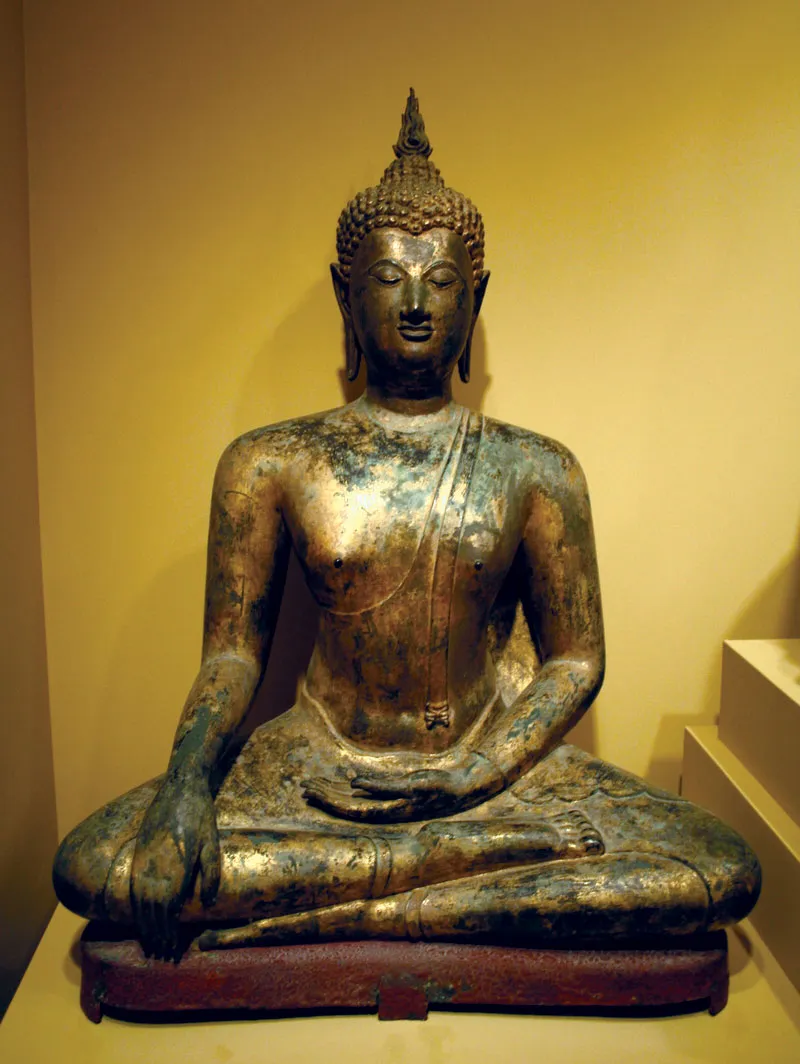
Buddha, one of the most revered figures in world history, is not just a religious icon but a symbol of enlightenment and spiritual awakening. But who was Buddha, and what was the journey that led to his profound influence on billions of people over millennia? This article explores the life of Siddhartha Gautama, the man who became known as the Buddha, delving into his early life, his path to enlightenment, and the legacy he left behind.
Early Life of Siddhartha Gautama
Siddhartha Gautama, who would later be known as Buddha, was born in 566 BCE in Lumbini, which is in present-day Nepal. His birth was surrounded by auspicious signs and prophecies, with sages predicting that he would either become a great king—a Chakravartin—or a spiritual leader, a renunciate ascetic who would guide humanity toward spiritual liberation.
Siddhartha was born into a life of luxury and privilege. His father, King Suddhodana, ruled over the Shakya clan, a warrior tribe in ancient India. His mother, Queen Maya, passed away just a week after his birth, leading Siddhartha to be raised by his aunt, Pajapati. The king, desiring for his son to follow in his footsteps and become a powerful ruler, shielded him from the harsh realities of life outside the palace. Siddhartha grew up surrounded by opulence, unaware of the suffering that existed beyond the palace walls.
The Four Sights and the Great Renunciation
Siddhartha’s life took a dramatic turn when, as a young man, he ventured outside the palace and encountered what are now known as the “Four Sights.” These were a sick man, an old man, a dead man, and an ascetic. These encounters profoundly affected Siddhartha, shattering his illusions about the world. He realized that all people, regardless of their wealth or status, were subject to suffering, aging, and death.
This realization ignited a deep spiritual crisis in Siddhartha. He understood that the material comforts and pleasures of his royal life could not protect him or anyone else from suffering. Determined to find a solution to the problem of human suffering, Siddhartha made a momentous decision: he would renounce his princely life and seek enlightenment.
One night, with the help of his charioteer Chandaka, Siddhartha left the palace, abandoning his family, his title, and his wealth. This event is known as the “Great Renunciation.” Dressed in simple robes, he set out on a quest for spiritual awakening.
Siddhartha’s Path to Enlightenment
Siddhartha spent the next six years of his life as an ascetic, practicing severe austerities and meditative disciplines. He studied under various spiritual teachers, including Alara Kalama and Uddaka Ramaputta, who taught him advanced techniques of meditation. Despite mastering these practices, Siddhartha remained unsatisfied, as they did not lead to the ultimate liberation he sought.
Realizing that extreme asceticism was not the path to enlightenment, Siddhartha abandoned these harsh practices. This decision led to the disillusionment of his five companions, who left him, believing he had given up his quest. However, Siddhartha had come to a critical insight: the path to enlightenment lay in the “Middle Way,” a balanced approach that avoids the extremes of self-indulgence and self-mortification.
One day, while meditating under a Bodhi tree in Bodh Gaya, Siddhartha experienced a profound spiritual breakthrough. After a night of deep meditation, during which he confronted and overcame the forces of desire and illusion, Siddhartha attained Nirvana—a state of perfect wisdom, compassion, and liberation from the cycle of birth and death. He was now the Buddha, the “Awakened One.”
The Teachings of Buddha and the Spread of Buddhism
Following his enlightenment, Buddha spent the next 45 years of his life teaching the path to liberation. His first sermon, delivered at the Deer Park in Sarnath, is known as the “Dhammacakkappavattana Sutta,” or the “Setting in Motion the Wheel of Dharma.” In this sermon, Buddha introduced the core teachings of Buddhism: the Four Noble Truths and the Noble Eightfold Path.
The Four Noble Truths outline the reality of suffering, its origin, the possibility of its cessation, and the path leading to its cessation. The Noble Eightfold Path provides practical guidance on how to live a life that leads to the cessation of suffering and the attainment of Nirvana. These teachings emphasized ethical conduct, mental discipline, and wisdom.
Buddha’s teachings attracted followers from all walks of life. He established a monastic community, the Sangha, which was open to all, regardless of caste or social status. This inclusivity was revolutionary in a society deeply divided by rigid social hierarchies. Among his early converts were merchants, nobles, and even kings, such as King Bimbisara of Magadha.
Buddha’s influence continued to grow, and his teachings spread across the Indian subcontinent. He founded the first monastic order for women, allowing them to pursue spiritual goals on equal footing with men. This was a radical move in a society where women’s roles were highly restricted.
Buddha’s Final Years and Death
Buddha continued to teach and travel throughout northern India until the age of 80. In his later years, he became increasingly concerned with the preservation of the Sangha and the continuity of his teachings. He emphasized the importance of maintaining the discipline and unity of the monastic community.
In 486 BCE, while traveling to the town of Kusinagara, Buddha fell seriously ill. He realized that his time had come, and he prepared his followers for his departure. After delivering his final teachings, Buddha lay down on his right side, facing west, and entered into deep meditation. He passed away peacefully, attaining Parinirvana—the final Nirvana, where the cycle of birth and death ceases entirely.
Buddha’s death marked the end of his earthly life, but it also marked the beginning of the global spread of Buddhism. His followers preserved his teachings in oral form, which were later written down as the Pali Canon. These texts, along with other Buddhist scriptures, form the foundation of Buddhist philosophy and practice.
The Legacy of Buddha and the Spread of Buddhism
Buddha’s legacy is vast and enduring. His teachings have inspired countless individuals and shaped the spiritual, philosophical, and cultural landscapes of many civilizations. After Buddha’s death, his teachings spread beyond India, reaching Central Asia, Southeast Asia, China, Japan, and eventually the Western world.
Buddhism evolved into several different schools, each interpreting Buddha’s teachings in unique ways. Theravada Buddhism, prevalent in Sri Lanka and Southeast Asia, focuses on the teachings of the Pali Canon and emphasizes individual enlightenment through meditation and ethical living. Mahayana Buddhism, dominant in East Asia, emphasizes the Bodhisattva path, where practitioners seek enlightenment not only for themselves but also for the benefit of all beings.
In addition to its spiritual teachings, Buddhism has also contributed significantly to art, literature, and culture. Buddhist monasteries became centers of learning, preserving and transmitting knowledge in various fields, including philosophy, medicine, and the arts. The construction of stupas, pagodas, and statues of Buddha became expressions of devotion and artistic achievement.
Exploring the Nuances and Historical Context of Buddha’s Life
To fully appreciate the significance of Buddha’s life and teachings, it is essential to understand the historical and cultural context in which he lived. The 6th century BCE was a time of great social and religious upheaval in India. The rigid caste system and the dominance of Vedic rituals had created a society deeply divided by social and religious hierarchies. The spiritual dissatisfaction among the people led to the emergence of various new religious movements, including Buddhism.
Buddha’s teachings were a response to the prevailing social and spiritual conditions of his time. His rejection of the caste system and his emphasis on ethical living and meditation as the means to liberation resonated with many people who were disillusioned with the established religious practices.
Buddha’s approach was also unique in its emphasis on empirical experience over blind faith. He encouraged his followers to question, investigate, and verify his teachings through their own experience. This rational and experiential approach made Buddhism accessible to a wide range of people, regardless of their intellectual or spiritual background.
Conclusion: The Enduring Impact of Buddha’s Teachings
The life of Buddha is a story of profound transformation—from a prince living in luxury to a spiritual leader who renounced everything in search of truth. His journey to enlightenment and his subsequent teachings have left an indelible mark on the world.
Buddha’s message of compassion, wisdom, and the path to liberation continues to resonate with people from all walks of life. His teachings offer a timeless guide to living a meaningful and ethical life, free from suffering and full of inner peace.
Today, Buddhism is practiced by millions of people around the world, and its principles continue to inspire individuals and influence societies. The legacy of Buddha is not just the spread of a religion but the enduring impact of a philosophy that encourages self-awareness, compassion, and the pursuit of truth.


