
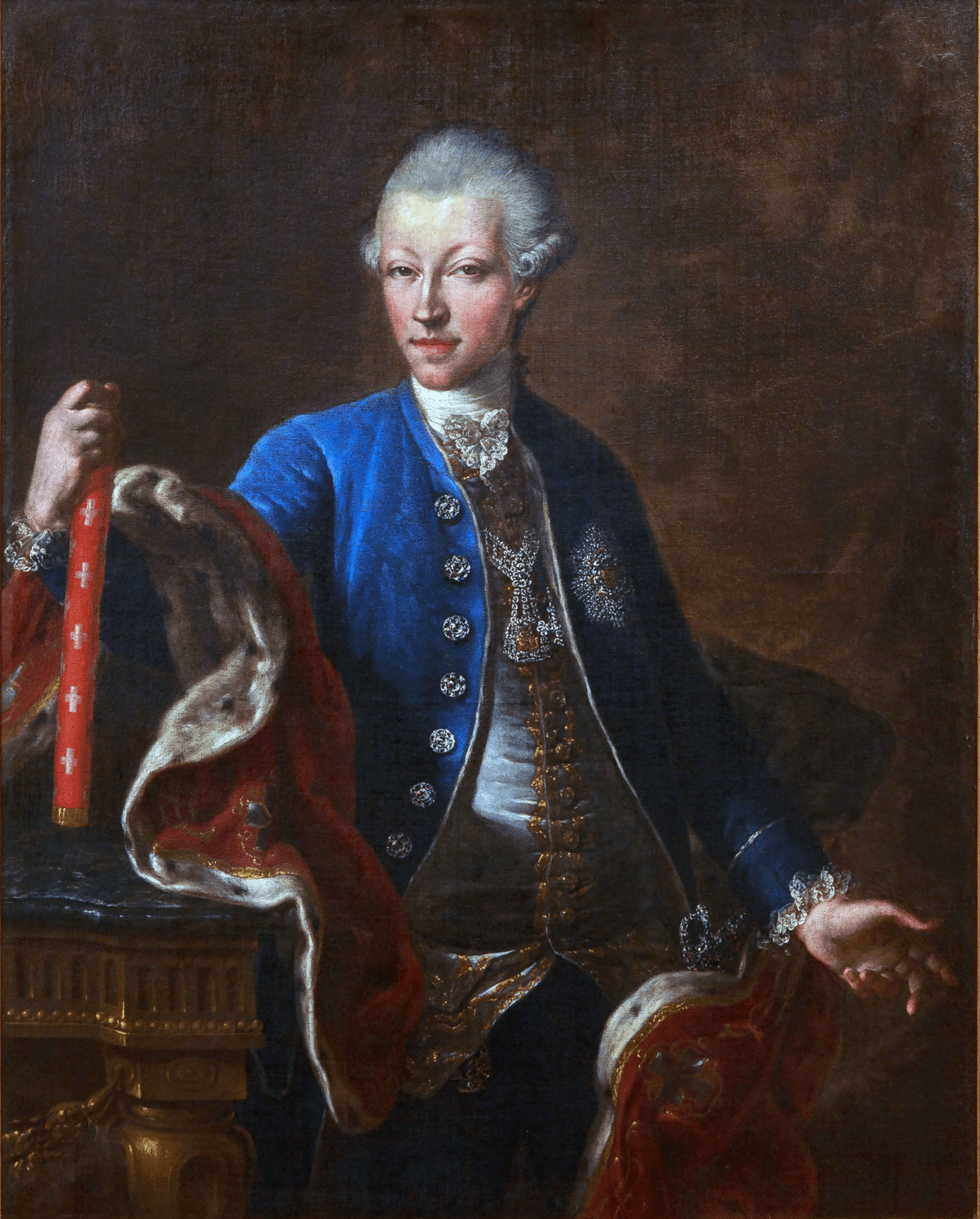
Carlo Emanuele IV di Sardegna was a figure whose life was marked by both political turmoil and deep spiritual devotion. Born in Turin on May 24, 1751, he was the eldest son of Vittorio Amedeo III and Maria Antonietta of Bourbon-Spain. His life unfolded during a time of great upheaval in Europe, particularly with the rise of the French Revolution and the subsequent Napoleonic Wars, events that would profoundly affect his reign and personal life.
Early Life and Marriage
Carlo Emanuele’s upbringing was typical of European royalty in the 18th century. As the heir to the Kingdom of Sardinia, his education was likely focused on preparing him for future leadership. On August 21, 1775, Carlo Emanuele married Maria Clotilde, the sister of Louis XVI of France. This marriage was not just a union of two individuals but also a significant political alliance between two powerful European dynasties.
Maria Clotilde, known for her devout Catholicism, greatly influenced Carlo Emanuele. Both were deeply religious, and their shared faith played a central role in their lives. In fact, Carlo Emanuele was so devout that in the years leading up to his ascension to the throne, he and his wife would often retreat to a convent, engaging in prayer and contemplation.
Ascension to the Throne
Carlo Emanuele IV ascended to the throne in 1796 following the death of his father, Vittorio Amedeo III. His reign, however, was marred by the political instability that had engulfed Europe. The liberal ideas of the French Revolution had spread across the continent, challenging the traditional monarchical order. In Italy, these revolutionary ideals, coupled with the military campaigns of Napoleon Bonaparte, created a volatile environment for Carlo Emanuele’s rule.
His father had already been forced to cede part of Piedmont to France, and under Carlo Emanuele’s reign, the situation only worsened. The Jacobin movements, encouraged by the French, grew stronger, further undermining his authority. The conflict that erupted between the Jacobins and the ruling government in June 1798 provided the pretext for a full-scale French military intervention. French troops occupied Turin, effectively making Carlo Emanuele a prisoner in his own kingdom.
The Fall of the Kingdom
By December 1798, Carlo Emanuele IV was forced to cede the entirety of Piedmont to France and retreat to Sardinia. His departure from Turin was a poignant moment, captured vividly by the historian and statesman Count Luigi Cibrario. According to Cibrario, on the night of December 9, 1798, Carlo Emanuele, along with his family, left Turin under the cover of darkness, accompanied by thirty carriages and escorted by dragoons holding windproof torches. The French troops entered the city the next day, incorporating the remnants of the Piedmontese forces into their own.
This marked the end of the Kingdom of Piedmont-Sardinia as an independent entity. Contrary to French promises that Piedmont would be declared a republic, it was instead incorporated into France. Even when the French were temporarily driven out of Italy in the spring of 1799, Carlo Emanuele was not allowed to return to his kingdom. The Austrians, who had their own expansionist ambitions in the region, prevented his restoration.
Personal Tragedies and Abdication
The series of humiliations that Carlo Emanuele IV suffered at the hands of the French were compounded by personal tragedies. The execution of his brother-in-law, Louis XVI, and his sister-in-law, Marie Antoinette, during the French Revolution, deeply affected him. The final blow came with the death of his beloved wife, Maria Clotilde, in March 1802. Her death left Carlo Emanuele emotionally devastated and devoid of any desire to continue ruling.
Three months after her death, Carlo Emanuele IV abdicated the throne in favor of his younger brother, Vittorio Emanuele I. This decision was not just a political one; it was a reflection of his long-standing desire to retreat from the world and dedicate himself entirely to his faith.
Life After Abdication
After abdicating, Carlo Emanuele IV fully embraced his religious inclinations. He joined the Jesuit order and became a monk, spending the rest of his life in prayer and contemplation. He lived in Rome, where he served in the Church of Sant’Andrea al Quirinale. Carlo Emanuele IV died on October 6, 1819, at the age of 68. He was buried in the church where he had spent his final years in spiritual service.
Historical Context and Legacy
Carlo Emanuele IV’s life and reign were emblematic of the broader struggles faced by European monarchs during the era of the French Revolution and Napoleonic Wars. His inability to effectively govern during a time of such intense political upheaval highlights the challenges that traditional monarchies faced in adapting to the new political realities of the late 18th and early 19th centuries.
His story also reflects the deep connection between religion and monarchy in pre-revolutionary Europe. Carlo Emanuele IV’s devotion to his faith was not unusual for the time; many European monarchs saw themselves as divinely appointed rulers, with a responsibility to uphold and defend the Christian faith. However, Carlo Emanuele took this belief to an extreme, choosing to abandon his throne and live out his days as a monk.
In historical assessments, Carlo Emanuele IV is often seen as an inadequate ruler, more suited to the cloister than the throne. His reluctance to engage with the political and military challenges of his time stands in stark contrast to the more assertive and ambitious rulers of the period, such as Napoleon Bonaparte. Yet, his life also offers a poignant example of the personal costs of leadership, especially in an era when the world was changing so rapidly and dramatically.
SEO Considerations
For those seeking information on Carlo Emanuele IV di Sardegna, the keywords to focus on include “Carlo Emanuele IV biography,” “King of Sardinia,” “Piedmont-Sardinia history,” and “Napoleonic Wars impact on Italy.” Additionally, search terms such as “European monarchs during the French Revolution” and “religious devotion of Carlo Emanuele IV” will help attract readers interested in the broader historical context. Given the increasing interest in the personal lives of historical figures, incorporating keywords related to his personal tragedies, abdication, and subsequent life as a monk will also be beneficial.
Moreover, for an article aimed at ranking well on search engines, maintaining a keyword density of around 1-2% is advisable. Phrases such as “Carlo Emanuele IV’s reign,” “political instability,” and “religious devotion” should be naturally integrated throughout the text to improve SEO performance while ensuring the content remains informative and engaging.
In conclusion, Carlo Emanuele IV di Sardegna was a ruler whose life was shaped by the dramatic political and social changes of his time. While his reign may have been brief and troubled, his deep religious conviction and the personal tragedies he endured make his story a compelling chapter in the history of European monarchy.


