
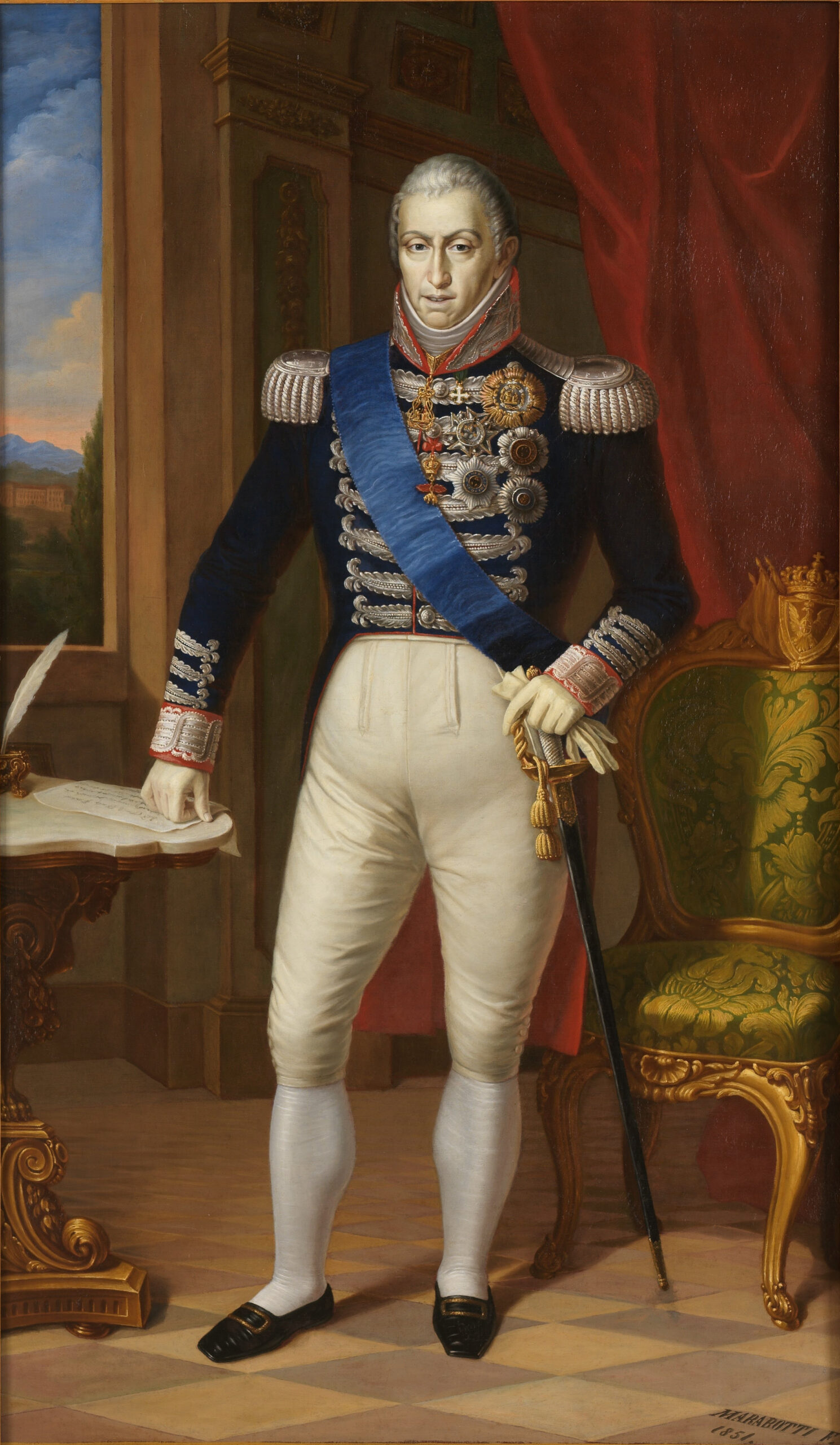
Carlo Felice di Savoia, born on April 6, 1765, in Turin, Italy, was a significant yet often overlooked figure in European history. His life and reign are crucial in understanding the final years of the Kingdom of Sardinia before the unification of Italy. As the eleventh child of Vittorio Emanuele III, Duke of Aosta, and King of Sardinia, and Maria Antonietta Ferdinanda of Bourbon, daughter of Philip V of Spain, Carlo Felice was born into a prominent royal family that played a key role in European politics.
Early Life and Family Background
Carlo Felice’s upbringing was steeped in the traditions of European aristocracy. Being the fifth male child in his family, he was not initially in line for the throne, which allowed him a degree of freedom in his early years. His education, like that of many noble children of the time, would have been extensive, focusing on subjects such as history, languages, military training, and governance, preparing him for a life of service to the kingdom.
In 1807, Carlo Felice married Maria Cristina of Sicily, the daughter of Ferdinand I of the Two Sicilies and Maria Carolina of Austria. This marriage was not only a union of two individuals but also a strategic alliance between powerful European houses, further solidifying the influence of the House of Savoy.
Rise to Power
Carlo Felice’s path to the throne was marked by the abdications of his older brothers, Vittorio Emanuele I and Carlo Emanuele IV. These abdications were precipitated by political upheaval, including the liberal revolutions sweeping across Europe in the early 19th century. Before becoming king, Carlo Felice had already demonstrated his capabilities as a leader during his tenure as Viceroy of Sardinia, from 1799 to 1802 and again from 1814 to 1817. His governance during these years was marked by efforts to maintain stability in the face of external pressures from Napoleonic France and internal unrest.
When Carlo Felice assumed the throne in 1821, he found himself in a challenging position. The Kingdom of Sardinia was grappling with the aftermath of the Napoleonic Wars, and the liberal movements that had spread across Europe were now threatening the established order in his own realm. At the time of his accession, Carlo Felice was in Modena, leading his brother, the outgoing king, to appoint Carlo Alberto of Savoy as regent. However, Carlo Alberto’s decision to grant the people a constitution enraged Carlo Felice, who swiftly revoked the constitution upon his arrival in Turin on October 17, 1821. He also disowned Carlo Alberto’s right to succeed him, a decision that would only be reversed after Carlo Alberto renounced his liberal leanings.
Reign and Governance
Carlo Felice’s reign was characterized by his staunch opposition to liberalism and constitutionalism. He was a firm believer in the divine right of kings, holding that the sovereignty of the monarch was sacred and inviolable. This belief underpinned his absolutist approach to governance, which was marked by a rigorous suppression of constitutional movements and liberal ideas.
His legitimacy as a ruler was bolstered by his harsh repression of any revolutionary activity within his kingdom. One of the most notorious examples of this was the execution of Santorre di Santarosa, a prominent leader of the Piedmontese revolutionaries. Carlo Felice’s uncompromising stance earned him the moniker “Carlo Feroce,” a testament to the severity of his rule.
However, Carlo Felice was not solely focused on political repression. He had a genuine interest in cultural and intellectual matters, and his reign saw significant developments in these areas. One of his most notable achievements was the establishment of the Regio Museo delle Antichità Egizie (Royal Museum of Egyptian Antiquities) in Turin in 1824. This institution, which remains one of the most important collections of Egyptian artifacts outside of Egypt, was a culmination of efforts by his predecessors, but it was Carlo Felice who expanded the collection significantly, bringing in over 5,000 artifacts, including sarcophagi, mummies, statues, and papyri.
This cultural initiative not only elevated Turin’s status on the international stage but also reflected Carlo Felice’s broader interest in fostering the arts and sciences within his kingdom. He also implemented judicial reforms and invested in public works, demonstrating a commitment to improving the infrastructure and administration of his realm.
Legacy and Historical Context
Carlo Felice’s reign ended with his death on April 27, 1831, at the age of 66. His passing marked the end of the main line of the House of Savoy, as his successor, Carlo Alberto, belonged to the cadet branch of the Savoy-Carignano family. Carlo Felice’s death also coincided with a period of significant unrest in central Italy, where the liberal revolutions sparked by the July Revolution in Paris were beginning to take hold.
In historical assessments, Carlo Felice is often viewed as a conservative and reactionary figure, whose rigid opposition to liberalism placed him at odds with the growing demand for constitutional governance across Europe. His reign is frequently contrasted with that of his successor, Carlo Alberto, who, despite his earlier conservative stance, eventually became a champion of the Italian unification movement.
Carlo Felice’s life and reign are emblematic of the broader struggles faced by European monarchs during a period of rapid social and political change. The tensions between absolutism and constitutionalism, between tradition and modernity, that defined his reign were reflective of the broader conflicts that were reshaping Europe in the early 19th century.
SEO Considerations
For those researching Carlo Felice di Savoia, key phrases to focus on include “Carlo Felice biography,” “King of Sardinia,” “Savoy dynasty history,” and “Regio Museo delle Antichità Egizie.” Additionally, search terms such as “European monarchs in the 19th century,” “Carlo Feroce legacy,” and “Italian unification precursors” will be useful for attracting readers interested in the broader historical and cultural context of his reign.
To optimize for search engines, it’s crucial to maintain a keyword density of around 1-2%, ensuring that relevant terms such as “Carlo Felice’s reign,” “Savoy dynasty,” and “cultural achievements of Carlo Felice” are woven naturally throughout the text. This will help improve the article’s visibility while ensuring it remains engaging and informative for readers.
In conclusion, Carlo Felice di Savoia was a complex figure whose life and reign were deeply intertwined with the broader historical currents of his time. His firm belief in the divine right of kings and his resolute opposition to liberalism left a lasting impact on the Kingdom of Sardinia. While often overshadowed by more prominent figures in the history of Italy, Carlo Felice’s contributions to cultural and intellectual life, as well as his role in the political struggles of his era, make him a figure worthy of closer examination.


