
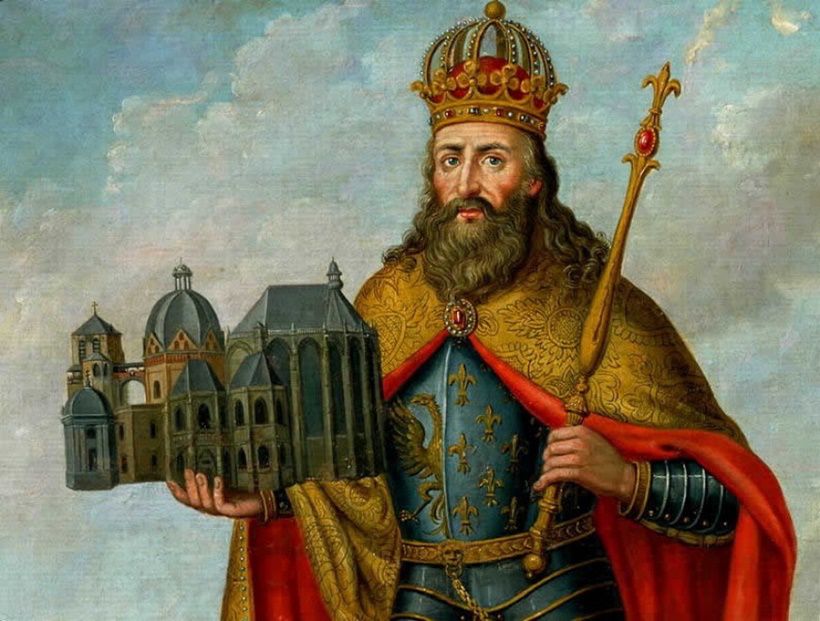
Carlo Magno, known in English as Charlemagne, is one of the most towering figures in European history. Born on April 2, 742, he was the eldest son of Pepin the Short and Bertrada of Laon. His reign as King of the Franks, King of the Lombards, and Emperor of the Carolingian Empire marked the beginning of what would later be known as the Holy Roman Empire. Charlemagne’s legacy is a blend of military conquest, religious influence, and cultural revival, which laid the foundations for modern Europe.
Early Life and Rise to Power
Charlemagne’s early life was shaped by the Frankish kingdom’s expanding influence under his father, Pepin the Short. Upon Pepin’s death in 768, the kingdom was divided between Charlemagne and his younger brother Carloman, in accordance with Frankish custom. This division, however, was short-lived. Carloman’s untimely death in 771 left Charlemagne as the sole ruler of the Franks, allowing him to consolidate power and pursue his ambitions unchallenged.
One of Charlemagne’s first major acts as king was to divorce his wife, Ermengarde, the daughter of Desiderius, the King of the Lombards. This move severed the alliance between the Franks and the Lombards, setting the stage for Charlemagne’s subsequent campaigns in Italy. The dissolution of this marriage also marked the beginning of Charlemagne’s close alliance with the Papacy, which would become a cornerstone of his reign.
Expansion of the Frankish Kingdom
Charlemagne’s reign is most famously characterized by his military conquests, which vastly expanded the territories under his control. His campaigns were numerous and varied, encompassing regions as diverse as Italy, Saxony, Spain, and the Danube basin.
In 773, Charlemagne responded to a call for assistance from Pope Adrian I, who was threatened by the Lombards. Charlemagne invaded Italy, defeated the Lombards, and took their king, Desiderius, prisoner. By 774, Charlemagne had declared himself King of the Lombards, the first time a Frankish king had taken such a title.
Charlemagne’s campaigns against the Saxons, however, were among the most prolonged and brutal of his reign. Over a series of campaigns from 772 to 804, Charlemagne sought to subjugate the Saxons, a Germanic tribe that fiercely resisted Frankish domination and Christian conversion. The wars were marked by Charlemagne’s policy of forced conversion, most notoriously exemplified by the Massacre of Verden in 782, where approximately 4,500 Saxons were executed for resisting conversion to Christianity.
In the west, Charlemagne extended his influence into the Iberian Peninsula, establishing the Spanish March as a buffer zone against the Umayyad Caliphate. His campaigns against the Moors in Spain were less successful than his northern and eastern conquests, but they nonetheless expanded the Frankish realm and solidified Charlemagne’s role as a defender of Christendom.
The Carolingian Renaissance
Beyond his military achievements, Charlemagne is celebrated for his role in the Carolingian Renaissance, a revival of art, culture, and learning based on classical models. Recognizing the importance of education and literacy in administration and governance, Charlemagne established a network of schools and encouraged the study of Latin, the language of the Church and of learned communication across Europe.
He gathered scholars from all over Europe, including the renowned Alcuin of York, to his court at Aachen, which became a center of intellectual activity. The period saw the preservation of numerous classical texts, the development of a standardized script known as Carolingian minuscule, and the promotion of the liberal arts. This cultural revival was instrumental in shaping the intellectual landscape of medieval Europe and laid the groundwork for the eventual rise of the universities in the High Middle Ages.
Charlemagne’s efforts to improve governance were also evident in his legal reforms. He issued a series of capitularies, which were written orders that dealt with issues ranging from judicial procedures to church regulations. These capitularies were aimed at ensuring the consistent application of laws throughout his empire, reflecting Charlemagne’s vision of a centralized and orderly state.
The Coronation as Emperor
One of the most significant events of Charlemagne’s reign occurred on Christmas Day in the year 800, when Pope Leo III crowned him as Emperor of the Romans in St. Peter’s Basilica in Rome. This event is often seen as the foundation of the Holy Roman Empire, although the title was not used officially until later. The coronation symbolized the fusion of Roman, Christian, and Germanic elements that characterized Charlemagne’s rule and the broader Carolingian dynasty.
The title of emperor conferred upon Charlemagne a status that placed him on a par with the Byzantine emperor in Constantinople, although the relationship between the two empires remained complex and often contentious. The coronation also strengthened the alliance between the Frankish crown and the papacy, ensuring mutual support in both spiritual and temporal matters.
Administration and Governance
Charlemagne’s empire was vast, encompassing much of Western and Central Europe, and governing such a large territory required significant administrative innovation. To manage his empire, Charlemagne relied on a network of local officials, including counts and bishops, who were responsible for maintaining order and justice in their respective regions. These officials were supervised by royal agents known as missi dominici, who traveled throughout the empire to ensure compliance with the emperor’s decrees.
The feudal system, which became the dominant social structure in medieval Europe, was further developed under Charlemagne. Lands were granted to loyal nobles in exchange for military service, a system that helped to maintain the empire’s stability and provided the emperor with a reliable source of troops for his many campaigns.
Charlemagne also took an active role in the governance of the Church, working closely with the papacy to enforce Christian doctrine and discipline. He convened church councils, reformed the clergy, and supported missionary activities aimed at converting the pagan populations of his empire. His efforts to Christianize Europe were integral to the cultural and religious identity of the region and had a lasting impact on the development of Western Christianity.
Legacy and Historical Significance
Charlemagne’s death on January 28, 814, marked the end of an era, but his legacy endured long after his passing. He was succeeded by his son, Louis the Pious, whom he had crowned co-emperor in 813, ensuring a smooth transition of power. However, the unity of Charlemagne’s empire did not survive long after his death. The Treaty of Verdun in 843 divided the Carolingian Empire among Louis’s three sons, leading to the fragmentation of the empire and the emergence of the distinct political entities that would later become the kingdoms of France, Germany, and Italy.
Charlemagne’s legacy is multifaceted. He is remembered as a great warrior-king who expanded the Frankish realm to unprecedented heights, as a devout Christian who spread the faith through both persuasion and force, and as a patron of the arts and learning who initiated a cultural revival that would influence European civilization for centuries. His reign is often seen as a turning point in European history, marking the transition from the classical world of the Roman Empire to the medieval world of feudal kingdoms.
In the centuries following his death, Charlemagne became a legendary figure, celebrated in epic poetry and medieval chronicles as the ideal Christian king and the founder of the Holy Roman Empire. His image as a unifier of Europe has continued to resonate, particularly in the context of modern European integration, where he is often invoked as a symbol of a shared European heritage.
SEO Considerations
For those researching Carlo Magno, key phrases to focus on include “Charlemagne biography,” “Carolingian Empire,” “Holy Roman Empire foundation,” and “Carolingian Renaissance.” Additionally, terms like “Charlemagne’s military campaigns,” “Saxon wars,” and “crowning of Charlemagne” will attract readers interested in the broader historical context.
To optimize for search engines, it is important to maintain a keyword density of around 1-2%, ensuring that relevant terms such as “Carolingian dynasty,” “Frankish kingdom,” and “medieval European history” are integrated naturally throughout the text. This will help improve the article’s visibility while ensuring it remains informative and engaging for readers.
In conclusion, Carlo Magno’s life and reign were instrumental in shaping the course of European history. His military conquests, cultural initiatives, and religious reforms laid the foundations for the medieval European order and left an indelible mark on the continent’s development. As both a historical figure and a symbol, Charlemagne continues to inspire and fascinate, embodying the ideals of leadership, unity, and cultural renewal.


