
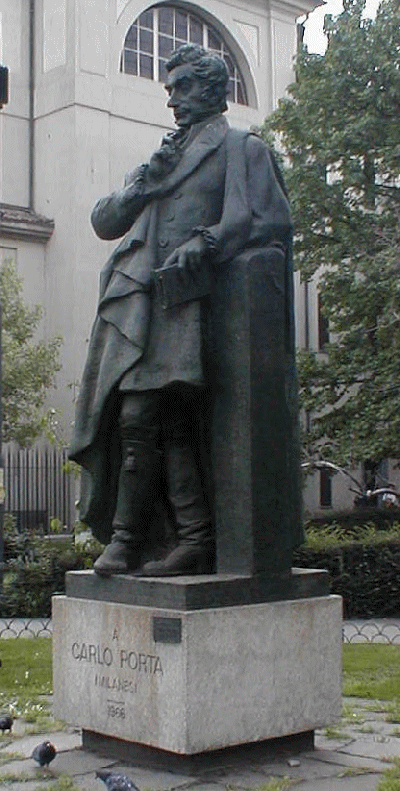
Carlo Porta, born on June 15, 1775, in Milan, Italy, is widely regarded as one of the most influential poets of the 19th century, particularly known for his contributions to Milanese dialect poetry. His work is celebrated for its vivid portrayal of the social conditions and cultural nuances of his time, making him a seminal figure in the history of Italian literature. This article explores the life, fame, and lasting impact of Carlo Porta, offering detailed insights into his work, the historical context in which he wrote, and his enduring legacy.
Early Life and Education
Carlo Porta was born into a middle-class family in Milan, the heart of the Lombardy region. His parents, Giuseppe Porta and Violante Gottieri, had eight children, but only Carlo and two of his brothers, Baldassare and Gaspare, survived into adulthood. Tragedy struck early in Carlo’s life when his mother passed away in 1785, leaving him and his siblings under the care of their father.
At just ten years old, Carlo was sent to a boarding school in Monza, where he began his formal education. From February 7, 1786, to August 16, 1792, Porta studied a range of subjects, including Latin, mathematics, French, history, music, and Italian verse. His education at this time was typical of the upper-middle class, designed to prepare young men for careers in administration or the clergy. Despite showing an early interest in literature and poetry, Porta’s father insisted that he pursue a more practical career, leading him to study accounting at the Milan Seminary.
The Influence of the French Revolution
The political landscape of Europe was rapidly changing during Porta’s youth, particularly with the advent of the French Revolution in 1789 and its subsequent impact on Italy. In 1796, French troops, led by Napoleon Bonaparte, invaded Milan, toppling the old regime and establishing the Cisalpine Republic. This upheaval disrupted the lives of many, including the Porta family. Carlo’s father lost his job, prompting Carlo to leave Milan and seek refuge with his brother in Venice, where he lived until 1799.
These turbulent times profoundly influenced Porta’s worldview and his later works. The ideals of the French Revolution—liberty, equality, fraternity—resonated with Porta, who became increasingly critical of the social injustices and hypocrisy he observed in society. This critical perspective would later become a hallmark of his poetry.
A Career in Public Service
Despite his literary ambitions, Porta was pragmatic about his need to earn a living. In 1804, he secured a position as a public servant, working under both the French and Austrian administrations that controlled Milan during his lifetime. His work as a government official provided him with a stable income, but it also exposed him to the bureaucratic inefficiencies and corruption that he would later satirize in his poetry.
In 1806, Porta married Vincenza Prevosti, with whom he shared a relatively quiet domestic life. However, his personal life was soon overshadowed by his growing passion for poetry, particularly his desire to write in the Milanese dialect. This decision was not just a stylistic choice but a political one, as writing in dialect allowed Porta to speak directly to the people of Milan, addressing their concerns in a language they understood and identified with.
The Milanese Dialect and Literary Contributions
Carlo Porta’s decision to write in the Milanese dialect was both innovative and controversial. At the time, Italian literature was dominated by works written in standard Italian, which was based on the Tuscan dialect. By choosing to write in the Milanese dialect, Porta was making a statement about the cultural and linguistic identity of his region. His work is considered a precursor to the regionalist movement in Italian literature, which sought to celebrate and preserve the diverse dialects and traditions of Italy’s many regions.
Porta’s early literary efforts included a Milanese translation of Dante Alighieri’s “Divine Comedy,” although he completed only a few cantos. This project, undertaken between 1804 and 1805, demonstrated Porta’s deep respect for Italy’s literary heritage while also highlighting his desire to make such works accessible to the Milanese public.
Major Works and Themes
Carlo Porta’s most significant period of literary production began in 1810 and continued until his death in 1821. During this time, he published several major works that solidified his reputation as the foremost poet of the Milanese dialect. These works can be categorized into three main thematic groups: criticism of religious hypocrisy, vivid portrayals of Milanese popular life, and political satire.
Critique of Religious Hypocrisy
One of Porta’s most distinctive themes was his critique of religious hypocrisy. In works like “Fraa Zenever” (1813), “On Miracol” (1813), and “Fraa Diodatt” (1814), Porta used his sharp wit to expose the contradictions and moral failings of the clergy and religious institutions. His poetry often depicted monks and priests as corrupt and self-serving, more interested in maintaining their power than in spiritual matters. This criticism was particularly daring in an era when the Catholic Church held significant influence over public life in Italy.
Portrayal of Milanese Popular Life
Another key theme in Porta’s work was his portrayal of everyday life in Milan. His poems vividly depict the lives of ordinary Milanese citizens, capturing their struggles, joys, and idiosyncrasies with both humor and empathy. Works like “Desgrazzi de Giovannin Bongee” (1812), “El lament del Marchionn di gamb’avert” (1816), and “La Ninetta del Verzee” (1815) are considered some of his finest achievements. These poems are notable not only for their rich characterizations but also for their linguistic creativity, as Porta skillfully employed the Milanese dialect to bring his characters and their world to life.
“La Ninetta del Verzee,” in particular, is often cited as Porta’s masterpiece. The poem tells the story of a young woman from the Verzee market district in Milan, using her life as a lens through which to explore broader social issues such as poverty, exploitation, and the harsh realities of urban life. Through his portrayal of Ninetta, Porta demonstrates his deep understanding of the human condition and his ability to convey complex emotions and ideas through the lens of a single character’s experience.
Political Satire
Porta’s third major thematic focus was political satire. His works often criticized the political situation in Lombardy, especially after the restoration of Austrian rule in 1815. Although Porta had initially hoped that Napoleon’s rule might lead to greater autonomy for Lombardy, he was ultimately disillusioned by both the French and Austrian regimes. His political poems, such as “Paracar che scappee de Lombardia” (1814) and “Marcanagg i politegh secca ball” (1815), reflect his disappointment and his desire for a more just and independent society.
These poems are characterized by their biting humor and incisive commentary on the political figures and events of Porta’s time. His use of the Milanese dialect in these works was particularly effective, as it allowed him to connect with his audience on a visceral level, making his critiques all the more powerful.
Legacy and Influence
Carlo Porta’s influence on Italian literature cannot be overstated. Alongside Giuseppe Gioachino Belli, who wrote in the Roman dialect, Porta is considered one of the most important dialect poets of the 19th century. His work laid the groundwork for future generations of Italian writers who would continue to explore and celebrate regional identities through literature.
Porta’s poems are also significant for their role in the development of Italian Romanticism. While he is often associated with the satirical tradition, his work also contains elements of romanticism, particularly in its focus on the individual and the emotions. His ability to blend humor with social commentary and emotional depth makes his work both timeless and universally relevant.
Tragically, Porta’s life was cut short by gout at the age of 45. He died on January 5, 1821, at the height of his fame. Despite his relatively short life, Porta left behind a body of work that continues to be celebrated and studied today. He was buried in San Gregorio outside Porta Orientale in Milan, but his grave was later lost, adding a layer of mystery to his already legendary status.
In the years following his death, Porta’s work continued to be published and read widely. His friend, the poet Tommaso Grossi, paid tribute to him with the poem “In morte di Carlo Porta,” written in the Milanese dialect. Porta’s legacy also lives on through the numerous streets, schools, and cultural institutions in Milan that bear his name, a testament to the enduring impact of his work on the city and its people.
Conclusion: The Enduring Legacy of Carlo Porta
Carlo Porta remains a towering figure in the history of Italian literature. His decision to write in the Milanese dialect was a bold and revolutionary act that challenged the linguistic norms of his time and helped to elevate regional dialects to the status of literary languages. Through his poetry, Porta captured the essence of Milanese life, from the bustling streets and markets to the political intrigues and social struggles of his era.
His work continues to resonate with readers today, not only for its linguistic innovation but also for its sharp social commentary and emotional depth. As both a satirist and a romantic, Porta’s poetry offers a unique window into the world of early 19th-century Milan, making him a poet whose work is as relevant now as it was two centuries ago.
Carlo Porta’s legacy is one of linguistic pride, cultural identity, and literary brilliance. His contributions to Italian literature and his influence on the development of dialect poetry ensure that his name will be remembered and celebrated for generations to come.


