
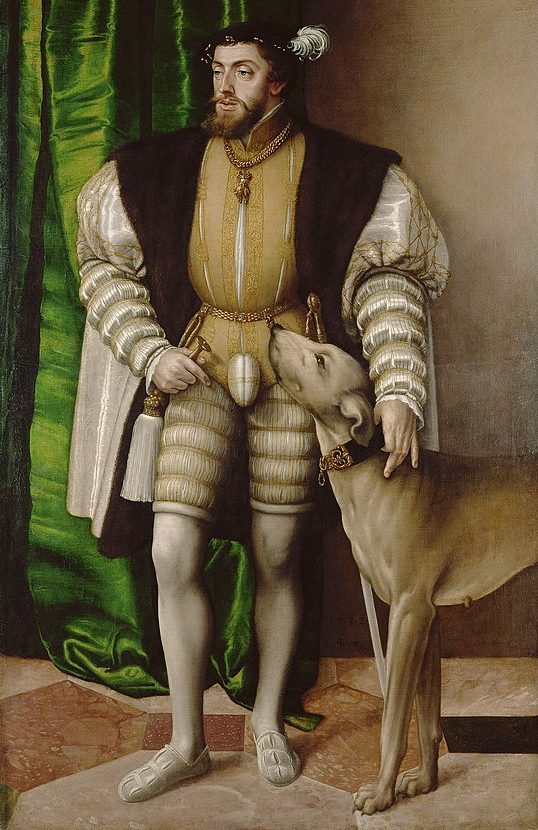
Carlo V, born Charles of Habsburg on February 24, 1500, in Ghent, Flanders, is one of the most pivotal figures in European history. His life and reign were marked by an unprecedented concentration of power, his dominion spanning vast territories across Europe and the Americas, which earned him the famous title, “the empire on which the sun never sets.” This article delves into his life, exploring his rise to power, his significant achievements, and the challenges he faced during his reign.
Early Life and Lineage: A Royal Bloodline
Carlo V was born into one of the most illustrious noble families in Europe. His father, Philip of Habsburg, also known as Philip the Handsome, was the son of Emperor Maximilian I of Austria. His mother, Joanna of Castile, was the daughter of Ferdinand of Aragon and Isabella of Castile, the Catholic Monarchs who completed the Reconquista of Spain and sponsored Christopher Columbus’s voyage to the New World. This lineage made Carlo V a key figure in European politics from birth, inheriting claims to several powerful thrones.
Upon the death of his father in 1506, Carlo inherited the Netherlands. His grandfather, Emperor Maximilian I, ensured that Carlo received an education befitting a future ruler, steeped in the principles of governance and statecraft. Carlo’s mother, Joanna, known as Joanna the Mad, was deemed unfit to rule due to her mental instability, leaving the young Carlo to be groomed for leadership from an early age.
Ascension to Power: The Unification of Kingdoms
The real turning point in Carlo’s life came in 1516, following the death of his maternal grandfather, Ferdinand II of Aragon. Carlo inherited the thrones of both Castile and Aragon, uniting Spain under a single monarch for the first time. This inheritance included not only Spain but also its overseas territories, which were rapidly expanding into the Americas.
Despite his youth, Carlo V faced significant challenges in asserting his authority in Spain. The Spanish Cortes, or parliament, was wary of their new, foreign-born king. Their refusal to grant him the funds he requested was an early sign of the regional resistance Carlo would face throughout his reign.
The Holy Roman Empire: A Global Empire Emerges
In 1519, following the death of his paternal grandfather, Maximilian I, Carlo pursued the title of Holy Roman Emperor, a position that would solidify his power across Europe. However, the path to the imperial crown was not straightforward. Carlo’s chief rival for the title was Francis I of France, a powerful monarch in his own right. To secure the votes of the electors, Carlo had to rely on substantial loans from the wealthy Fugger banking family of Augsburg. His successful election marked the beginning of his rule as Emperor Charles V.
As Emperor, Carlo V presided over a vast and diverse empire. His dominions included not only the Holy Roman Empire and Spain but also the Burgundian territories and the Habsburg hereditary lands in Austria. The Spanish crown also brought with it the burgeoning colonial empire in the Americas, where Spanish conquests were yielding immense wealth in gold and silver. Carlo’s reign thus marked the height of Habsburg power, a time when it could be said that “the sun never set” on his empire.
Military Campaigns and Territorial Conflicts
Carlo V’s reign was characterized by a series of military conflicts, driven by his ambition to expand and defend his territories. One of his earliest and most prolonged struggles was with Francis I of France. The rivalry between the two monarchs led to several wars, primarily over the control of Italy. In 1521, Francis invaded Italy, claiming the Duchy of Milan, which had previously been taken by Louis XII of France. This conflict, known as the Italian Wars, saw several phases and only concluded in 1544 with the Treaty of Crépy, which established peace on the basis of the status quo.
Carlo’s reign also coincided with the rise of the Protestant Reformation, a movement that fundamentally challenged the religious unity of Europe. Carlo, a devout Catholic, initially took a cautious approach to the growing Protestant movement. At the Diet of Worms in 1521, he presided over the trial of Martin Luther, the movement’s leader. Although Luther was declared an outlaw, he was not pursued aggressively, reflecting Carlo’s desire to maintain stability in his empire.
However, as Protestantism spread, it became increasingly difficult for Carlo to ignore the religious schism. The Peace of Augsburg in 1555, which allowed for the legal coexistence of Catholicism and Lutheranism in Germany, was a significant compromise that highlighted the limits of Carlo’s power to enforce religious unity.
The Ottoman Threat and Mediterranean Dominance
Another major challenge during Carlo V’s reign was the threat posed by the Ottoman Empire. The expansion of Ottoman power in the Mediterranean and Central Europe was a significant concern for the Habsburgs. In 1534, the notorious pirate and Ottoman admiral, Khair ad-Din, known as Barbarossa, seized Tunis, using it as a base for piracy against European shipping. Carlo V responded by organizing a crusade-like expedition, involving most of the European powers, except for Venice. The campaign was successful, and Tunis was restored to its former ruler, Mulay Hasan, dealing a significant blow to Ottoman influence in the region.
Despite this victory, the Ottoman threat remained, and Carlo spent much of his reign dealing with the constant pressure from the east. The siege of Vienna in 1529, where Ottoman forces under Sultan Suleiman the Magnificent attempted to capture the Austrian capital, was a particularly tense moment. Although the siege was ultimately unsuccessful, it underscored the ongoing struggle between the Habsburgs and the Ottomans for control of Central Europe.
The Concilio di Trento and the Counter-Reformation
The Protestant Reformation prompted Carlo to take decisive action in the latter part of his reign. The Council of Trent, convened in 1545, was a cornerstone of the Catholic Counter-Reformation, aiming to address the issues raised by Protestant reformers and to clarify Catholic doctrine. Carlo supported the council, hoping it would lead to a unified Christian Europe under Catholic leadership.
However, the religious tensions in his empire were too deep-rooted to be resolved by councils alone. After years of religious wars and political maneuvering, Carlo V was forced to concede that a unified Catholic Europe was no longer possible. The Peace of Augsburg was a pragmatic acknowledgment of this reality, allowing each German prince to choose the religion of his own state.
Abdication and Legacy: The Sunset of an Empire
By the mid-1550s, Carlo V was weary of the continuous warfare and the heavy burden of ruling such a vast empire. In 1556, he made the momentous decision to abdicate his thrones. He divided his empire between his son, Philip II of Spain, and his brother, Ferdinand I, who became Holy Roman Emperor. This division marked the end of the unified Habsburg Empire and the beginning of two separate branches of the family – the Spanish and the Austrian Habsburgs.
Carlo retired to the Monastery of San Jerónimo de Yuste in Spain, where he spent his final years in contemplation and prayer. He died on September 21, 1558, leaving behind a legacy as one of the most powerful rulers in European history. His reign had shaped the course of European politics, religion, and culture, and his empire’s reach across continents set the stage for the modern era of global empires.
Historical Context and Nuances
Carlo V’s reign must be understood within the broader context of the 16th century, a time of significant transformation in Europe. The period was marked by the rise of nation-states, the discovery and colonization of the Americas, the Protestant Reformation, and the ongoing conflict between Christianity and Islam, exemplified by the struggles against the Ottoman Empire.
Carlo’s attempt to create a universal monarchy that would unite all of Christendom under his rule was ultimately unsuccessful. His reign was a constant balancing act, managing the competing interests of different territories, religions, and political factions. His legacy is thus a complex one – a ruler who presided over an empire of unprecedented scope but who also witnessed the fragmentation of the religious and political unity he sought to maintain.
His abdication can be seen as a recognition of the limits of imperial power in the face of these challenges. Carlo V’s life and reign are a testament to the complexities of leadership in a rapidly changing world, where the ambitions of empire often clash with the realities of governance.
Conclusion: The Lasting Impact of Carlo V
Carlo V remains a towering figure in the history of Europe, a symbol of the heights of Habsburg power and the challenges of maintaining such a vast and diverse empire. His reign was marked by both remarkable achievements and significant challenges, and his legacy continues to be studied and debated by historians today. From his efforts to control a continent-spanning empire to his role in the religious conflicts of his time, Carlo V’s life offers a window into the complexities of power and the enduring impact of his rule on the course of European history.


