
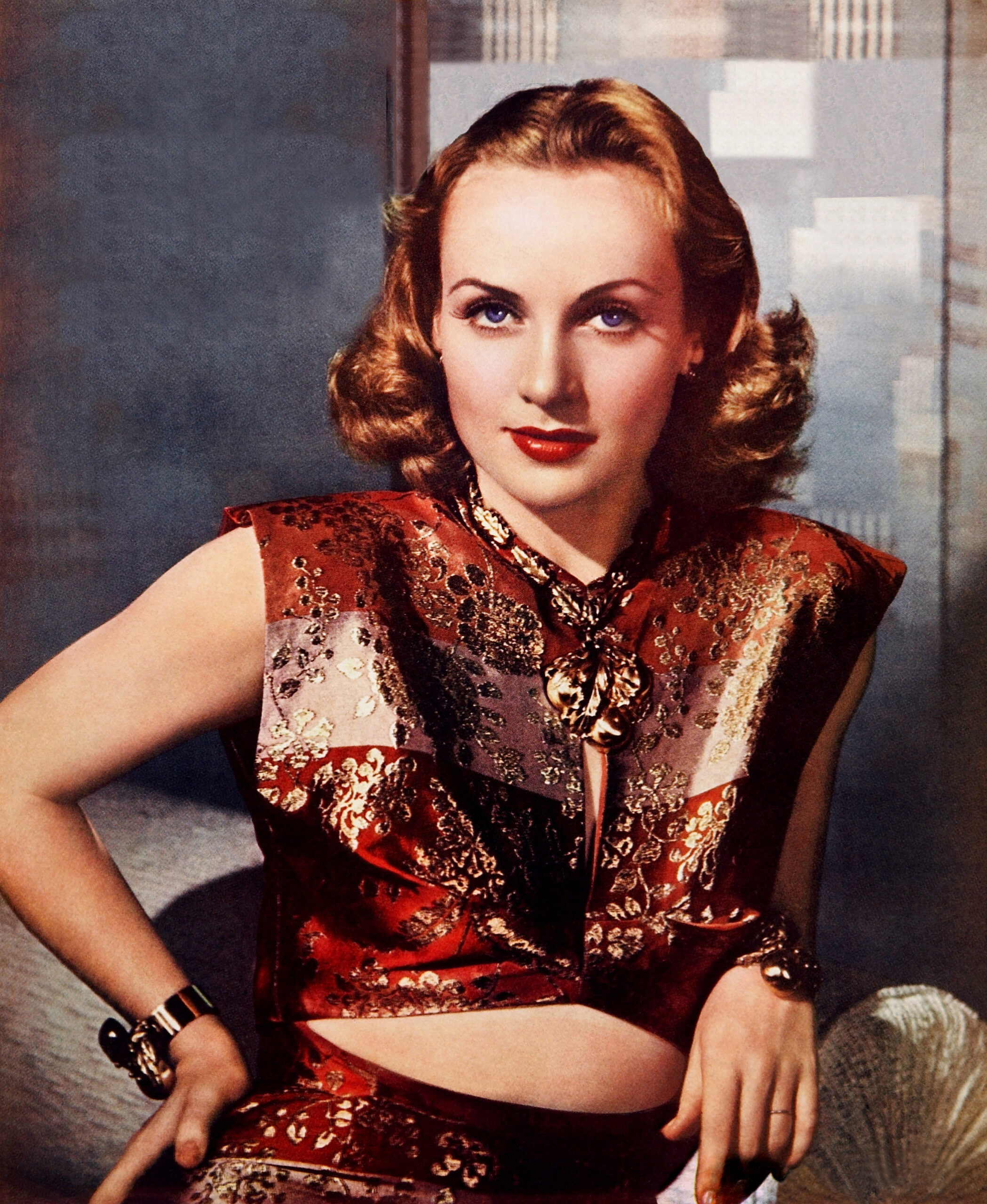
Carole Lombard, born Alice Jane Peters on October 6, 1908, in Fort Wayne, Indiana, is celebrated as one of the brightest stars of Hollywood’s Golden Age. Her career, tragically cut short at the age of 33, left an indelible mark on the world of cinema, particularly in the genre of screwball comedy, where she reigned supreme. In this article, we explore Carole Lombard’s life, her rise to fame, and the highlights that defined her extraordinary journey.
Early Life and Entry into Hollywood
Carole Lombard’s entry into the world of cinema was as serendipitous as it was remarkable. Discovered by director Allan Dwan at the tender age of 12, Lombard made her debut in the silent film “A Perfect Crime” (1921). Her vibrant personality and striking beauty caught Dwan’s attention, leading to her first foray into acting. This early exposure to the film industry would set the stage for what would become a storied career.
Throughout the 1920s, Lombard appeared in numerous silent films, gradually honing her craft and establishing herself as a rising star in Hollywood. Her transition from silent films to talkies was seamless, showcasing her adaptability and natural talent. It was during this period that she adopted the stage name “Carole Lombard,” which would soon become synonymous with wit, charm, and comedic brilliance.
The Queen of Screwball Comedy
Carole Lombard’s career reached its zenith in the 1930s, a decade that saw her emerge as the undisputed queen of screwball comedy. This genre, characterized by its fast-paced dialogue, slapstick humor, and romantic entanglements, provided the perfect platform for Lombard’s talents. Her quick wit, impeccable timing, and ability to balance humor with genuine emotion made her a favorite among audiences and critics alike.
Lombard’s breakthrough in screwball comedy came with the 1934 film “Twentieth Century,” directed by Howard Hawks. Starring opposite John Barrymore, Lombard played the role of a headstrong actress embroiled in a tumultuous relationship with a flamboyant Broadway producer. Her performance was a revelation, earning her widespread acclaim and solidifying her status as a leading lady in Hollywood.
Following the success of “Twentieth Century,” Lombard continued to dominate the genre with a string of hit films. In 1936, she starred in “My Man Godfrey,” a satirical comedy that offered a sharp critique of the social inequalities in Depression-era America. Her portrayal of the eccentric and spoiled socialite Irene Bullock earned her an Academy Award nomination for Best Actress. This role not only showcased her comedic prowess but also highlighted her ability to bring depth and nuance to her characters.
Another significant film in Lombard’s career was “Nothing Sacred” (1937), directed by William A. Wellman. In this biting satire of media sensationalism, Lombard played the role of Hazel Flagg, a small-town girl who is mistakenly believed to be dying of radiation poisoning. Her performance was lauded for its blend of humor and pathos, further cementing her reputation as a versatile and gifted actress.
Personal Life and the Hollywood Romance
Carole Lombard’s personal life was as captivating as her on-screen performances. Known for her vibrant and sometimes irreverent personality, Lombard was a fixture in Hollywood’s social scene. Her off-screen persona was a stark contrast to the glamorous image she portrayed on film. Often described as a “tomboy” with a penchant for practical jokes and colorful language, Lombard was beloved by her peers for her down-to-earth nature and infectious sense of humor.
Lombard’s first marriage was to actor William Powell, her co-star in “My Man Godfrey.” The couple married in 1931 but divorced two years later, citing irreconcilable differences. Despite the end of their marriage, Lombard and Powell remained close friends, a testament to their mutual respect and admiration.
However, it was Lombard’s relationship with Clark Gable that captured the imagination of the public and solidified her place in Hollywood lore. The two stars began their romance in the mid-1930s, and their love story became one of the most celebrated in the industry. Gable, known as “The King of Hollywood,” and Lombard were often referred to as the industry’s golden couple.
In 1939, Lombard and Gable married in a private ceremony, away from the prying eyes of the press. The couple settled on a ranch in Encino, California, where they enjoyed a relatively quiet life away from the Hollywood spotlight. Their home became a sanctuary where they could indulge in their shared passions for hunting and horseback riding. Lombard’s marriage to Gable was marked by deep affection and mutual support, and she was often described as the love of his life.
Collaborations with Cinematic Masters
Carole Lombard’s illustrious career was marked by collaborations with some of the most renowned directors of her time. Her ability to adapt to different cinematic styles and genres made her a sought-after actress, and her work with directors like Howard Hawks, Alfred Hitchcock, and Ernst Lubitsch further elevated her status in Hollywood.
In 1941, Lombard starred in “Mr. and Mrs. Smith,” a romantic comedy directed by Alfred Hitchcock. Unlike Hitchcock’s typical suspense-filled thrillers, this film was a lighthearted exploration of marriage and love. Lombard’s performance was praised for its comedic timing and chemistry with co-star Robert Montgomery. This collaboration with Hitchcock showcased her versatility as an actress, proving that she could excel in a variety of genres.
Perhaps one of Lombard’s most memorable performances came in 1942 with Ernst Lubitsch’s “To Be or Not to Be.” In this dark comedy, Lombard played the role of Maria Tura, a Polish actress caught up in a plot to thwart the Nazis during World War II. The film, which was both a satire of the Nazi regime and a poignant commentary on the power of theater, allowed Lombard to display her full range as an actress. Her performance was both hilarious and deeply moving, solidifying her legacy as one of Hollywood’s greatest talents.
Tragic End and Lasting Legacy
Tragically, Carole Lombard’s life was cut short on January 16, 1942, when the airplane she was traveling on crashed into Table Rock Mountain near Las Vegas, Nevada. Lombard was returning home after a successful war bond tour, during which she had raised over $2 million to support the American war effort. Her untimely death at the age of 33 shocked the nation and left a void in Hollywood that would never be filled.
Lombard’s death was a devastating blow to her husband, Clark Gable, who was inconsolable after her passing. Gable’s grief was so profound that he enlisted in the U.S. Army Air Forces, serving as a combat cameraman in Europe during World War II. Lombard’s death also marked the end of an era in Hollywood, as she was one of the last great stars of the screwball comedy genre.
Despite her brief career, Carole Lombard’s impact on cinema was immense. She was a trailblazer for women in Hollywood, breaking away from the traditional roles assigned to actresses and carving out a space for herself as a comedic powerhouse. Her ability to combine beauty, intelligence, and humor made her a unique figure in the film industry, and her legacy continues to inspire generations of actors and filmmakers.
Historical Context and Influence
Carole Lombard’s career unfolded during a transformative period in Hollywood. The 1930s and early 1940s were a time of significant change in the film industry, marked by the transition from silent films to talkies, the Great Depression, and the looming threat of World War II. Lombard’s work, particularly in screwball comedies, reflected the social and economic realities of the time, offering audiences a much-needed escape through laughter and satire.
The screwball comedy genre, in which Lombard excelled, was itself a product of its time. Emerging during the Great Depression, these films often featured themes of class conflict, financial struggle, and the absurdity of life’s challenges. Lombard’s performances in films like “My Man Godfrey” and “Nothing Sacred” captured the zeitgeist of the era, using humor to address serious issues in a way that was both entertaining and thought-provoking.
Lombard’s influence extended beyond her films. She was known for her philanthropic efforts, particularly during World War II, when she became one of Hollywood’s most active supporters of the war effort. Her dedication to raising funds for the troops and boosting public morale exemplified her deep sense of patriotism and generosity.
Conclusion
Carole Lombard was a singular talent in Hollywood’s Golden Age, whose contributions to cinema have left a lasting legacy. Her ability to navigate the complexities of comedy and drama with equal skill made her a beloved figure both on and off the screen. Although her life was tragically short, her impact on the film industry endures, and she remains a symbol of the wit, charm, and resilience that defined her generation.
As we look back on Carole Lombard’s life and career, we are reminded of the power of laughter and the enduring appeal of a performer who could make us smile even in the darkest of times. Lombard’s work continues to resonate with audiences today, proving that true talent is timeless.


