
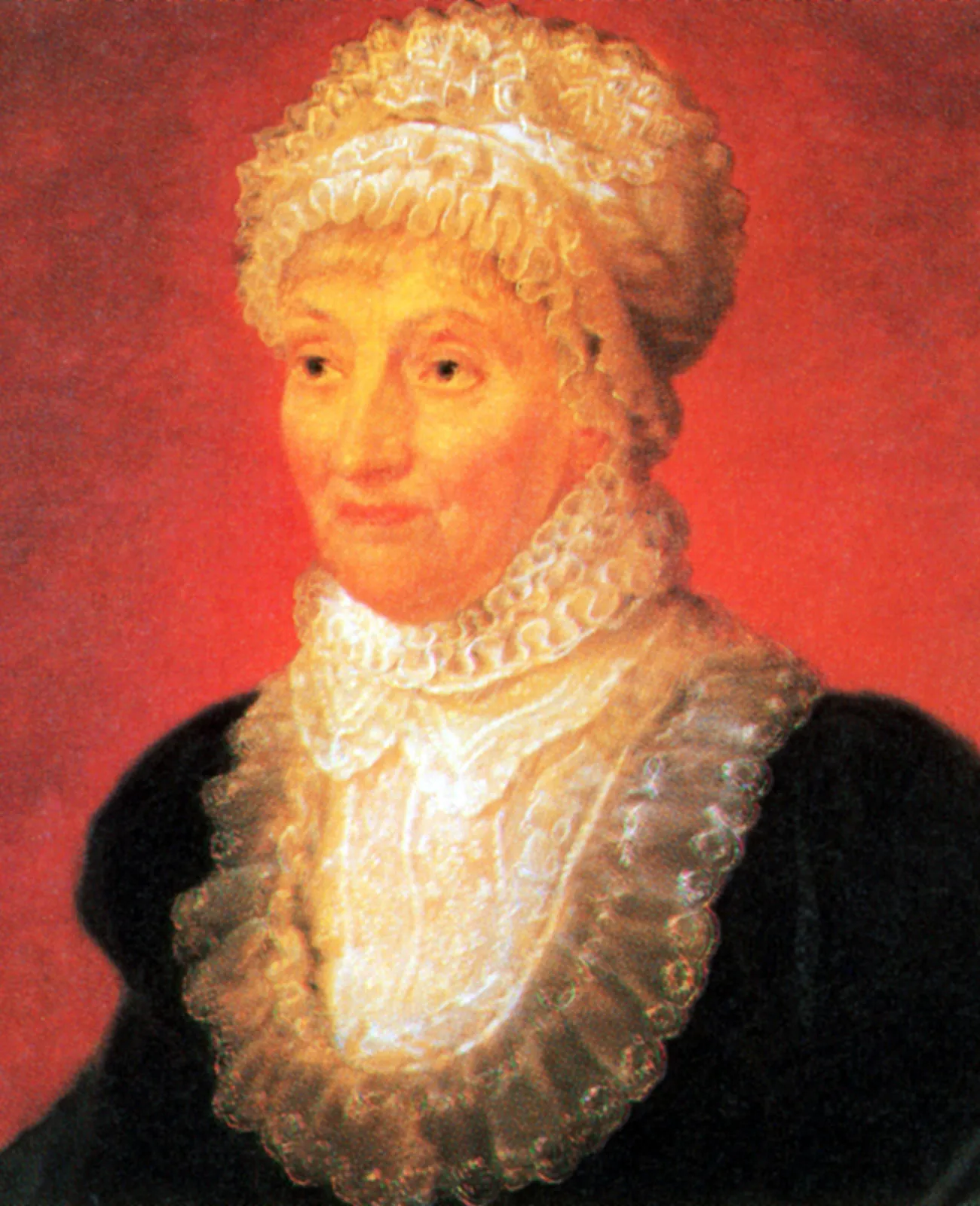
Caroline Lucretia Herschel (1750-1848) stands as a towering figure in the history of astronomy, whose contributions helped shape our understanding of the cosmos. Born in Hanover, Germany, on March 16, 1750, Caroline Herschel’s life is a testament to perseverance, intellectual curiosity, and the breaking of gender barriers in science.
Early Life and Background
Caroline was born into a working-class family where intellectual pursuits were highly encouraged. Her father, Isaac Herschel, was a gardener by profession but also a talented musician. He ensured that all his six children, including Caroline, received a well-rounded education that included mathematics, French, and music. This emphasis on education, particularly for women at the time, was quite progressive.
Caroline’s early life was marred by illness. At the age of ten, she contracted typhus, a disease that stunted her growth and left her physically weakened. This illness had a profound impact on her, both physically and psychologically, but it did not deter her from pursuing her interests.
She remained with her parents until she was 21 years old. In 1772, Caroline joined her elder brother, William Herschel, in Bath, England. William, who was 12 years her senior, was making a name for himself as an astronomer and composer. Initially, Caroline worked as a governess in her brother’s household. However, she soon embarked on a career as a professional opera singer, a pursuit she was passionate about.
Astronomical Endeavors and Achievements
While Caroline’s career as an opera singer was flourishing, she never lost sight of her interest in astronomy. Under her brother’s tutelage, Caroline began to delve deeply into the subject. The Herschels shared a laboratory and an observatory, working together to advance their astronomical studies.
Caroline’s role initially involved assisting William, but she soon started making her own discoveries. Her contributions to the field of astronomy were significant and groundbreaking. She was the first woman to discover a comet, a milestone that marked the beginning of her fame in the scientific community. In total, she discovered six comets:
- C/1786 P1 Herschel
- 35P/Herschel-Rigollet
- C/1790 A1 Herschel
- C/1790 H1 Herschel
- C/1791 X1 Herschel
- C/1797 P1 Bouvard-Herschel
These discoveries were no small feat, particularly in an era when women were rarely recognized for their contributions to science. Caroline’s work required meticulous observation, detailed record-keeping, and a profound understanding of the night sky. Her dedication to astronomy was unwavering, and her discoveries earned her recognition from scientific societies across Europe.
The Herschel Family Dynamics
Caroline’s relationship with her brother William was complex and multifaceted. While they were close collaborators, tensions arose when William married Mary Pitt, a wealthy widow, in 1788. Caroline’s writings from this period suggest that she struggled with feelings of jealousy and resentment, as she had become deeply attached to her brother and their work together. The introduction of Mary into their household disrupted the close-knit partnership that Caroline had cherished.
Despite these initial tensions, Caroline eventually formed a bond with Mary, and she developed a deep affection for her nephew, John Herschel, who would later become a renowned astronomer in his own right. Caroline’s contributions to John’s work were invaluable, and she continued to support and mentor him in his scientific endeavors.
Later Years and Legacy
After William’s death in 1822, Caroline returned to Hanover, where she dedicated herself to preserving and continuing her brother’s work. She meticulously cataloged nebulae and other celestial objects, which greatly assisted John in his astronomical research. Caroline’s commitment to the advancement of astronomy remained steadfast throughout her life.
In 1828, the Royal Astronomical Society awarded Caroline a gold medal for her contributions to science. This was a monumental achievement, as it would take another 168 years before another woman, Vera Rubin, would receive the same honor. Caroline was also made an honorary member of the Royal Astronomical Society in 1835, the first woman to receive this distinction. In 1838, she was elected as a member of the Royal Irish Academy, further cementing her legacy in the scientific community.
In recognition of her contributions, several celestial bodies have been named in her honor, including:
- The lunar crater C. Herschel
- The periodic comet 35P/Herschel-Rigollet
- The asteroid 281 Lucretia
In her later years, Caroline Herschel’s fame extended beyond the scientific community. At the age of 85, she was still being recognized for her contributions to astronomy. In 1846, the King of Prussia awarded her the Gold Medal for Science, a fitting tribute to a lifetime of dedication and discovery.
Caroline Herschel passed away on January 9, 1848, at the age of 96, in her hometown of Hanover. She was buried at the Gartengemeinde Cemetery in Hanover, leaving behind a legacy that continues to inspire generations of scientists, particularly women in STEM fields.
The Impact of Caroline Herschel on Modern Astronomy
Caroline Herschel’s life and work were a precursor to the broader acceptance and recognition of women in science. Her achievements, particularly in a male-dominated field, paved the way for future generations of female astronomers. The challenges she faced and overcame are a testament to her resilience and determination.
Her contributions to the cataloging of nebulae and the discovery of comets were foundational in the field of astronomy. The precision and care with which she approached her work set a standard for future astronomers. Caroline’s legacy is not just in the discoveries she made but also in the doors she opened for women in science.
Historical Context and Legacy
To fully appreciate Caroline Herschel’s contributions, it is essential to understand the historical context in which she lived. The 18th and early 19th centuries were a time when women were largely excluded from scientific discourse. Educational opportunities for women were limited, and those who pursued intellectual careers often faced significant societal barriers.
Caroline’s achievements were not just a result of her talent and hard work but also of the support she received from her family, particularly her brother William. However, it was her determination to overcome the limitations imposed by her gender that truly set her apart.
The recognition Caroline received during her lifetime was unprecedented for a woman in science. Her awards and honors were a reflection of the scientific community’s acknowledgment of her contributions, which was a rare occurrence for women of her time. Her induction into the Royal Astronomical Society and the Royal Irish Academy marked a significant shift in the inclusion of women in scientific institutions.
Caroline Herschel’s legacy lives on not just in the celestial bodies that bear her name but in the inspiration she provides to women in science today. Her story is a reminder that perseverance, passion, and dedication can break down even the most formidable barriers.
In 2016, Google honored Caroline Herschel with a Google Doodle on the 266th anniversary of her birth, highlighting her contributions to astronomy and her role as a pioneering woman in science. This recognition in the digital age underscores the lasting impact of her work and her significance as a trailblazer in the history of science.
Conclusion
Caroline Herschel’s life is a remarkable story of triumph over adversity. From her early struggles with illness to her groundbreaking discoveries in astronomy, Caroline’s journey was one of persistence and passion. Her contributions to science, particularly in the field of astronomy, were monumental, and her legacy continues to influence and inspire. Caroline Herschel is not just a figure from history; she is a beacon of what can be achieved through determination and a relentless pursuit of knowledge.
Her life serves as a powerful reminder that the pursuit of science knows no gender, and her story will continue to inspire future generations of astronomers and scientists for years to come.


