
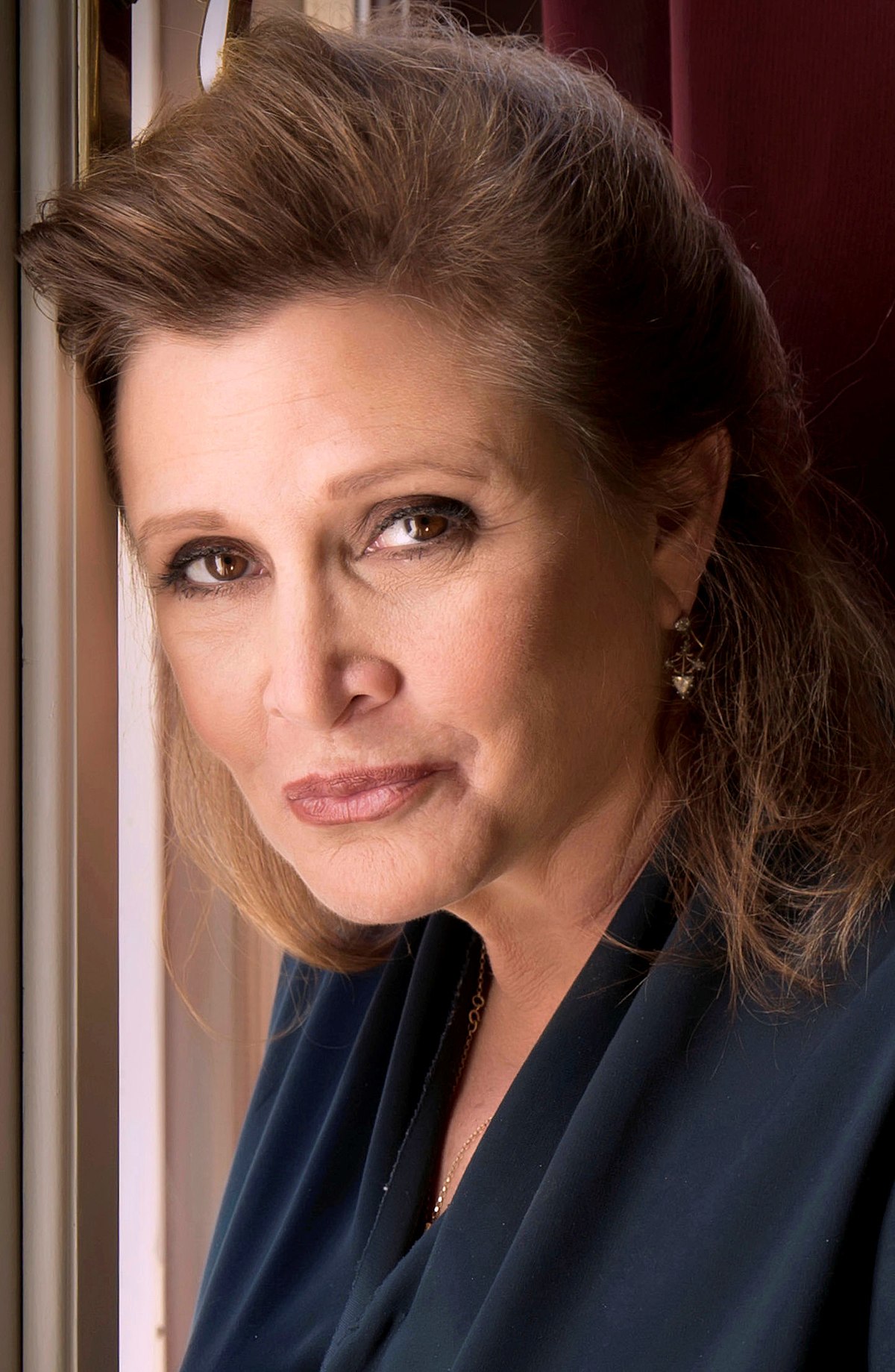
Carrie Fisher, a name synonymous with Hollywood royalty and sci-fi iconography, remains one of the most beloved figures in American pop culture. Born on October 21, 1956, in Beverly Hills, California, Fisher’s life was a blend of glittering fame, personal struggles, and immense creativity. Best known for her iconic role as Princess Leia Organa in the Star Wars saga, Fisher’s legacy extends far beyond the silver screen. As an actress, writer, and advocate for mental health awareness, Fisher’s influence continues to resonate with audiences worldwide.
Early Life: Hollywood Royalty in the Making
Carrie Frances Fisher was born into Hollywood aristocracy. Her father, Eddie Fisher, was a popular singer, and her mother, Debbie Reynolds, was a legendary actress. Fisher’s early years were steeped in the glitz and glamour of Tinseltown. However, this celebrity upbringing came with its challenges. When Carrie was just two years old, her parents divorced—a highly publicized split that saw Eddie Fisher leave Debbie Reynolds for Elizabeth Taylor, another screen legend. This early upheaval in her family life set the stage for the complex relationships that would characterize much of Fisher’s life.
Growing up in the shadow of her famous parents, Fisher was drawn to the entertainment industry from a young age. She made her first public appearance alongside her mother in Las Vegas at the tender age of 12. Fisher attended Beverly Hills High School but dropped out at 15 to pursue acting full-time. She later enrolled in the Central School of Speech and Drama in London, where she honed her craft for a year and a half before returning to the United States.
Breaking Into Hollywood: The Early Roles
Fisher’s first foray into the world of film came with a supporting role in the 1975 comedy Shampoo, where she starred alongside Warren Beatty, Julie Christie, and Goldie Hawn. While this role helped Fisher gain some recognition, it was her next role that would catapult her to international stardom.
In 1977, Fisher was cast as Princess Leia in Star Wars, directed by George Lucas. The film, later retitled Star Wars: Episode IV – A New Hope, became a global phenomenon, making Fisher an overnight sensation. Princess Leia, with her iconic “cinnamon bun” hairstyle and fierce determination, quickly became a symbol of female empowerment in cinema. Fisher reprised her role in The Empire Strikes Back (1980) and Return of the Jedi (1983), solidifying her status as a sci-fi icon.
The success of Star Wars brought Fisher unprecedented fame. Princess Leia became a merchandising triumph, with action figures, posters, and other memorabilia flooding the market. Despite this, Fisher often quipped that it wasn’t she who became famous, but rather the character of Princess Leia—a distinction that reflected her complicated relationship with the role that defined much of her career.
Beyond Star Wars: Writing and Screenwriting Career
While Star Wars made Carrie Fisher a household name, she was determined to be more than just an actress. In 1987, Fisher published her semi-autobiographical novel, Postcards from the Edge. The book, which drew heavily on Fisher’s own experiences with addiction and her tumultuous relationship with her mother, was a critical and commercial success. In 1990, it was adapted into a film directed by Mike Nichols, with Meryl Streep starring as the protagonist, Suzanne Vale. Fisher herself wrote the screenplay, marking the beginning of her successful career as a screenwriter.
Fisher’s sharp wit and keen insight into the human condition made her a sought-after “script doctor” in Hollywood. She was known for her ability to punch up dialogue and refine scripts, contributing to films like Hook (1991) and Sister Act (1992). Her work as a script doctor was often uncredited, but her contributions were well-known within the industry.
In addition to Postcards from the Edge, Fisher penned several other novels, including Surrender the Pink (1990) and Delusions of Grandma (1993). Her books often explored themes of love, loss, and the often surreal nature of life in Hollywood, all infused with her trademark humor and candor.
Personal Struggles and Advocacy
Despite her success, Fisher’s life was marked by significant personal struggles. In the late 1970s, she began abusing drugs, a problem that worsened as her career progressed. Her substance abuse issues were well-documented, and they nearly derailed her career during the filming of The Blues Brothers (1980), where her drug use became so problematic that she was almost fired.
Fisher’s battle with addiction was intertwined with her struggle with mental health. Diagnosed with bipolar disorder at the age of 24, Fisher initially resisted the diagnosis. It wasn’t until she suffered an overdose at 28 that she fully accepted her condition. From then on, Fisher became a vocal advocate for mental health awareness, openly discussing her bipolar disorder and the challenges it presented. Her willingness to speak candidly about her struggles helped destigmatize mental illness and inspired many others to seek help.
Fisher’s personal life was equally tumultuous. In 1983, she married singer-songwriter Paul Simon, but the marriage lasted just a year. The couple rekindled their relationship briefly before finally parting ways in 1991. Fisher then began a relationship with talent agent Bryan Lourd, with whom she had a daughter, Billie Lourd, in 1992. However, their relationship ended in 1994 when Lourd left Fisher for a man.
Fisher’s later years were marked by a renewed focus on her mental health and her work as an advocate. In 2009, she brought her one-woman show Wishful Drinking to the stage, where she shared her life story with humor and honesty. The show was later adapted into a memoir and an HBO special, both of which received critical acclaim.
Return to Star Wars and Final Years
In 2015, Fisher reprised her role as Princess Leia in Star Wars: The Force Awakens, directed by J.J. Abrams. The film was a major success, and Fisher’s return was celebrated by fans who had grown up with the original trilogy. She continued to portray Leia in Star Wars: The Last Jedi (2017), which was released posthumously.
Fisher’s final years were a mix of professional triumph and personal challenges. On December 23, 2016, while on a flight from London to Los Angeles, Fisher suffered a massive heart attack. She was rushed to the hospital upon landing, where she was stabilized, but despite initial signs of improvement, Fisher passed away on December 27, 2016, at the age of 60. The cause of death was later determined to be sleep apnea and other undetermined factors, with a history of drug use contributing to her condition.
Legacy: A Cultural Icon
Carrie Fisher’s death marked the end of an era, but her legacy continues to endure. She was a trailblazer in many respects: as an actress who broke new ground for female characters in cinema, as a writer who candidly addressed personal and societal issues, and as an advocate who fought to destigmatize mental illness.
Fisher’s influence is evident in the many tributes that followed her death. Fans and colleagues alike praised her for her resilience, her humor, and her willingness to confront her demons head-on. Her daughter, Billie Lourd, has continued Fisher’s legacy in Hollywood, becoming an actress in her own right.
Fisher’s portrayal of Princess Leia remains one of the most iconic in cinematic history. Leia was more than just a princess—she was a leader, a warrior, and a symbol of hope. Fisher’s performance imbued Leia with strength, vulnerability, and a wry sense of humor, making her a character that has inspired generations.
Beyond Leia, Fisher’s contributions to the arts and her advocacy work have left an indelible mark. Her books continue to be read and loved, her films remain classics, and her advocacy for mental health has had a lasting impact on public discourse. Fisher’s life was one of highs and lows, of triumphs and challenges, but through it all, she remained unapologetically herself—a quality that endeared her to millions.
Conclusion
Carrie Fisher was a woman of many talents and complexities. Her life was a tapestry woven with threads of fame, creativity, struggle, and advocacy. She was not just Princess Leia; she was a brilliant writer, a sharp-witted humorist, and a courageous advocate for those battling mental illness. Fisher’s legacy is multifaceted, touching the worlds of film, literature, and mental health advocacy.
As we remember Carrie Fisher, it is important to celebrate not just her achievements, but also her humanity. She was a star who shone brightly, even when the weight of the world seemed too much to bear. Fisher’s life and career offer a powerful reminder that even in the face of great challenges, it is possible to create something beautiful, something lasting. And in that creation, Carrie Fisher found immortality.


