
Introduction
Cimabue, born as Cenni di Pepo (or Cenni di Pepe), is often regarded as one of the pioneers of the Italian Renaissance in painting. His exact birth year is commonly cited as 1240, and he was born in Florence, Italy. While details of his early life remain sparse and somewhat shrouded in mystery, Cimabue’s contributions to art are unmistakable. He is credited with breaking away from the rigid Byzantine style that dominated the era and paving the way for more naturalistic and expressive forms of art that characterized the Renaissance. This article delves into the life and work of Cimabue, exploring his early years, his most significant works, and his enduring legacy.
Early Life and Background
Cimabue was born in Florence, a city that would later become the cradle of the Renaissance. His nickname, “Cimabue,” which could translate to “bull-headed” or “proud-headed,” is believed to reflect his strong personality and pride in his work. Although much about his early life remains uncertain, it is known that he trained in the workshop of Coppo di Marcovaldo, a renowned Florentine painter of the time. This early apprenticeship was crucial in shaping Cimabue’s artistic style, exposing him to the Byzantine traditions that dominated Italian painting in the 13th century.
During this period, the prevalent style was heavily influenced by the art of the Byzantine Empire, characterized by its formal and somewhat static figures, gold backgrounds, and lack of depth and perspective. However, Cimabue, with his innovative spirit, would soon challenge these conventions.
Artistic Breakthrough and the Move Toward Naturalism
Cimabue’s artistic journey took a significant turn after a visit to Rome between 1270 and 1275. This trip exposed him to various artistic influences and inspired him to develop a more personal style that deviated from the rigid forms of Byzantine art. Instead of adhering strictly to the idealized and emotionless figures typical of the time, Cimabue began to infuse his works with a sense of humanity and emotion, a radical departure from the norm.
One of his earliest and most notable works, the Crucifix in the Church of San Domenico in Arezzo (c. 1265), exemplifies this shift. The Crucifix showcases a more naturalistic representation of Christ’s suffering, with a body that is more realistically proportioned and draped in cloth that follows the contours of the figure. This work marked a significant step towards the humanism that would later define Renaissance art.
Major Works and Contributions
Cimabue’s contributions to art are most evident in a series of frescoes and panel paintings that demonstrate his evolving style. Among his most significant works are the frescoes in the Basilica of San Francesco in Assisi, created between 1277 and 1280. These frescoes, which depict scenes from the lives of the Virgin Mary and St. Francis, are noted for their vibrant colors, dynamic compositions, and the introduction of more lifelike expressions and gestures. Although parts of these frescoes have been damaged over time, they remain a testament to Cimabue’s innovative approach to religious art.
Another landmark work is the Maestà, a large panel painting now housed in the Louvre Museum in Paris, created around 1280. This work, which depicts the Virgin Mary enthroned with the Christ Child surrounded by angels, is a striking example of Cimabue’s ability to blend Byzantine traditions with new elements of naturalism. The figures in the Maestà are more softly modeled, with a greater sense of volume and space, reflecting Cimabue’s move towards a more realistic depiction of the human form.
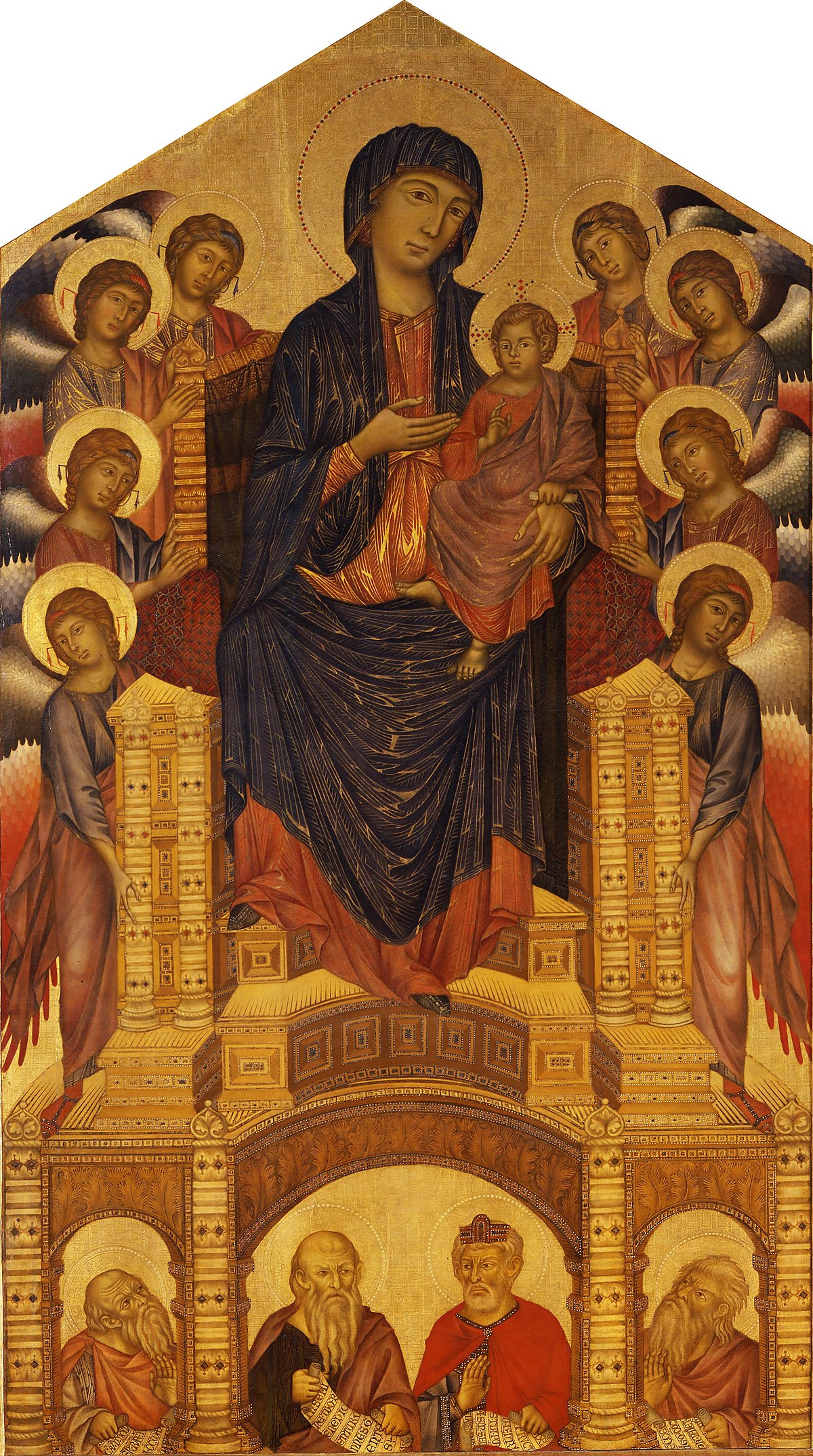
Perhaps one of Cimabue’s most celebrated works is the Maestà di Santa Trinita, created between 1290 and 1300. This altarpiece, originally located in the church of Santa Trinita in Florence and now housed in the Uffizi Gallery, showcases Cimabue’s mature style. The Maestà di Santa Trinita features a towering Madonna and Child, surrounded by a host of angels, with the figures rendered in a more naturalistic and expressive manner than earlier works. The use of chiaroscuro (the treatment of light and shade) and the delicate treatment of drapery are particularly noteworthy, highlighting Cimabue’s skill in creating a sense of depth and realism.
The Influence of Byzantine Art and Cimabue’s Legacy
Cimabue’s work is often discussed in the context of his relationship to Byzantine art, which was the dominant style in Italy during his lifetime. Byzantine art, known for its iconic and symbolic representations, heavily influenced Cimabue’s early work. However, his later paintings reveal a clear departure from this tradition. Cimabue began to explore more naturalistic approaches, incorporating elements of light, shadow, and spatial depth that were less common in Byzantine art.
Cimabue’s influence is most clearly seen in the work of his famous pupil, Giotto di Bondone, who is often credited with fully realizing the transition from the medieval to the Renaissance style in painting. Giotto’s work, characterized by its naturalism, emotional depth, and use of perspective, owes much to the foundations laid by Cimabue. In this way, Cimabue can be seen as a crucial bridge between the medieval and Renaissance periods, setting the stage for the innovations that would follow.
Later Years and Death
In the later years of his life, Cimabue continued to produce works that exemplified his pioneering approach to art. One of his final known works is the Crucifix in the Basilica di Santa Croce in Florence, which was tragically damaged by the Arno River flood in 1966. Despite this damage, the Crucifix remains a powerful example of Cimabue’s ability to convey deep emotion and spiritual suffering through art.
Cimabue spent the last years of his life in Pisa, where he continued to work until his death in 1302. Although he passed away more than seven centuries ago, his influence on the course of Western art is still felt today. Cimabue’s works represent a turning point in the history of art, moving away from the rigidity of the Byzantine tradition and towards the naturalism and humanism that would come to define the Renaissance.
Cimabue’s Legacy and Historical Significance
Cimabue’s contributions to art cannot be overstated. As a pioneer of the early Renaissance, he played a crucial role in the transition from the medieval to the modern world in art. His work laid the groundwork for the innovations that would follow in the 14th and 15th centuries, influencing generations of artists, including his most famous pupil, Giotto.
Cimabue’s legacy is also reflected in the way he is remembered in art history. Giorgio Vasari, the 16th-century Italian painter and historian, recognized Cimabue as the “father of modern painting” in his seminal work, Lives of the Most Excellent Painters, Sculptors, and Architects. While this title may be an exaggeration, it underscores the importance of Cimabue’s contributions to the development of Western art.
Today, Cimabue’s works are studied not only for their artistic merit but also for their historical significance. His paintings are seen as a critical link between the art of the Byzantine Empire and the new directions that emerged during the Italian Renaissance. As such, Cimabue remains a figure of enduring importance in the history of art, representing the beginning of a profound transformation in the way artists viewed and depicted the world.
Conclusion
Cimabue, born in the 13th century, stands as a pivotal figure in the history of Western art. His innovative approach to painting, which combined elements of Byzantine tradition with emerging naturalistic techniques, set the stage for the Italian Renaissance. Cimabue’s works, characterized by their emotional depth, lifelike figures, and sophisticated use of light and shadow, mark the beginning of a new era in art.
While much about Cimabue’s life remains shrouded in mystery, his legacy is clear. As a teacher to Giotto and a pioneer of new artistic techniques, Cimabue’s influence can be seen in the work of countless artists who followed in his footsteps. His contributions to art are not only a testament to his skill and creativity but also to his role in shaping the future of Western art.
As we reflect on the life and work of Cimabue, we are reminded of the power of innovation and the importance of challenging established conventions. Cimabue’s willingness to push the boundaries of artistic expression helped to lay the foundation for the Renaissance, a period that would see some of the greatest achievements in the history of art. His story is one of vision, creativity, and enduring impact—a legacy that continues to inspire artists and art lovers alike.


