
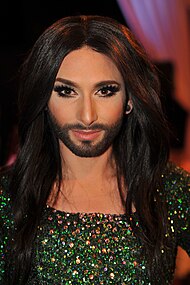
Conchita Wurst, the stage persona of Austrian artist Thomas Neuwirth, has become a global symbol of diversity, tolerance, and artistic expression. Born on November 6, 1988, in Gmunden, Austria, Conchita rose to international fame by winning the Eurovision Song Contest in 2014 with her powerful performance of “Rise Like a Phoenix.” However, her journey to stardom is much more than just a victory in a music competition—it’s a story of courage, identity, and breaking stereotypes.
Early Life and the Birth of Conchita Wurst
Thomas Neuwirth grew up in the small town of Bad Mitterndorf, located in the mountainous region of Styria, Austria. From a young age, Neuwirth faced the challenges of growing up as a homosexual in a conservative and rural environment. His struggle with societal prejudices began early, with instances like wanting to wear a skirt to school, which highlighted his awareness of being different from his peers. These experiences laid the foundation for his later creation of the drag persona, Conchita Wurst.
At the age of 14, Neuwirth moved to Graz, Austria, to study fashion, driven by a desire to follow in the footsteps of fashion icon Victoria Beckham. This move was a pivotal moment in Neuwirth’s life, marking the beginning of his journey into the world of entertainment and self-expression.
The First Taste of Fame
In 2006, before Conchita Wurst was born, Thomas Neuwirth participated in the third season of the Austrian TV show “Starmania,” where he finished as the runner-up. This early success in the music industry was followed by a brief stint in a boy band named Jetzt Anders!, which disbanded shortly afterward. The dissolution of the band led Neuwirth to reevaluate his path in the music industry, ultimately resulting in the creation of his drag persona, Conchita Wurst.
The Creation of Conchita Wurst
Conchita Wurst was born out of a need to express individuality and challenge societal norms. The name “Wurst” is a nod to the German expression “Das ist mir doch alles Wurst,” which translates to “I don’t care,” reflecting a sense of defiance against prejudice and societal expectations. The name “Conchita,” on the other hand, was inspired by a Cuban friend and also carries a slang connotation in Spanish.
Conchita Wurst is not just a drag persona; she is a symbol of freedom, acceptance, and the breaking of boundaries. Neuwirth has emphasized that Conchita is a character separate from his own identity. He identifies as a gay man and a drag queen, using female pronouns when referring to Conchita and male pronouns when speaking about himself.
To add a layer of complexity and intrigue to the character, Neuwirth created a fictional backstory for Conchita Wurst, portraying her as a bearded woman born in the Colombian mountains and married to a French burlesque dancer named Jacques Patriaque, who is a real-life friend of Neuwirth.
Rise to International Fame: Eurovision Song Contest 2014
Conchita Wurst’s journey to international fame culminated in 2014 when she was selected to represent Austria at the Eurovision Song Contest in Copenhagen, Denmark. However, her selection was met with significant controversy, particularly in Eastern Europe, where petitions were organized in Russia and Belarus to censor her performance. Russian politician Vitaly Milonov even called for a boycott of the competition, labeling Conchita’s performance as a promotion of homosexuality and spiritual decline.
Despite the backlash, Conchita’s performance of “Rise Like a Phoenix” was a resounding success. She qualified for the final after participating in the second semifinal on May 8, 2014, and went on to win the competition with 290 points. This victory marked Austria’s first win at Eurovision since 1966.
Conchita’s triumph was not just a musical victory but a significant cultural moment. In her acceptance speech, she declared, “We are unstoppable,” addressing her words to politicians and individuals who opposed LGBT rights. Her win was a powerful statement against discrimination and a call for unity and acceptance.
Life After Eurovision: Continued Advocacy and Success
Following her Eurovision win, Conchita Wurst’s fame soared. Rumors circulated that she would open for Lady Gaga on her European tour, although these were later denied by Conchita herself. Nonetheless, she remained a prominent figure in the LGBT community, participating in Pride parades across Europe and performing in front of massive crowds.
In June 2014, Conchita performed at the LGBT Pride Parade in London, sharing the stage at Trafalgar Square with actor Ian McKellen, a prominent gay rights activist. She also headlined the LGBT Pride Festival in Madrid, drawing large crowds to her performance in Plaza Chueca. Her influence extended beyond the music world when she was chosen by renowned designer Jean Paul Gaultier to model his new collection during Paris Fashion Week.
Conchita continued to advocate for LGBT rights, performing at various Pride events in Stockholm, Antwerp, and Manchester. In October 2014, she participated in the European Parliament’s “Light in Darkness 2014/15” project, where she recorded the single “My Lights” and performed in front of 2,000 delegates at the European Parliament in Brussels. During her performance, she delivered a powerful speech on tolerance, stating, “As I always say, you don’t have to love me, but you have to respect me.”
In November 2014, Conchita was recognized by the BBC as one of the 100 women who made a significant impact that year. She also released the single “Heroes” and performed at the United Nations office in Vienna, where she was praised by then-UN Secretary-General Ban Ki-Moon as a “cultural icon.”
Personal Struggles and Public Life
In April 2018, Conchita Wurst made headlines again when she publicly disclosed that she had been living with HIV for several years. This announcement was made in response to threats from a former partner who had threatened to expose her HIV status. By choosing to go public, Conchita aimed to combat the stigma associated with the virus and to encourage others to be open about their health.
Conchita’s public disclosure of her HIV status was met with widespread support and admiration, further solidifying her status as a symbol of strength and resilience.
Conchita Wurst’s Legacy
Conchita Wurst’s impact on the world extends far beyond her Eurovision victory. She has become a symbol of courage, resilience, and the fight for equality. Her journey from a small town in Austria to international stardom is a testament to the power of self-expression and the importance of challenging societal norms.
Through her music, advocacy, and public appearances, Conchita Wurst has inspired millions around the world to embrace their true selves and to stand up against discrimination. Her story is one of triumph over adversity, and her legacy will undoubtedly continue to inspire future generations.
Conchita Wurst is not just a performer; she is a beacon of hope for those who have been marginalized, a reminder that we are all worthy of respect, regardless of our differences.


