
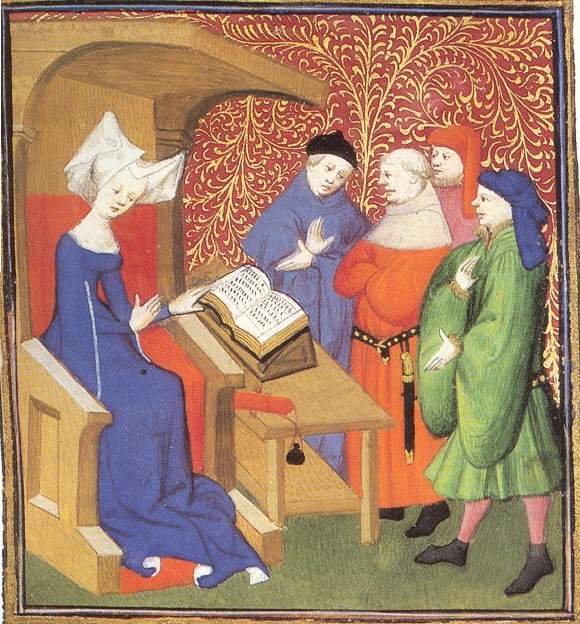
Cristina da Pizzano, often known by her French name Christine de Pizan, is a significant figure in medieval European literature, recognized as one of the earliest professional female writers. Her life, works, and legacy provide profound insights into the socio-cultural dynamics of her time, particularly regarding the roles and perceptions of women. Born in Venice, Italy, around 1364, Cristina’s life journey took her from the bustling canals of Venice to the intellectual circles of the French royal court, where she would eventually emerge as a pioneering voice against misogyny and for the intellectual and social empowerment of women.
Early Life and Education
Cristina da Pizzano was born into a well-educated family. Her father, Tommaso da Pizzano, was a noted physician and astrologer who served at the University of Bologna before being invited to the French court of King Charles V. This move to France around 1368 marked a significant turning point in young Cristina’s life, exposing her to a rich cultural environment that was crucial in shaping her future intellectual pursuits.
At the French court, Cristina had access to the vast resources of the royal library at the Louvre, which was one of the most extensive collections of books and manuscripts in Europe at the time. This exposure to literature and scholarly works from an early age played a crucial role in her development as a writer and thinker. It was during this period that she began to develop her own ideas and philosophies, influenced by the intellectual milieu around her.
Marriage and Early Widowhood
At the tender age of 15, Cristina was married to Étienne de Castel, a notary and secretary to the king. Her marriage, though initially happy, was short-lived. By the age of 25, Cristina was widowed, her husband having died of an epidemic in 1390. Left with three young children and her mother to care for, Cristina found herself in a precarious financial situation. The loss of her husband not only brought emotional turmoil but also thrust her into a position where she needed to support her family, a challenge that she met with remarkable resilience.
To make ends meet, Cristina turned to writing, a decision that would define the rest of her life. Her early works, including poems like “Seulete sui” (I Am Alone), reflect her deep personal grief and the struggles of widowhood. These works were well-received, allowing her to gain a foothold in the literary world. Over the next few years, Cristina would write and sell a hundred ballads, establishing herself as a professional writer, a rarity for a woman in medieval Europe.
Professional Writing Career and Literary Contributions
Cristina’s literary output was prodigious, encompassing poetry, prose, and philosophical treatises. Her works often reflected her own life experiences, but they also engaged with broader social and political issues, particularly those related to women’s rights and gender equality.
One of her most significant works, “The Book of the City of Ladies” (“Le Livre de la Cité des Dames”), written between 1404 and 1405, stands as a pioneering feminist text. In this allegorical work, Cristina constructs an ideal city inhabited by virtuous women from history, literature, and religion, effectively countering the misogynistic narratives that were prevalent in medieval literature. The book serves as a defense of women’s capabilities and contributions to society, challenging the stereotypes and prejudices of her time.
Cristina’s critique of the pervasive misogyny of her era is also evident in her earlier works, such as “Epistre au Dieu d’Amours” (Letter to the God of Love) and “Epistres du Débat sur le ‘Roman de la Rose'” (Letters on the Debate about the ‘Romance of the Rose’). In these texts, she confronts the male-dominated literary tradition that often portrayed women in a negative light, arguing for a more balanced and respectful representation of women in literature and society.
Later Years and Legacy
Cristina’s later years were marked by continued literary productivity and a deepening of her philosophical and political ideas. Her final work, “Ditié de Jehánne d’Arc,” written in 1429, is a poetic tribute to Joan of Arc. This poem, composed while Joan of Arc was still alive, is one of the earliest literary celebrations of the French heroine and reflects Cristina’s enduring commitment to celebrating female strength and virtue.
In 1430, at the age of 65, Cristina retired to a convent, where she spent the remaining years of her life. The exact date of her death is uncertain, but it is believed to have been shortly after her retirement, around 1430.
Historical Context and Impact
Cristina da Pizzano’s life and works must be understood within the broader context of the late medieval period, a time of significant social, political, and intellectual change in Europe. The 14th and 15th centuries were marked by the upheavals of the Hundred Years’ War, the Black Death, and the growing influence of humanism, which laid the groundwork for the Renaissance.
Amidst these turbulent times, Cristina’s writings offered a unique perspective that challenged the status quo. Her defense of women’s rights and her critique of misogyny were groundbreaking, not only because they came from a woman but also because they addressed issues that were largely ignored or dismissed by her contemporaries. Cristina’s works provided an early feminist critique of society, arguing for the recognition of women’s intellectual and moral equality with men.
Cristina da Pizzano’s Enduring Legacy
Today, Cristina da Pizzano is recognized as one of the first professional female writers in Europe and a pioneer of feminist thought. Her works continue to be studied and appreciated for their literary quality and their insightful commentary on gender and society. Cristina’s legacy is also evident in the way her writings have influenced subsequent generations of women writers and thinkers, who have drawn inspiration from her courage and intellect.
In recent years, there has been a resurgence of interest in Cristina’s works, with scholars and feminists alike recognizing the relevance of her ideas to contemporary discussions about gender equality. Her life and writings serve as a reminder of the enduring struggle for women’s rights and the importance of challenging societal norms that seek to limit women’s potential.
In 2010, Cristina’s life was brought to the silver screen in the biographical film “Christine Cristina,” directed by Stefania Sandrelli. The film, starring Amanda Sandrelli as Cristina, offered a dramatized portrayal of her life and work, bringing her story to a new audience and highlighting her significance as a historical figure.
In conclusion, Cristina da Pizzano’s life and works stand as a testament to the power of intellect and resilience in the face of adversity. Her contributions to literature and her pioneering advocacy for women’s rights have secured her place in history as a trailblazer and a role model for future generations.


