
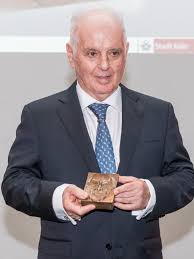
Daniel Barenboim, born on November 15, 1942, in Buenos Aires, Argentina, is a world-renowned pianist and conductor. His illustrious career spans over seven decades, marked by his exceptional musical talent and his commitment to using music as a bridge for peace and understanding. Born to Jewish parents of Russian descent, Barenboim’s journey from a prodigious young pianist to a celebrated conductor and peace advocate is both inspiring and significant.
Early Life and Musical Beginnings
Daniel Barenboim began his piano studies at the tender age of five with his mother and continued with his father, who remained his primary teacher. His prodigious talent was evident early on, and by the age of seven, he made his official concert debut in Buenos Aires in August 1950.
In 1952, his family moved to Israel, where Barenboim’s musical education and career continued to flourish. Two years later, in the summer of 1954, his parents took him to Salzburg to participate in master classes conducted by Igor Markevitch. During this period, he also had the opportunity to meet and perform for the legendary conductor Wilhelm Furtwängler, who famously remarked, “At eleven years old, Barenboim is a phenomenon.” This endorsement opened many doors for the young musician.
Early Career and International Recognition
In 1955, Barenboim studied harmony and composition with Nadia Boulanger in Paris. His early career was marked by a series of successful debuts: Vienna and Rome in 1952, Paris in 1955, London in 1956, and New York in 1957 with Leopold Stokowski and the Symphony of the Air. By the late 1950s, Barenboim had established himself as one of the most versatile pianists of his generation, performing regularly across Europe, the United States, and Australia.
Barenboim’s recording career began in 1954 and quickly expanded to include major works from the piano repertoire, such as the complete piano sonatas of Mozart and Beethoven. His deep musicality and technical prowess garnered widespread acclaim and solidified his reputation as a leading pianist.
Transition to Conducting
In addition to his success as a pianist, Barenboim began to explore conducting. His close relationship with the English Chamber Orchestra began in 1965 and lasted over a decade. He made his conducting debut with the New Philharmonia Orchestra of London in 1967 and went on to work with major symphony orchestras across Europe and the United States.
From 1975 to 1989, Barenboim served as the Music Director of the Orchestre de Paris. His operatic debut came in 1973 with a performance of Mozart’s “Don Giovanni” at the Edinburgh International Festival. In 1981, he made his debut at the Bayreuth Festival, conducting Wagner’s “Tristan und Isolde,” the Ring Cycle, “Parsifal,” and “Die Meistersinger.”
Leadership Roles and Achievements
Barenboim’s leadership roles have been numerous and impactful. In 1991, he succeeded Sir Georg Solti as Music Director of the Chicago Symphony Orchestra, a position he held for 15 years. Under his direction, the orchestra achieved numerous successes and toured extensively. Upon the conclusion of his tenure in 2006, he was named “Honorary Conductor for Life.”
In 1992, Barenboim became the General Music Director of the Deutsche Staatsoper Berlin (Berlin State Opera). In the fall of 2000, the Staatskapelle Berlin appointed him as its Principal Conductor for Life. His work with the Staatskapelle Berlin has been highly acclaimed, and he continues to appear as a guest conductor with the Berlin Philharmonic and the Vienna Philharmonic Orchestra.
In 2006, Barenboim was appointed Maestro Scaligero at the Teatro alla Scala in Milan, where he directed the acclaimed production of “Tristan und Isolde” in December 2007.
Advocacy and the West-Eastern Divan Orchestra
Beyond his musical achievements, Daniel Barenboim is known for his efforts to promote peace and understanding through music. In the early 1990s, a chance meeting with Palestinian-American scholar Edward Said in a London hotel lobby led to a profound friendship and collaboration. Despite their differing backgrounds, Barenboim and Said discovered a shared vision for peaceful coexistence between Israelis and Palestinians.
In February 1999, Barenboim organized a concert in the West Bank, a piano recital at Birzeit University. He also established a workshop in Germany for young musicians from the Middle East, leading to the formation of the West-Eastern Divan Orchestra in August 1999. This orchestra brought together talented young musicians from Egypt, Syria, Lebanon, Jordan, Tunisia, and Israel, aiming to foster dialogue and understanding through music.
The West-Eastern Divan Orchestra has since performed worldwide, including at the Carnegie Hall and the United Nations, promoting the message of peace and coexistence. The project has continued even after Said’s death in 2003, supported by the Barenboim-Said Foundation, which promotes music education and cooperation among young Arabs and Israelis.
Educational Initiatives
Barenboim is deeply committed to music education. In 2004, he founded a music school in Ramallah, and in 2005, he established another in Berlin. Through the Barenboim Foundation, he has inspired the creation of a music education project in the Middle East and an academy for orchestral studies in Seville.
Both foundations support music education in the West Bank and Nazareth. On March 28, 2008, Barenboim held a special concert in Jerusalem with young Israeli and Palestinian musicians to mark the 60th anniversary of the state of Israel.
Awards and Recognitions
Daniel Barenboim’s contributions to music and peace have earned him numerous awards and recognitions from around the world. These include the Order of Merit of Germany, the Knight Grand Cross of the Italian Republic, the Legion of Honour in France, the Prince of Asturias Award, the Wolf Prize in Arts, the Goethe Medal, the Praemium Imperiale, the Gold Medal of the Royal Philharmonic Society, the International Service Award for the Global Defence of Human Rights, and the Westphalian Peace Prize.
Personal Life and Legacy
Barenboim’s personal life has been closely intertwined with his musical career. He was married to the renowned British cellist Jacqueline du Pré, whose career was tragically cut short by multiple sclerosis. After her death, Barenboim married Russian pianist Elena Bashkirova, with whom he has two sons, David and Michael.
Daniel Barenboim’s legacy extends far beyond his musical achievements. He is a symbol of the power of music to transcend cultural and political barriers, and his work has demonstrated the potential for art to foster understanding and peace. His commitment to music education and his efforts to bridge divides through the West-Eastern Divan Orchestra stand as enduring testaments to his vision and dedication.
Conclusion
Daniel Barenboim’s life and career are a testament to his extraordinary talent, dedication, and vision. From his early days as a prodigious pianist to his roles as a conductor, educator, and advocate for peace, Barenboim has made a significant impact on the world of music and beyond. His contributions to cultural diplomacy and his efforts to promote dialogue and understanding through music have left an indelible mark on the global stage.
As Barenboim continues to inspire and influence future generations of musicians and peace advocates, his legacy remains a powerful reminder of the transformative power of music. His story is one of artistic excellence, cultural bridging, and unwavering commitment to the ideals of harmony and understanding.


