
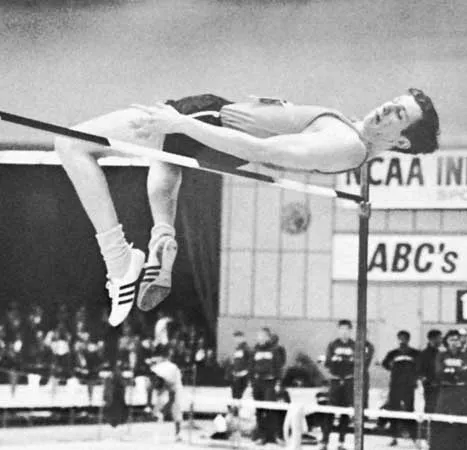
Richard Douglas “Dick” Fosbury, born on March 6, 1947, in Portland, Oregon, revolutionized the sport of high jumping with his innovative technique known as the “Fosbury Flop.” His name is synonymous with the modern high jump, and his legacy is deeply embedded in the history of athletics. Fosbury’s method, introduced to the world during the 1968 Olympics, transformed the sport, challenging existing conventions and paving the way for future generations of high jumpers.
Early Life and Athletic Beginnings
Dick Fosbury’s early years were typical of many American children of his generation. Growing up in Portland, he displayed a keen interest in sports from a young age. His athletic journey began in earnest during his high school years at Medford High School in Oregon. Fosbury initially struggled with traditional high jump techniques, which at the time predominantly included the straddle and scissors methods. Despite these challenges, Fosbury’s passion for the sport remained undiminished.
It was during his time at Medford High that Fosbury began experimenting with alternative techniques. Frustrated by his lack of progress with the conventional methods, he started to explore a new way of clearing the bar. This exploration eventually led to the development of what would later become known as the Fosbury Flop. This technique involved approaching the bar at an angle, rotating his body mid-air, and arching his back to clear the bar while landing on his back. While initially met with skepticism, Fosbury’s persistence and innovation would soon pay off.
The Birth of the Fosbury Flop
The genesis of the Fosbury Flop is rooted in Fosbury’s dissatisfaction with the existing high jump techniques and his desire to improve his performance. During his teenage years, Fosbury’s experimentation with different approaches led him to develop a technique that was not only unique but also highly effective. By the time he entered Oregon State University, where he studied civil engineering, Fosbury had begun to refine this technique under the guidance of his coach, Berny Wagner.
The key innovation of the Fosbury Flop lay in its biomechanical efficiency. Unlike the straddle technique, which required a great deal of upper body strength and flexibility, the Fosbury Flop relied on a combination of speed, momentum, and body positioning. By approaching the bar at a curve, Fosbury was able to generate greater centrifugal force, which allowed him to clear the bar with less effort. His body’s backward arching motion kept his center of mass below the bar, even as his body cleared it, which was a revolutionary concept in high jumping.
1968 Olympics: A Historic Moment
The 1968 Summer Olympics in Mexico City marked a pivotal moment in Dick Fosbury’s life and in the history of athletics. On October 20, 1968, Fosbury introduced the world to his revolutionary high jump technique. Competing against some of the best athletes in the world, Fosbury’s unconventional style immediately drew attention. Spectators and commentators were initially perplexed by his method, but as the competition progressed, it became clear that Fosbury was onto something extraordinary.
In a performance that would go down in history, Fosbury won the gold medal with a jump of 2.24 meters (7 feet 4.25 inches), setting an Olympic record in the process. His success was not just a personal triumph but a watershed moment for the sport of high jumping. The Fosbury Flop was no longer a curiosity; it was the future of the sport.
The Fosbury Flop’s Impact on High Jumping
The introduction of the Fosbury Flop at the 1968 Olympics marked a paradigm shift in the world of high jumping. Before Fosbury’s innovation, the straddle technique was the dominant method used by high jumpers. However, Fosbury’s success demonstrated the effectiveness of his technique, and within a few years, the Fosbury Flop became the standard technique for high jumpers worldwide.
The impact of the Fosbury Flop extended beyond just the technique itself. It also influenced the design of high jump equipment and facilities. The technique’s reliance on a backward landing necessitated the development of softer, more cushioned landing pads, replacing the wood chips or sand pits that were previously used. This change not only made the sport safer but also allowed athletes to push the limits of what was possible, leading to new records and higher jumps.
Recognition and Legacy
Dick Fosbury’s contribution to the sport of athletics was recognized long before his retirement. In 1981, he was inducted into the National Track & Field Hall of Fame, a testament to the lasting impact of his innovation. Fosbury’s influence on the sport is undeniable; his technique is now universally adopted, and his name is forever etched in the annals of sports history.
Beyond his athletic achievements, Fosbury’s legacy is also one of innovation and creativity. His willingness to challenge the status quo and think outside the box serves as an inspiration not just to athletes, but to anyone striving for excellence in their field. Fosbury’s story is a reminder that great achievements often come from those who dare to be different.
Later Life and Death
After his Olympic triumph, Dick Fosbury continued to be involved in athletics, though he never again competed at the same level. He graduated from Oregon State University with a degree in civil engineering and went on to have a successful career in that field. Fosbury also remained a prominent figure in the world of athletics, often serving as a motivational speaker and advocate for sports.
Fosbury’s later years were marked by his continued involvement in the Olympic community. He served as vice president of the United States Olympians and Paralympians Association and was a vocal supporter of athlete welfare and the promotion of sportsmanship. His life and career were a testament to the power of perseverance and the impact that one individual can have on a sport.
Dick Fosbury passed away on March 12, 2023, at the age of 76, in his hometown of Portland, Oregon. His death was met with an outpouring of tributes from the athletics community and beyond, as people around the world reflected on the lasting legacy of a man who changed the face of high jumping forever.
The Nuances of Fosbury’s Innovation
While the Fosbury Flop is widely recognized as a revolutionary technique, it’s important to understand the nuances that made it so effective. Fosbury’s innovation was not just in the way he cleared the bar but also in his understanding of the physics and biomechanics involved in the high jump. His technique made optimal use of centrifugal force generated by his curved approach, which allowed for a more efficient transfer of energy from the run-up to the jump.
Moreover, the Fosbury Flop required a significant shift in the athlete’s mental approach to the high jump. Traditional techniques focused on clearing the bar with the chest or stomach facing downwards, which required a different set of physical and mental skills. The Fosbury Flop, by contrast, emphasized speed, agility, and precision, with the athlete’s back facing the bar at the peak of the jump. This shift not only required a change in technique but also in the way athletes trained and prepared for competition.
Historical Context and Legacy
The Fosbury Flop emerged during a period of significant change in the world of sports. The 1960s were a time of experimentation and innovation, as athletes and coaches sought new ways to push the limits of human performance. Fosbury’s technique was a product of this environment, where traditional methods were being questioned and new approaches were being tested.
In the decades since Fosbury’s historic jump, the Fosbury Flop has become the standard technique in high jumping. Almost all elite high jumpers today use the technique, and it has been instrumental in the breaking of numerous world records. Fosbury’s legacy is not just in the technique itself but in the mindset of innovation and creativity that it represents. His story is a powerful reminder that progress often comes from those who dare to challenge the conventional wisdom.
Conclusion
Dick Fosbury was more than just a high jumper; he was an innovator who changed the course of athletic history. His development of the Fosbury Flop revolutionized the sport of high jumping and left a lasting impact on the world of athletics. Fosbury’s legacy is one of creativity, perseverance, and a willingness to think differently. His life and achievements serve as an inspiration to athletes and innovators everywhere, reminding us that the greatest breakthroughs often come from those who are willing to take risks and challenge the status quo.
Fosbury’s story is a testament to the power of innovation in sports and beyond. His name will forever be associated with the high jump, but his legacy extends far beyond that. Dick Fosbury showed the world that sometimes, the best way to move forward is to turn things upside down.


