
Dino Buzzati, born on October 16, 1906, in San Pellegrino, near Belluno, Italy, remains one of the most influential Italian writers of the 20th century. His life was marked by a profound exploration of surrealism, allegory, and the existential concerns that permeate human life. This article delves into Buzzati’s age, the height of his fame, and the significant highlights of his life that contributed to his enduring legacy in the literary world.
Early Life and Influences
Dino Buzzati grew up in a family that valued intellectual pursuits. His father, a professor of international law, passed away when Dino was just 14 years old, an event that profoundly impacted him and instilled a lifelong fear of dying young from the same illness—pancreatic cancer. This early encounter with mortality deeply influenced his writing, often infusing it with themes of existential dread and the inexorable passage of time.
From a young age, Buzzati exhibited a strong interest in various artistic disciplines, including music, drawing, and writing. He studied the violin and piano, which later influenced his literary works, including the librettos he composed for operas. His love for the mountains, stemming from his childhood in the Dolomites, inspired his first novel, “Barnabo delle montagne” (1933), which, like much of his work, intertwines the natural world with a sense of mystery and foreboding.
Career Beginnings: Journalism and Early Novels
Buzzati’s professional career began in 1928 when he joined the editorial staff of the prestigious Italian newspaper Corriere della Sera. Initially, he worked as an apprentice, but his talent quickly became apparent, and he rose through the ranks to become one of the paper’s leading journalists. His experience as a journalist, particularly as a war correspondent during World War II, profoundly influenced his narrative style, blending factual reporting with a unique blend of surrealism and fantasy.
In 1935, Buzzati published his second novel, “Il segreto del Bosco Vecchio” (The Secret of the Old Wood), which, unlike his debut, received little attention at the time. However, it showcased many of the themes that would define his later works, such as the tension between reality and imagination, the passage of time, and the inevitable decay of all things.
The Masterpiece: “The Tartar Steppe”
The turning point in Buzzati’s career came in 1940 with the publication of his most famous work, Il deserto dei Tartari (The Tartar Steppe). This novel tells the story of Giovanni Drogo, a young soldier stationed at a remote fortress on the edge of a vast desert, awaiting a battle that may never come. The novel is a profound allegory of the human condition, exploring themes of isolation, the passage of time, and the futility of waiting for a purpose or meaning that remains elusive.
The Tartar Steppe was an instant success, solidifying Buzzati’s reputation as one of Italy’s leading literary figures. The novel has since been translated into numerous languages and remains a staple in the study of 20th-century European literature. Its themes resonate with readers worldwide, capturing the universal experience of waiting for something that may never happen, a metaphor for the human condition that transcends time and culture.
Buzzati’s Artistic Ventures and Later Works
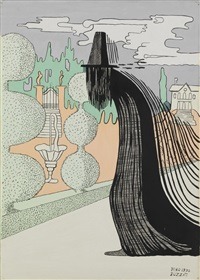
In addition to his writing, Buzzati was also an accomplished painter and illustrator. His artwork, much like his literary work, was characterized by a surrealist style that often depicted fantastical and dreamlike scenarios. This visual aspect of his creativity was most notably displayed in his 1971 work I miracoli di Val Morel (The Miracles of Val Morel), a collection of paintings accompanied by short, whimsical stories that blend the mystical with the mundane.
Buzzati’s later literary works continued to explore the themes of existential anxiety and the surreal. Notable among these is Un amore (A Love) published in 1963, which is a departure from his earlier works in its exploration of eroticism and obsessive love, set against the backdrop of a rapidly modernizing Milan. This novel provided a more intimate, though equally disquieting, examination of human emotions and relationships.
The Final Years: Recognition and Legacy
Despite his success, Buzzati’s later years were marked by declining health, echoing the fears that had haunted him since his father’s death. In 1971, he began experiencing symptoms of the same illness that had claimed his father’s life—pancreatic cancer. Despite his illness, Buzzati remained active, continuing to write, paint, and contribute to Corriere della Sera until his final days.
Dino Buzzati passed away on January 28, 1972, leaving behind a rich legacy of literary and artistic works that continue to be studied and celebrated worldwide. His influence extends beyond literature; his works have inspired films, theatrical adaptations, and continue to resonate with audiences for their timeless exploration of the human condition.
Exploring Buzzati’s Themes: A Deeper Dive
Buzzati’s work is often associated with the existentialist movement, although he is perhaps more accurately described as a surrealist who was deeply concerned with the metaphysical aspects of existence. His narratives often blur the line between reality and fantasy, inviting readers to question the nature of existence itself. This is evident in The Tartar Steppe, where the anticipation of an event—a battle that never occurs—becomes a metaphor for the existential waiting that defines much of human life.
His stories frequently explore the absurdity of bureaucratic systems and the ways in which they dehumanize individuals, a theme that resonates in today’s world as much as it did in the mid-20th century. This critique of modernity is coupled with a deep sense of nostalgia for a lost past, as seen in works like Il segreto del Bosco Vecchio, where the ancient forest represents a world of magic and mystery that is slowly being eroded by the encroaching forces of rationality and progress.
Buzzati’s use of allegory and symbolism is another hallmark of his style. In The Tartar Steppe, the fortress becomes a symbol of the human condition—a place where people are trapped by their own hopes and fears, unable to escape the passage of time. Similarly, his short stories often use fantastical elements to explore deep psychological and philosophical themes, such as the fear of death, the search for meaning, and the inevitable decay of all things.
Buzzati’s Influence on Modern Literature and Culture
Buzzati’s work has had a lasting impact on both Italian and international literature. His blending of realism and fantasy has influenced a wide range of writers, from his contemporaries to modern authors who continue to explore the boundaries between the real and the surreal. His work is often compared to that of Franz Kafka, with whom he shares a similar preoccupation with the absurdity of existence and the bureaucratic forces that govern modern life.
In Italy, Buzzati is regarded as one of the most important literary figures of the 20th century, and his works are still widely read and studied. Internationally, his influence can be seen in the works of writers such as Gabriel García Márquez, who similarly blends magical realism with social commentary, and Haruki Murakami, whose surreal narratives often explore the same themes of alienation and existential dread that are central to Buzzati’s work.
Buzzati’s influence also extends to other forms of art. His visual works, particularly I miracoli di Val Morel, continue to be celebrated for their unique blend of humor, surrealism, and religious symbolism. His stories have been adapted into films, most notably the 1976 film adaptation of The Tartar Steppe, directed by Valerio Zurlini, which brought his work to an even wider audience.
Conclusion: The Enduring Legacy of Dino Buzzati
Dino Buzzati’s life and work offer a profound exploration of the human condition, blending the real and the surreal to create narratives that are as unsettling as they are insightful. His exploration of themes such as the passage of time, the inevitability of death, and the absurdity of modern life continues to resonate with readers and audiences around the world.
Buzzati’s legacy is not just that of a writer, but of an artist who used his talents in multiple disciplines to explore the deepest questions of existence. His work remains a testament to the power of literature and art to confront the most profound aspects of the human experience, making him a figure of enduring relevance in the world of letters.


