
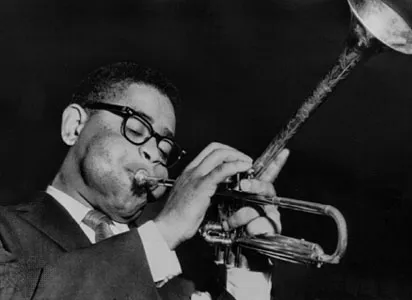
Dizzy Gillespie, born John Birks Gillespie on October 21, 1917, in Cheraw, South Carolina, was a towering figure in the world of jazz. His influence extended far beyond his remarkable trumpet skills; he was a pioneering force in the development of bebop and modern jazz. Gillespie’s life was marked by both struggle and triumph, as he rose from humble beginnings to become one of the most celebrated musicians of his time.
Early Life and Musical Beginnings
John Birks Gillespie, the youngest of nine children, had a childhood that was far from easy. His father, a strict man who often resorted to physical discipline, passed away when Dizzy was just ten years old. Despite these challenges, Gillespie discovered a passion for music at an early age. He began teaching himself to play the trumpet at the age of twelve, a journey that started almost as a playful experiment but soon became a lifelong pursuit.
Gillespie’s musical education was largely self-driven, though he did receive some formal training later on. He earned a scholarship to attend the Laurinburg Institute in North Carolina, a rare opportunity given his family’s financial struggles. However, Gillespie’s rebellious spirit led him to leave school in 1935, before completing his studies, as he sought to pursue a full-time career in music.
The Birth of Bebop: A Revolutionary Movement
By the late 1930s, Dizzy Gillespie had begun to make a name for himself in the jazz world. He joined several big bands, including those of Teddy Hill, Lucky Millinder, and the legendary Cab Calloway. It was during this period that Gillespie began to develop the unique style that would later come to define bebop, a revolutionary new form of jazz that emphasized fast tempos, complex chord progressions, and intricate melodies.
Gillespie’s collaborations with fellow musicians like Charlie Parker, Thelonious Monk, and Kenny Clarke at New York’s Minton’s Playhouse were pivotal in the creation of bebop. The late-night jam sessions at Minton’s became the breeding ground for this new style, which was characterized by its innovative and challenging approach to improvisation.
In 1943, Gillespie’s career took a significant turn when he joined Earl Hines’ orchestra. This period was crucial in his development as a musician and composer, as he worked closely with other rising stars of the bebop movement, including Charlie Parker. The influence of these collaborations was profound, as they helped to solidify Gillespie’s role as one of the key architects of bebop.
Dizzy Gillespie’s Unique Style and Influence
Dizzy Gillespie was not just a musician; he was a performer in every sense of the word. His energetic stage presence, combined with his technical prowess on the trumpet, made him a captivating figure in the jazz world. He was known for his distinctive trumpet, with its bell bent at a 45-degree angle, a result of a happy accident that Gillespie decided to embrace. This unique instrument, along with his trademark puffed cheeks while playing, became iconic symbols of his career.
Gillespie’s compositions, such as “Groovin’ High,” “Woody ‘n’ You,” “Anthropology,” “Salt Peanuts,” and the legendary “A Night in Tunisia,” are considered revolutionary works that pushed the boundaries of jazz. These pieces showcased his ability to blend traditional jazz elements with new, innovative techniques, creating a sound that was both fresh and deeply rooted in the jazz tradition.
Bebop and Cultural Impact
The bebop movement, of which Gillespie was a central figure, was more than just a musical innovation; it was a cultural phenomenon. Bebop represented a shift in the African American community, as black musicians began to reclaim jazz as a form of cultural expression. This period saw a movement away from the more commercialized swing music, which had been popularized by predominantly white bands, towards a more complex and intellectually demanding style that emphasized individual expression and creativity.
Gillespie’s work in the 1940s and 1950s played a significant role in this cultural shift. His embrace of bebop was not just about creating a new sound but also about asserting the importance of African American contributions to the evolution of jazz. His leadership in this movement helped to inspire a generation of musicians and established bebop as a cornerstone of modern jazz.
The Big Band Era and Beyond
While Gillespie is often associated with smaller bebop ensembles, he also had a deep love for big bands. Throughout his career, he led several big bands, which allowed him to explore the full range of his musical ideas. These ensembles were often showcases for Gillespie’s skills as both a leader and a soloist, and they played a crucial role in popularizing bebop.
Gillespie’s big bands were known for their high-energy performances and innovative arrangements. However, the financial challenges of maintaining a big band in the post-World War II era were significant, and many of Gillespie’s ensembles were short-lived. Despite these difficulties, his work with big bands left an indelible mark on the jazz world and helped to bring bebop to a wider audience.
Afro-Cuban Jazz and Musical Innovation
In the late 1940s and early 1950s, Dizzy Gillespie began to explore new musical territories, incorporating elements of Afro-Cuban and Latin music into his work. This fusion of styles was groundbreaking and helped to lay the foundation for what would later become known as Latin jazz. Gillespie’s collaboration with Cuban percussionist Chano Pozo was particularly influential, leading to the creation of compositions like “Manteca” and “Tin Tin Deo,” which are now considered classics of the genre.
Gillespie’s interest in Afro-Cuban music was part of a broader trend in his career of constantly seeking out new influences and pushing the boundaries of jazz. His willingness to experiment and embrace new ideas was a defining characteristic of his work, and it helped to ensure that his music remained relevant and innovative throughout his career.
Later Years and Legacy
As Gillespie’s career progressed into the 1960s and beyond, he continued to be a major figure in the jazz world. In 1964, in a tongue-in-cheek move, he announced his candidacy for President of the United States, promising to rename the White House the “Blues House” and appoint jazz greats like Ray Charles, Miles Davis, and Malcolm X to key government positions. While the campaign was more of a publicity stunt than a serious political effort, it reflected Gillespie’s playful personality and his desire to bring attention to the importance of jazz in American culture.
In the 1970s, Gillespie published his autobiography, To Be, or Not to Bop, in which he reflected on his life and career, providing insights into the development of bebop and his role in the jazz world. He also continued to perform and record, leading the United Nations Orchestra in the 1980s, a group that brought together musicians from around the world and showcased Gillespie’s enduring commitment to musical innovation.
Dizzy Gillespie passed away on January 6, 1993, at the age of 75, after a battle with pancreatic cancer. His death marked the end of an era in jazz, but his legacy lives on through his recordings, compositions, and the countless musicians he inspired.
Conclusion: The Enduring Influence of Dizzy Gillespie
Dizzy Gillespie’s contributions to jazz are immeasurable. As a musician, composer, and bandleader, he played a pivotal role in the development of bebop and modern jazz. His willingness to experiment with new sounds and his ability to blend different musical traditions made him a true innovator. Gillespie’s influence extends beyond the world of jazz; he helped to shape the cultural landscape of the 20th century and left a lasting impact on the history of music.
Gillespie’s life story is one of perseverance, creativity, and a relentless pursuit of excellence. From his early days as a self-taught trumpet player to his status as one of the most celebrated figures in jazz, Dizzy Gillespie’s journey is a testament to the power of music to transform lives and bring people together. His work continues to inspire new generations of musicians, and his legacy as one of the giants of jazz is secure.


