
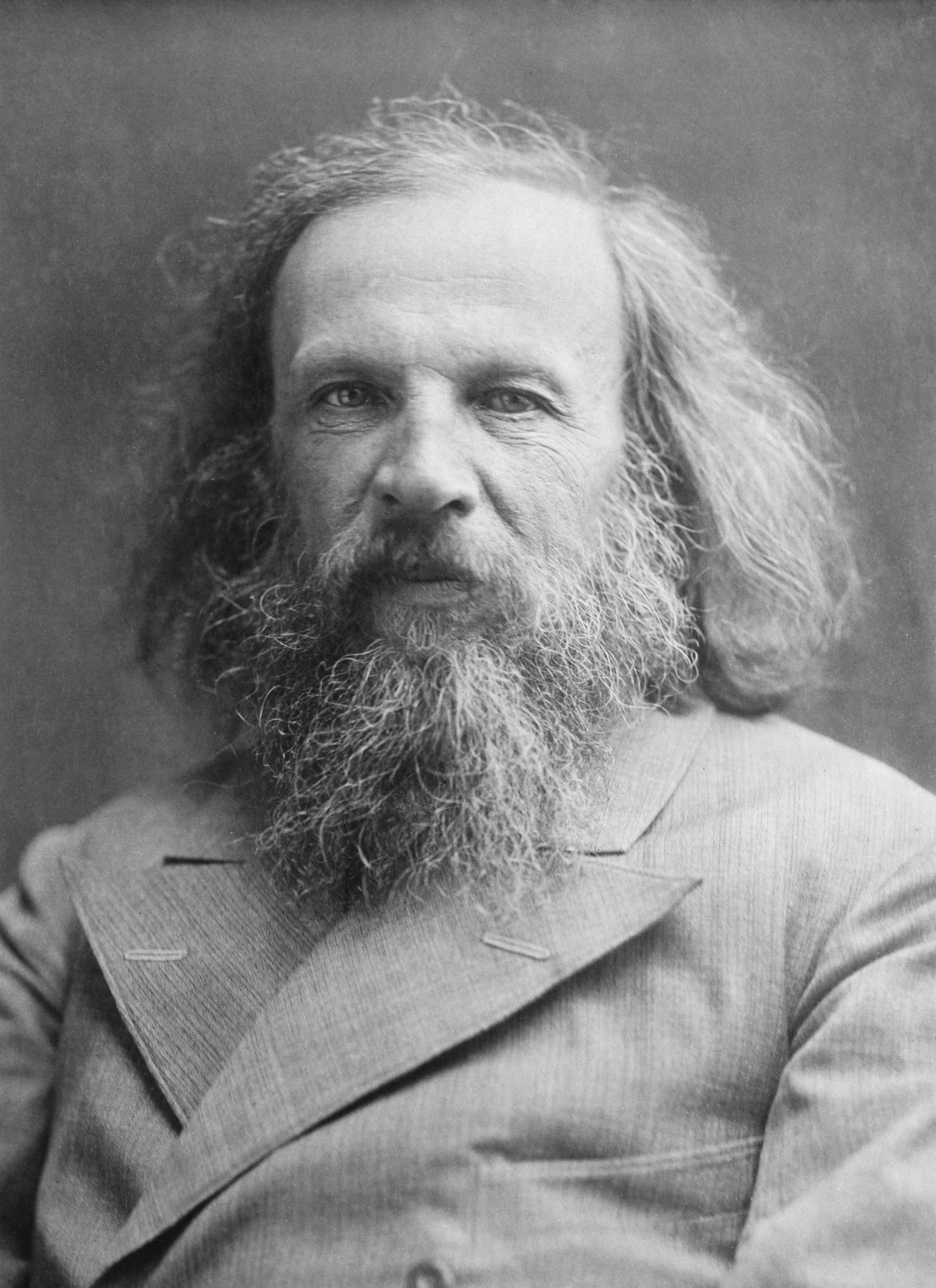
Dmitri Mendeleev, born on February 8, 1834, in Tobolsk, Siberia, is celebrated as one of the most pivotal figures in the history of science, primarily known for formulating the Periodic Table of Elements. His groundbreaking work in chemistry not only revolutionized the field but also laid the foundation for future discoveries in chemistry and related sciences. This comprehensive exploration delves into Mendeleev’s life, achievements, and enduring legacy.
Early Life and Education
Dmitri Ivanovich Mendeleev was born into a large family, the youngest of seventeen children. His early years were marked by hardship, including the death of his father and the consequent decline in the family’s economic status. Despite these challenges, Mendeleev’s mother supported his education, and he attended the Tobolsk Gymnasium.
In 1849, Mendeleev moved to St. Petersburg, where he enrolled at the Main Pedagogical Institute. His academic prowess was evident early on; he excelled in his studies, particularly in chemistry. Mendeleev’s passion for chemistry was further fueled by his exposure to the scientific community in St. Petersburg, setting the stage for his future innovations.
Academic and Professional Journey
Upon graduating in 1856, Mendeleev began his academic career as a teacher and researcher. His early work involved a significant focus on spectroscopy and the capillarity of liquids, which he studied during his time in Heidelberg. This period was instrumental in shaping his scientific approach, integrating experimental precision with theoretical analysis.
Mendeleev’s return to Russia marked the beginning of a notable academic career. He became a professor of chemistry at the University of St. Petersburg and the St. Petersburg Institute of Technology. During this time, Mendeleev’s research expanded into various areas of chemistry, and he contributed to the development of several important chemical theories.
The Creation of the Periodic Table
The pinnacle of Mendeleev’s career came with his development of the Periodic Table of Elements. In 1869, he presented his periodic table to the Russian Chemical Society. This revolutionary system arranged the 63 known elements according to their atomic weights, revealing a periodic pattern in their properties.
Mendeleev’s periodic table was groundbreaking for several reasons:
- Predictive Power: Mendeleev’s table was not merely a catalog of elements but a predictive tool. He left gaps in the table for elements that had not yet been discovered, accurately predicting the properties of elements such as gallium, germanium, and scandium. These elements were discovered later and confirmed his predictions.
- Periodic Law: Mendeleev’s periodic law stated that the properties of elements are a periodic function of their atomic weights. This principle provided a unifying framework for understanding the relationships between different elements and their compounds.
The Periodic Table of Elements became one of the most enduring symbols of chemistry, fundamentally transforming the study of the subject and providing a structured approach to chemical research.
Contributions Beyond the Periodic Table
While Mendeleev is best known for his work on the periodic table, his contributions to science extended far beyond this achievement:
- Alcohol and Water: Mendeleev conducted extensive research on the properties of alcohol and water, resulting in his work on the behavior of solutions and the development of methods to improve the quality of vodka.
- Petroleum Industry: Mendeleev played a significant role in the Russian petroleum industry. He supported the theory that petroleum and natural gas were formed from the decomposition of organic matter, which facilitated the development of Russia’s oil industry. His work led to the establishment of the first Russian refinery.
- Metric System: Mendeleev was an advocate for the adoption of the metric system in Russia, which was formally adopted in 1899. His efforts in standardizing measurements and weights had a lasting impact on scientific and industrial practices in Russia.
Challenges and Controversies
Mendeleev’s career was not without its challenges. His personal life and professional opinions often put him at odds with the Russian scientific establishment. His second marriage, which occurred shortly after his first divorce, led to social scandal and affected his professional relationships.
Moreover, Mendeleev’s liberal political views and his criticisms of the Russian government sometimes put him in conflict with the authorities. Despite these challenges, his scientific achievements earned him recognition and respect both in Russia and internationally.
Legacy and Honors
Dmitri Mendeleev’s legacy is reflected in the numerous honors and awards he received throughout his life. He was awarded the Davy Medal by the Royal Society of London in 1882 and the Copley Medal in 1905. These accolades recognized his profound contributions to science and his role in advancing chemical knowledge.
Mendeleev’s impact extends beyond his lifetime. The periodic table he developed remains a fundamental tool in chemistry, continuously used in education and research. His work laid the groundwork for future discoveries and inspired countless scientists to explore the complexities of chemical elements and their interactions.
Mendeleev passed away on February 2, 1907, in St. Petersburg, leaving behind a legacy that continues to influence the scientific community. His work exemplifies the intersection of theory and experimentation, illustrating how rigorous scientific inquiry can lead to transformative discoveries.
Conclusion
Dmitri Mendeleev’s contributions to science, particularly through his development of the Periodic Table of Elements, have cemented his place as a pivotal figure in the history of chemistry. His work not only revolutionized the field but also provided a lasting framework for understanding the elements and their properties.
Mendeleev’s life and achievements underscore the importance of scientific innovation and the enduring quest for knowledge. His legacy serves as a testament to the power of theoretical and experimental research in shaping our understanding of the natural world. As we reflect on his life, we are reminded of the profound impact that one individual’s contributions can have on the advancement of human knowledge and the betterment of society.


