
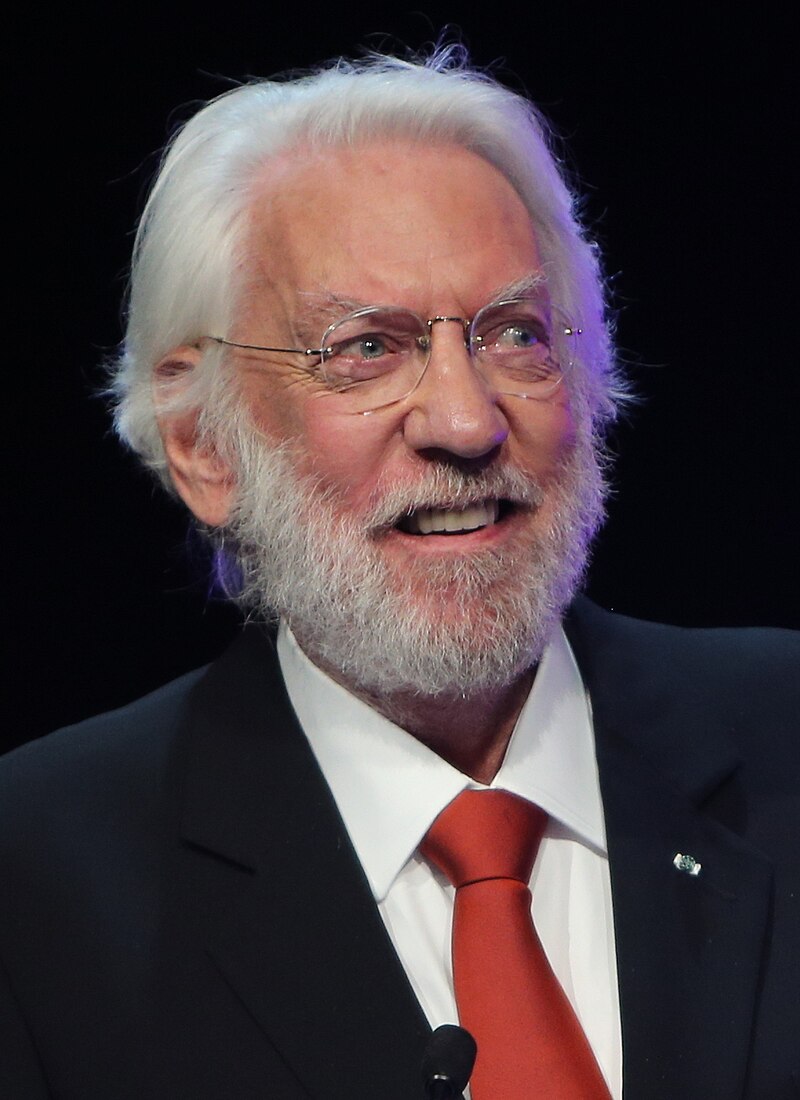
Donald Sutherland is a name that resonates with fans of cinema worldwide. With a career spanning over six decades, he has established himself as one of the most versatile and respected actors in Hollywood. Born on July 17, 1935, in Saint John, New Brunswick, Canada, Sutherland’s journey to stardom is as fascinating as the roles he has portrayed on screen. This article delves into the life, career, and impact of Donald Sutherland, exploring his rise to fame, his most notable performances, and the legacy he leaves behind.
Early Life and Education
Donald McNichol Sutherland was born into a middle-class family in the small town of Saint John. His early years were marked by a quiet upbringing in Bridgewater, Nova Scotia, where he spent much of his childhood. At just 14 years old, Sutherland began working as a deejay at a local radio station, a job that would plant the seeds for his future in the entertainment industry.
Despite his early interest in the arts, Sutherland initially pursued a degree in engineering at the University of Toronto. It was during his time at university that he discovered his passion for acting, leading him to abandon his engineering studies in favor of the stage. He attempted to enroll at the prestigious London Academy of Music and Dramatic Art, but his application was unsuccessful. Undeterred, Sutherland continued to pursue his dream, taking on various roles in theater productions across Canada and eventually making his way to the silver screen.
Breakthrough and Rise to Fame
Sutherland’s film debut came in 1964 with the Italian horror film Il castello dei morti vivi (Castle of the Living Dead). While the film did not make waves internationally, it marked the beginning of Sutherland’s long and illustrious career. Two years later, he gained wider recognition for his role as Vernon L. Pinkley in the war film The Dirty Dozen (1967), directed by Robert Aldrich. This role was a turning point for Sutherland, showcasing his ability to play complex and often dark characters.
The 1970s proved to be a decade of significant growth for Sutherland. His performance as Hawkeye Pierce in Robert Altman’s MASH* (1970) catapulted him to international fame. The film, a dark comedy set during the Korean War, was both a critical and commercial success, earning Sutherland widespread acclaim for his portrayal of the sardonic yet compassionate army surgeon. This role cemented his reputation as an actor who could bring depth and nuance to any character he played.
Career Highlights and Iconic Roles
Throughout the 1970s and 1980s, Sutherland continued to take on a variety of challenging roles, further establishing himself as a versatile actor. In 1971, he starred alongside Jane Fonda in Alan J. Pakula’s Klute, a noir thriller that earned Fonda an Academy Award for Best Actress. Sutherland’s portrayal of John Klute, a private detective, was praised for its understated intensity and complexity.
Another notable role came in 1973 when Sutherland starred in Don’t Look Now, a psychological horror film directed by Nicolas Roeg. His performance as John Baxter, a grieving father tormented by visions of his deceased daughter, is often cited as one of his best. The film’s haunting atmosphere and Sutherland’s emotionally charged performance have made it a cult classic.
In 1976, Sutherland took on the role of the infamous lover Casanova in Federico Fellini’s Casanova. This was a significant departure from his previous roles, showcasing his ability to embody larger-than-life historical figures with the same ease as contemporary characters. The film, while polarizing at the time, has since been recognized as a masterpiece of Italian cinema, with Sutherland’s performance at its core.
The 1980s saw Sutherland continue to work with some of the most acclaimed directors of the time. He starred in Robert Redford’s Ordinary People (1980), a family drama that won the Academy Award for Best Picture. Sutherland’s portrayal of a grieving father struggling to connect with his surviving son was deeply moving, adding yet another layer to his already impressive filmography.
Later Career and Continued Success
As Sutherland entered the 1990s, he showed no signs of slowing down. He appeared in a variety of films, ranging from big-budget blockbusters to smaller, independent projects. One of his most memorable roles from this period was in Oliver Stone’s JFK (1991), where he played the mysterious informant “X.” His brief but impactful performance added to the film’s suspense and intrigue, demonstrating once again his ability to leave a lasting impression, even in smaller roles.
In the early 2000s, Sutherland continued to take on diverse roles, including a part in Clint Eastwood’s Space Cowboys (2000). This film, which also starred Tommy Lee Jones and James Garner, showcased Sutherland’s comedic timing and charm, proving that he could still hold his own in ensemble casts.
One of Sutherland’s most significant roles in recent years was in the Hunger Games series, where he portrayed the villainous President Snow. His chilling performance as the ruthless leader of Panem brought a new generation of fans to appreciate his work. Sutherland’s portrayal of Snow was both menacing and charismatic, making him one of the most memorable villains in recent film history.
Personal Life and Legacy
Donald Sutherland’s personal life has been as eventful as his career. He has been married three times, first to Lois Hardwick, then to Shirley Douglas, with whom he had twins, including actor Kiefer Sutherland. His third marriage was to actress Francine Racette, with whom he has three sons: Roeg, Rossif, and Angus.
Despite his many achievements, Sutherland has remained humble and grounded. He is known for his quiet activism, particularly his opposition to the Vietnam War, which he vocally protested during the height of his career. This commitment to social justice has been a constant throughout his life, influencing both his personal and professional choices.
Sutherland’s contributions to cinema have not gone unnoticed. In 2017, he was awarded an Honorary Academy Award for his lifetime achievement in film. This recognition was long overdue, as Sutherland’s body of work has left an indelible mark on the industry.
Conclusion
Donald Sutherland’s career is a testament to his talent, versatility, and dedication to his craft. From his early days as a struggling actor to his status as a Hollywood legend, Sutherland has continually pushed the boundaries of what it means to be a great actor. His performances have resonated with audiences across generations, and his influence on the industry is undeniable.
As of 2024, Sutherland’s legacy continues to grow, inspiring new actors and filmmakers to strive for excellence. His work serves as a reminder of the power of cinema to explore the depths of the human experience, and his life story is a beacon of perseverance and passion in the face of adversity. Donald Sutherland is not just an actor; he is an icon, and his contributions to film will be celebrated for years to come.


