
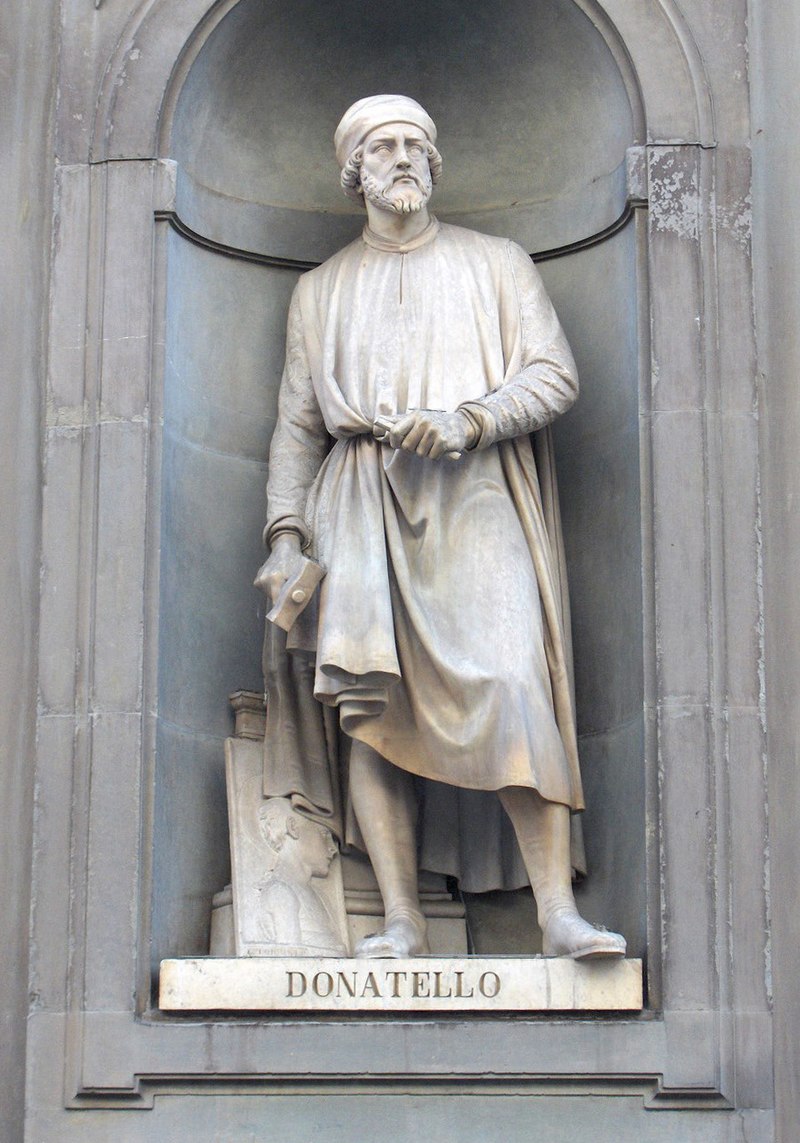
Donato di Niccolò di Betto Bardi, better known as Donatello, is one of the most revered figures in the history of art. Born in Florence in 1386, Donatello’s life and work are foundational to the Renaissance, an era that revolutionized art, culture, and human thought. As a sculptor, goldsmith, and draftsman, Donatello was instrumental in moving Western art away from the rigid and formulaic styles of the Gothic period, ushering in a new age of realism, humanism, and individual expression.
Early Life and Artistic Beginnings
Donatello was born into a modest family in Florence, a city that was the cradle of the Italian Renaissance. His early education remains somewhat mysterious, but it’s believed that he received training in the workshop of a local goldsmith, a common practice for young boys in Florence at the time. The skills he learned there would become the foundation of his later work in sculpture.
By 1403, Donatello had joined the workshop of Lorenzo Ghiberti, a prominent sculptor and goldsmith. Ghiberti was working on the first set of bronze doors for the Florence Baptistery, a project that would become one of the most famous artistic endeavors of the time. Donatello’s role in the workshop provided him with invaluable experience, allowing him to work on one of the most prestigious projects in Florence. It was during these early years that Donatello began to develop his unique style, characterized by a deep interest in human emotion and naturalism.
The Influence of Classical Antiquity
The early 15th century was a period of rediscovery in Italy, as artists and scholars turned to the classical world of Greece and Rome for inspiration. Donatello was no exception. Alongside his friend, the architect Filippo Brunelleschi, Donatello traveled to Rome in the early 1400s to study ancient ruins and classical sculptures. These trips were formative for Donatello, who was deeply influenced by the balance, harmony, and naturalism of classical art.
One of the earliest works that show this influence is his marble statue of David, created in 1409. While still retaining elements of Gothic stylization, this work marks Donatello’s move towards a more naturalistic style, with careful attention to the anatomy and posture of the figure. This early David was a precursor to his later, more famous bronze David, which would become a symbol of the Renaissance.
Innovations in Sculpture: The Introduction of Perspective and Emotion
Donatello’s work is renowned for its innovative use of perspective and emotional depth. These innovations are perhaps most evident in his statue of St. George, created for the Orsanmichele in Florence around 1416. St. George stands in a relaxed, contrapposto stance, a posture that was inspired by classical sculptures. The figure is infused with a sense of inner life and determination, qualities that were new to sculpture at the time.
At the base of the St. George statue, Donatello carved a relief depicting the saint’s battle with the dragon. This relief is one of the first examples of the technique known as “schiacciato” or “stiacciato,” a type of shallow relief that creates a powerful illusion of depth. By varying the depth of the carving by mere millimeters, Donatello was able to create a convincing three-dimensional space within the constraints of a flat surface. This technique would become a hallmark of his work and would influence generations of artists.
The Bronze David: A Masterpiece of Renaissance Art
Perhaps Donatello’s most famous work is his bronze statue of David, created in the early 1440s. This sculpture was revolutionary in several ways. Firstly, it was the first free-standing nude statue since antiquity, a bold statement that signaled a return to classical ideals. Unlike his earlier marble David, this bronze version is imbued with a new sense of vitality and sensuality.
David is depicted as a young, almost androgynous figure, standing over the severed head of Goliath. The sculpture is notable for its lifelike portrayal of the human form, with delicate attention to the details of David’s anatomy and posture. The work was commissioned by the powerful Medici family, who saw the youthful David as a symbol of civic virtue and Florentine strength.
The bronze David is also a reflection of Donatello’s deep understanding of classical art, combined with his innovative approach to form and narrative. The relaxed posture, the subtle play of light and shadow on the bronze surface, and the enigmatic expression on David’s face all contribute to the sculpture’s enduring power and mystery.
The Cantoria and the Expansion of Donatello’s Influence
In the 1430s, Donatello was commissioned to create a cantoria, or choir loft, for the Florence Cathedral. This work, known as the “Cantoria,” is a remarkable example of Donatello’s ability to blend classical inspiration with innovative design. The cantoria is adorned with a series of reliefs depicting playful putti, or cherubic figures, dancing and singing. These figures are full of movement and life, capturing the joy and energy of music.
The Cantoria was a significant project, as it demonstrated Donatello’s ability to work on a large scale and to create complex compositions that combined architecture and sculpture. The playful, dynamic nature of the reliefs contrasts with the more solemn and monumental works he had created earlier, showing the range and versatility of his talent.
The Gattamelata: An Icon of Equestrian Sculpture
In 1443, Donatello was invited to Padua to create a monument for the condottiero Erasmo da Narni, known as Gattamelata. The resulting work, the Equestrian Statue of Gattamelata, was completed in 1453 and stands as one of the greatest achievements of Renaissance sculpture. This bronze statue was the first large-scale equestrian monument created since the Roman Empire, and it set a new standard for public monuments.
The Gattamelata is a powerful depiction of the military leader, portrayed with stern dignity and control. The horse, equally important in the composition, is depicted in a calm yet commanding stance, with exquisite attention to detail in the anatomy and movement of the animal. The statue is both a tribute to classical equestrian statues and a forward-looking work that would influence the future of Western sculpture.
Donatello’s work on the Gattamelata had a profound impact on the development of Renaissance art. The statue became a model for subsequent equestrian monuments and established Donatello as a master of bronze sculpture. The Gattamelata is not just a portrait of a man; it is a statement of power, authority, and the human spirit’s potential.
Later Years and Continued Innovation
After completing the Gattamelata, Donatello returned to Florence in 1454. In his later years, he continued to work on a variety of projects, demonstrating an ongoing commitment to innovation and excellence. One of his last major works was the bronze group of Judith and Holofernes, created for the Medici family and now located in the Palazzo Vecchio.
The Judith and Holofernes statue is a dramatic and intense work, depicting the biblical heroine Judith as she beheads the Assyrian general Holofernes. The composition is striking for its dynamic movement and emotional intensity. Donatello’s ability to convey narrative and emotion through sculpture is fully realized in this work, which remains one of the most powerful examples of Renaissance art.
Legacy and Influence on Western Art
Donatello passed away on December 13, 1466, at the age of 80. His death marked the end of an era, but his influence on Western art has endured for centuries. Donatello’s work laid the groundwork for many of the developments in Renaissance art, particularly in sculpture. His innovative use of perspective, his exploration of human emotion, and his return to classical ideals set the stage for artists like Michelangelo, who would continue to push the boundaries of what sculpture could achieve.
Donatello’s legacy is not just found in his individual works, but in the way he transformed the possibilities of art. He was a pioneer who broke away from the constraints of Gothic art and helped to define the visual language of the Renaissance. His work remains a testament to the power of creativity, innovation, and the human spirit.
Today, Donatello is celebrated as one of the greatest sculptors of all time. His works are studied by art historians, admired by millions, and continue to inspire artists around the world. From the graceful lines of his St. George to the dramatic tension of his Judith and Holofernes, Donatello’s art captures the essence of the Renaissance—a period of rebirth, exploration, and profound change.
Conclusion
Donatello’s life and work are central to the story of the Renaissance. His ability to blend classical inspiration with innovative techniques made him a true master of his craft. From his early days in Florence to his later works in Padua and beyond, Donatello consistently pushed the boundaries of what was possible in sculpture. His influence can be seen in the works of countless artists who followed in his footsteps, making him one of the most important figures in the history of Western art.


