
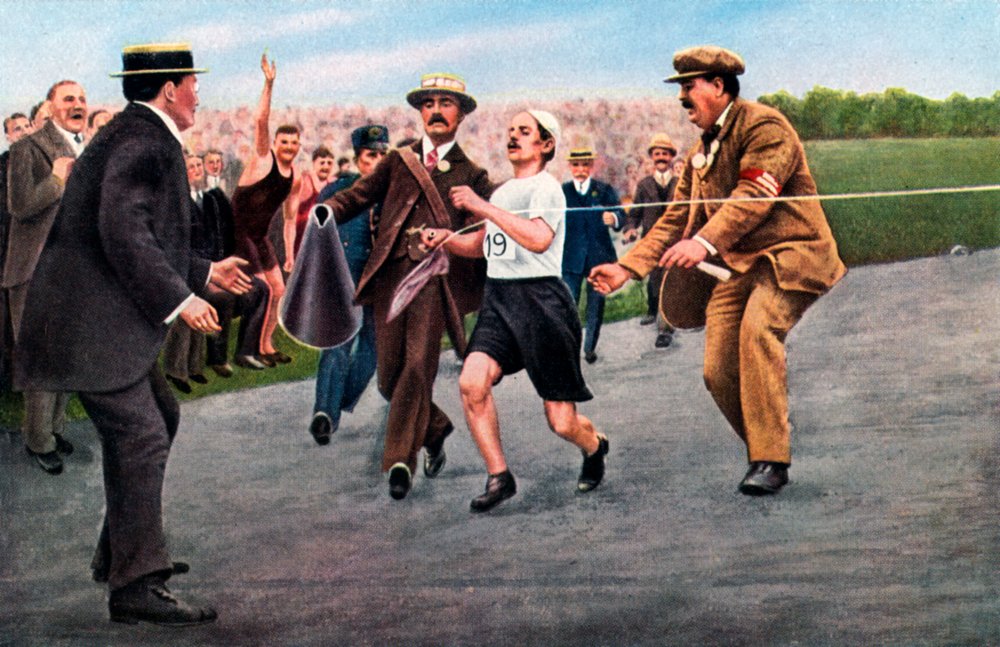
Dorando Pietri is a name that resonates with both triumph and heartbreak in the world of athletics. Born on October 16, 1885, in Mandrio, a small village in Italy, Pietri’s journey from a modest upbringing to global fame is a story of perseverance, determination, and the human spirit’s resilience. His legacy, immortalized by his dramatic finish at the 1908 London Olympics, has made him a symbol of athletic tenacity and a figure of enduring fascination. In this comprehensive exploration, we will delve into Dorando Pietri’s age, rise to fame, and key life highlights, offering insights into the historical context and the significance of his achievements.
Early Life and Background
Dorando Pietri was born into a humble family in Mandrio, a rural area near Correggio in the province of Reggio Emilia, Italy. He was the third of four children born to Desiderio Pietri and Teresa Incerti. In 1897, when Dorando was 12 years old, the family moved to Carpi, a nearby town where his father opened a fruit and vegetable shop.
Pietri’s early life was marked by the typical challenges of a working-class family in late 19th-century Italy. He began working at a young age, taking up a job as an apprentice at a local pastry shop. Despite his small stature—standing at just 5 feet 2 inches (159 cm)—Pietri was active and energetic, qualities that would serve him well in his future athletic endeavors.
The Start of a Running Career
Dorando Pietri’s entry into the world of athletics was almost serendipitous. In 1904, at the age of 19, he attended a local footrace in Carpi, where he was captivated by the performance of Pericle Pagliani, one of Italy’s leading runners at the time. Inspired, Pietri decided to follow Pagliani’s example, even joining the race despite wearing his work clothes. Remarkably, he managed to keep pace with the seasoned athlete, an early indication of his natural talent.
Soon after, Pietri officially entered his first competitive race—a 3,000-meter event in Bologna—where he finished second. This promising start encouraged him to pursue running more seriously. In 1905, Pietri began to achieve significant success, both domestically and internationally, culminating in a victory at the prestigious 30-kilometer race in Paris, where he finished a full six minutes ahead of the second-place runner.
Rise to National Prominence
By 1906, Dorando Pietri had established himself as one of Italy’s top distance runners. He won the marathon qualifying race for the Intercalated Games in Athens with a time of 2 hours and 48 minutes. Unfortunately, his performance in Athens was less successful; he was forced to withdraw from the race due to intestinal problems after leading at the 24-kilometer mark.
Pietri’s setback in Athens did not deter him. In 1907, he continued to dominate the Italian long-distance running scene, securing national titles in the 5,000 meters and 20 kilometers, the latter with a national record time of 16’27″2. By this time, Pietri had become a household name in Italy, recognized for his endurance and his ability to win across different distances, from middle-distance races to marathons.
The 1908 London Olympics: Triumph and Tragedy
The 1908 London Olympics were supposed to be the crowning achievement of Dorando Pietri’s career. He had trained rigorously for the event, and in July of that year, he won a 40-kilometer marathon in his hometown of Carpi, finishing in 2 hours and 38 minutes—a time that was unprecedented in Italy at the time. This victory earned him a spot on the Italian Olympic team, and Pietri entered the London Games with high hopes.
The Olympic marathon, held on July 24, 1908, was a historic event for several reasons. It was the first time the distance was standardized at 42.195 kilometers (26.2 miles), a length chosen to accommodate the British royal family, allowing the race to start at Windsor Castle and finish in front of the royal box at the Olympic Stadium.
The day of the marathon was unusually warm for England, and the conditions were challenging. Pietri, wearing the number 19 on his chest, started the race conservatively, staying near the back of the pack to conserve energy. As the race progressed, however, he began to move up through the field, eventually taking the lead at the 39-kilometer mark after the previous leader, South African Charles Hefferon, began to falter.
The Dramatic Finish
As Pietri entered the stadium, he was greeted by a crowd of over 75,000 spectators. However, the intense heat and the grueling pace had taken a severe toll on his body. Disoriented and exhausted, Pietri mistakenly turned in the wrong direction upon entering the stadium. The race officials redirected him, but it was clear that Pietri was in a dire state. He collapsed multiple times on the track, each time being helped to his feet by officials.
Despite his physical state, Pietri managed to cross the finish line, though he did so with assistance—a fact that would lead to his disqualification. His official time was 2 hours 54 minutes 46 seconds, but it took nearly 10 minutes for him to complete the final 500 meters of the race.
The American team, whose runner Johnny Hayes finished second, lodged an immediate protest, citing the assistance Pietri received as a violation of the rules. The protest was upheld, and Pietri was disqualified, handing the gold medal to Hayes. The decision was a bitter pill to swallow for Pietri, who had given everything he had in pursuit of Olympic glory.
Legacy and Recognition
Although Dorando Pietri did not win the Olympic gold medal, his heroic effort and the dramatic circumstances of his finish made him an international sensation. The British press, moved by his determination and the tragic outcome, rallied around Pietri. Queen Alexandra herself presented Pietri with a gilded silver cup as a consolation prize, a gesture that underscored the emotional impact of his performance.
The story of Pietri’s marathon spread around the world, turning him into a global celebrity. In the United States, Pietri was welcomed as a hero and was offered a lucrative contract to compete in a series of exhibition races. On November 25, 1908, he faced Johnny Hayes in a rematch at Madison Square Garden in New York City. This time, Pietri emerged victorious, defeating Hayes in front of a crowd of 20,000 spectators, with another 10,000 waiting outside due to the venue being sold out. The rematch was a redemption of sorts for Pietri, who proved that he was capable of winning under the right circumstances.
Post-Olympic Career and Later Life
Dorando Pietri’s post-Olympic career was marked by continued success, particularly in the United States, where he won 17 out of 22 races during his 1908-1909 tour. His popularity in America was immense, and he became a symbol of determination and resilience, particularly among the Italian immigrant community.
Pietri returned to Italy in 1909 and continued to compete for several more years. He set his personal best in the marathon at 2 hours 38 minutes 48 seconds during a race in Buenos Aires in 1910. His final competitive race in Italy took place in 1911, where he easily won a 15-kilometer event in Parma.
After retiring from competitive running, Pietri attempted to transition to a career as a hotelier, investing his earnings in a hotel venture with his brother. Unfortunately, the business was not successful, and Pietri eventually moved to Sanremo, where he operated a garage. Despite the challenges he faced in his post-athletic career, Pietri remained a beloved figure in Italy and among the global athletic community.
Death and Legacy
Dorando Pietri passed away on February 7, 1942, at the age of 56, after suffering a heart attack. His death marked the end of a life that had been defined by extraordinary highs and lows, from the glory of his Olympic performance to the struggles of his later years.
Pietri’s legacy endures, not just as a runner who fell short of Olympic gold, but as a symbol of perseverance and the indomitable human spirit. His story has inspired countless athletes and has been immortalized in books, films, and even a song by composer Irving Berlin titled “Dorando.”
Conclusion
Dorando Pietri’s life is a testament to the power of determination and the impact of sports on global culture. Though he did not achieve the Olympic victory he sought, his dramatic finish in the 1908 London marathon left an indelible mark on the history of athletics. Pietri’s story continues to resonate as an example of how the journey, with all its trials and tribulations, can be just as important as the destination. His legacy as an athlete who gave everything in pursuit of his dreams remains an enduring inspiration for generations to come.


