
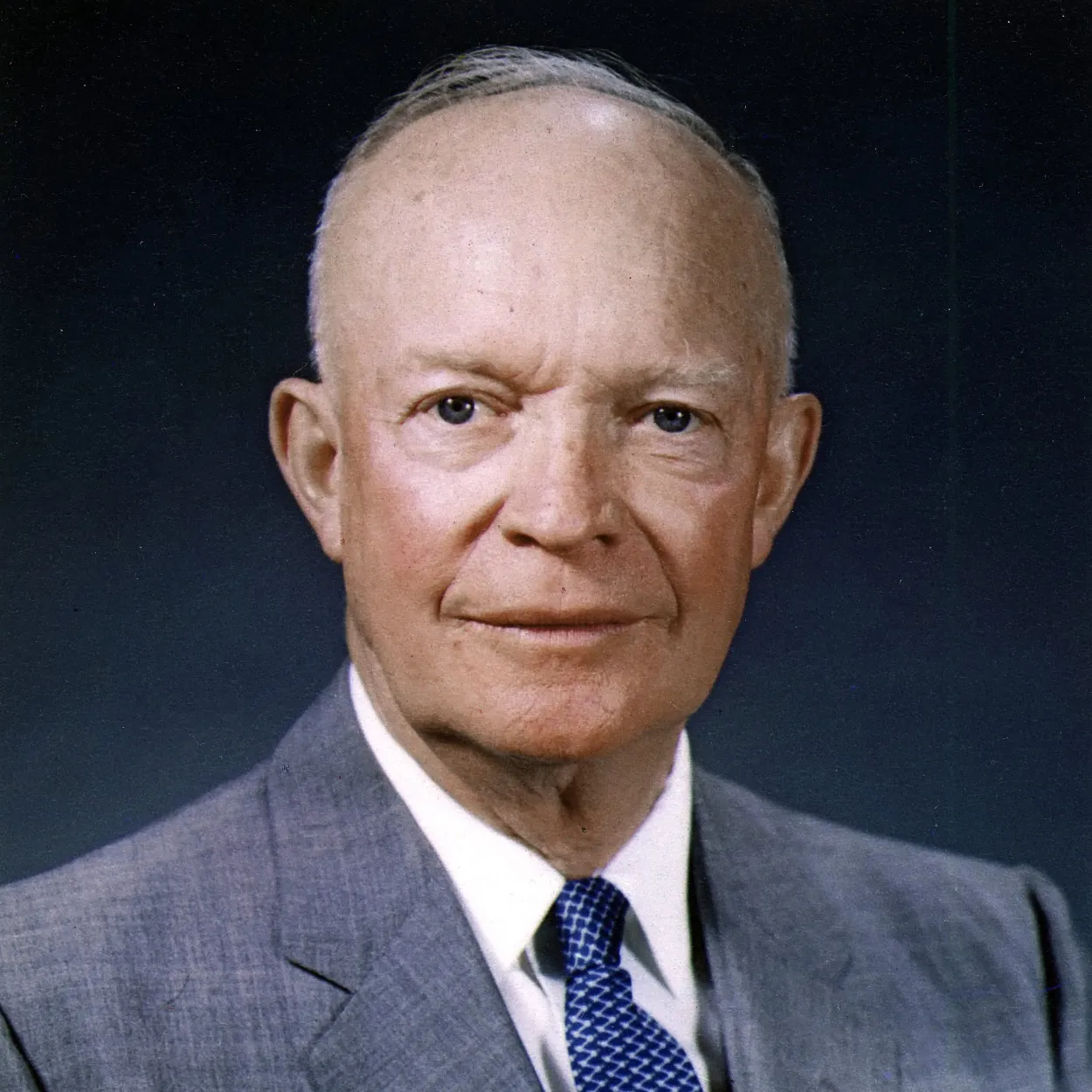
Dwight David Eisenhower, the 34th President of the United States, was a leader whose influence extended far beyond the White House. Born on October 14, 1890, in Denison, Texas, Eisenhower’s journey from a small-town boy in Kansas to a five-star general and two-term U.S. President is a testament to his strategic mind, military acumen, and diplomatic prowess. This article explores his life, tracing his rise to fame, his contributions during World War II, his presidency, and his lasting impact on American history.
Early Life and Education
Dwight Eisenhower, affectionately known as “Ike,” was the third of seven sons in a modest family. Raised in Abilene, Kansas, he was instilled with a strong sense of discipline and work ethic from an early age. His upbringing in the heartland of America profoundly shaped his values and approach to leadership. Despite financial constraints, Eisenhower excelled in academics and sports, particularly football, which earned him a place at the United States Military Academy at West Point.
At West Point, Eisenhower honed his leadership skills and graduated in 1915 as a second lieutenant. His early military career saw him stationed in various posts, where he quickly distinguished himself under the command of notable generals like John J. Pershing, Douglas MacArthur, and Walter Krueger. His marriage to Mamie Geneva Doud in 1916 marked the beginning of a partnership that would support him through the rigors of military and political life.
Military Career and World War II
Eisenhower’s military career took a decisive turn during World War II. After the attack on Pearl Harbor in 1941, General George Marshall recognized Eisenhower’s strategic brilliance and called him to Washington to work on war plans. This was the beginning of Eisenhower’s ascent to global prominence.
In November 1942, Eisenhower was appointed Supreme Commander of the Allied Expeditionary Force in North Africa, leading Operation Torch. His success in North Africa set the stage for his most famous military achievement: the D-Day invasion of Normandy on June 6, 1944. As the Supreme Allied Commander in Europe, Eisenhower orchestrated the largest amphibious military assault in history, which played a critical role in the defeat of Nazi Germany.
Eisenhower’s leadership during World War II was characterized by his ability to manage complex coalitions, his calm demeanor under pressure, and his commitment to the principles of democracy and freedom. His wartime experiences solidified his reputation as a strategic thinker and a leader of immense integrity.
Presidency: Domestic and Foreign Policy
Eisenhower’s popularity as a war hero made him a natural candidate for the presidency. In 1952, he was persuaded by the Republican Party to run for office, and his campaign slogan, “I Like Ike,” resonated with millions of Americans. Eisenhower won the election by a landslide, defeating Democrat Adlai Stevenson, and took office as President in 1953.
Eisenhower’s presidency was marked by a moderate approach to domestic policy. He maintained many of the New Deal and Fair Deal programs initiated by his predecessors, focusing on balancing the federal budget and promoting economic stability. One of his significant domestic achievements was the signing of the Federal-Aid Highway Act of 1956, which led to the creation of the Interstate Highway System, revolutionizing transportation in the United States.
On civil rights, Eisenhower’s record was mixed but noteworthy. He ordered the desegregation of schools following the Supreme Court’s decision in Brown v. Board of Education and sent federal troops to Little Rock, Arkansas, to enforce the integration of Central High School. Additionally, he ordered the desegregation of the armed forces, reinforcing his commitment to civil rights.
In foreign policy, Eisenhower’s presidency was dominated by the Cold War. He sought to contain the spread of communism through a policy of deterrence, epitomized by the doctrine of “massive retaliation,” which threatened overwhelming nuclear force in response to any Soviet aggression. Eisenhower also played a key role in negotiating the Korean Armistice Agreement in 1953, which ended active combat in the Korean War.
Eisenhower’s foreign policy was not without its challenges. The Soviet Union’s successful test of the hydrogen bomb in 1953 and the subsequent arms race created a tense international environment. Eisenhower’s efforts to ease Cold War tensions included the “Open Skies” proposal at the Geneva Summit in 1955, which called for mutual aerial surveillance between the U.S. and the Soviet Union to prevent surprise attacks. Although the proposal was rejected by the Soviets, it demonstrated Eisenhower’s commitment to transparency and peace.
Health Challenges and Second Term
Eisenhower’s presidency was not without personal trials. In September 1955, while on vacation in Denver, Colorado, Eisenhower suffered a heart attack. This health crisis raised concerns about his ability to serve a second term. However, after a seven-week recovery period, Eisenhower returned to the White House, and his doctors declared him fit for duty. In 1956, he was re-elected by a wide margin, demonstrating the public’s continued confidence in his leadership.
During his second term, Eisenhower continued to navigate the complexities of the Cold War. His administration faced several significant events, including the Hungarian Revolution of 1956, the Suez Crisis, and the launch of Sputnik by the Soviet Union in 1957. The latter event spurred the United States to increase its investment in science and technology, leading to the creation of NASA in 1958.
Eisenhower also made strides in improving U.S.-Soviet relations. His efforts culminated in the 1959 Camp David talks with Soviet Premier Nikita Khrushchev, which temporarily eased tensions between the two superpowers. However, the U-2 incident in 1960, where an American spy plane was shot down over the Soviet Union, strained relations once again and cast a shadow over the final months of Eisenhower’s presidency.
Legacy and Post-Presidency
Eisenhower’s farewell address in January 1961 is one of his most enduring legacies. In this speech, he famously warned against the growing influence of the “military-industrial complex,” cautioning that the combination of a large military establishment and a powerful arms industry could threaten democratic governance. This address reflected Eisenhower’s deep concern for the future of American democracy and his belief in the importance of maintaining a balance between security and liberty.
After leaving office, Eisenhower retired to his farm in Gettysburg, Pennsylvania, where he remained active in public life, offering advice to his successors and writing his memoirs. He continued to be a respected figure in American politics and a symbol of strong, principled leadership.
Eisenhower passed away on March 28, 1969, in Washington, D.C., after a prolonged illness. His death marked the end of an era, but his contributions to the United States and the world continue to be remembered and honored. Eisenhower’s leadership during World War II and his presidency set the stage for America’s post-war prosperity and its role as a global superpower.
Conclusion
Dwight D. Eisenhower was a leader whose influence extended beyond his military achievements and presidency. His moderate approach to governance, his commitment to civil rights, and his efforts to maintain peace during the Cold War left an indelible mark on American history. Eisenhower’s legacy is that of a leader who guided the nation through some of its most challenging times with integrity, wisdom, and a deep commitment to the principles of democracy. His life story serves as a reminder of the power of leadership grounded in values and the importance of balancing strength with restraint in the pursuit of national and global security.


