
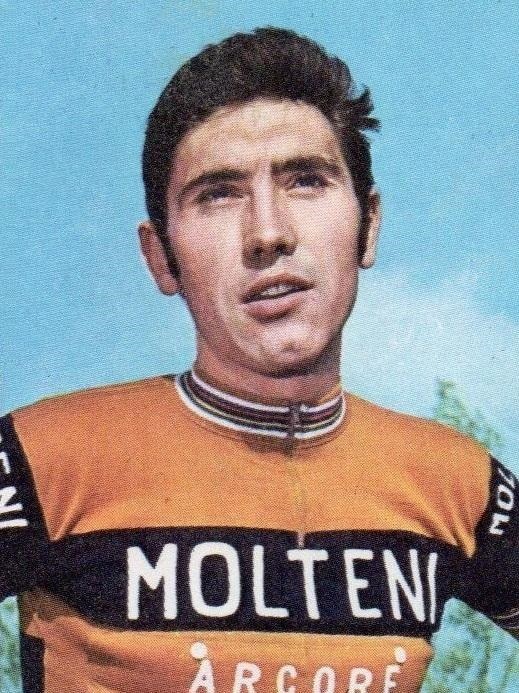
Eddy Merckx is a name that resonates with cycling enthusiasts and sports historians alike. Often hailed as the greatest cyclist of all time, Merckx’s career is marked by an unparalleled dominance in the sport. Born on June 17, 1945, in Meensel-Kiezegem, Belgium, Merckx’s journey from a small Belgian town to becoming a global sports icon is a tale of perseverance, exceptional talent, and relentless determination.
Early Life and Introduction to Cycling
Eddy Merckx was born into a modest family near Brussels, Belgium. From an early age, Merckx displayed a strong competitive spirit, which was evident in his early forays into cycling. His first race, which took place on July 16, 1961, marked the beginning of a career that would see him rise to the pinnacle of the sport. Just a year later, Merckx became the national champion in the novice category, a victory that was followed by 23 additional wins, allowing him to progress to higher levels of competition.
By 1964, Merckx had already begun to make a name for himself, winning the World Championship in the amateur category in Sallanches, France. This victory set the stage for his transition to professional cycling in 1965, where he quickly established himself as a formidable competitor. His professional debut was marked by an impressive four wins out of five races in the amateur category, signaling the arrival of a future legend in the sport.
The Rise of “The Cannibal” in the 1960s
Merckx’s professional career took off in the mid-1960s, with his first major victory coming in 1966 at the Milan-San Remo, one of cycling’s most prestigious races. This victory was the beginning of a series of triumphs that would see Merckx dominate the sport like no other. In 1967, Merckx won the Milan-San Remo again, followed by victories in other significant races such as the Ghent-Wevelgem and the Flèche Wallonne. His performance at the 1967 Giro d’Italia was particularly notable, with two stage wins, including a sprint victory at Lido degli Estensi and a mountain stage win on the Majella.
The crowning achievement of 1967 came when Merckx won the World Championship in Heerlen, marking his first world title as a professional cyclist. This victory solidified his reputation as a dominant force in the sport, a reputation that would only grow in the years to come.
Dominance in the Grand Tours: The 1968-1970 Era
The year 1968 marked a turning point in Merckx’s career as he began to assert his dominance in the Grand Tours. That year, he won his first Giro d’Italia, a race he would go on to win five times during his career. His victory was not just a win; it was a statement, as he led the race from start to finish, leaving his competitors in the dust.
The following year, Merckx continued his winning streak, securing victories in 43 races, including another Milan-San Remo, the Tour of Flanders, and the Liège-Bastogne-Liège. His performance at the 1969 Tour de France was nothing short of legendary. Merckx won the race with a margin of nearly 20 minutes over the second-place finisher, claiming six stage victories and winning all major classifications, including the points, mountain, and combination classifications. This incredible performance earned him the nickname “The Cannibal,” as he seemed to devour every competition he entered.
The Pinnacle of Success: The 1970s and Beyond
The early 1970s saw Merckx at the height of his powers. In 1970, he achieved a rare double by winning both the Giro d’Italia and the Tour de France in the same year, a feat he would repeat in 1972. His dominance in the Tour de France was particularly evident, as he won eight stages and led his team to victory in the team time trial. During this period, Merckx also won numerous other races, including the Paris-Roubaix, the Flèche Wallonne, and the Ghent-Wevelgem.
In 1971, Merckx added another world championship to his name, winning the title in Mendrisio, Switzerland. He also continued his dominance in the classics, winning the Milan-San Remo, the Liège-Bastogne-Liège, and the Giro di Lombardia, among others. His total of 54 victories in 1971 alone is a testament to his unparalleled skill and determination.
The year 1972 was another stellar year for Merckx, highlighted by his setting the world hour record in Mexico City, a record that stood for 12 years. This achievement, along with his victories in the Giro d’Italia, the Tour de France, and several other prestigious races, solidified his status as the greatest cyclist of all time.
The “Cannibal” at His Peak: 1973-1975
Even as he approached the latter stages of his career, Merckx continued to dominate the sport. In 1973, he won both the Vuelta a España and the Giro d’Italia, marking the first and only time he won the Spanish Grand Tour. His total of 51 victories that year included wins in the Amstel Gold Race, Paris-Roubaix, and Liège-Bastogne-Liège.
In 1974, Merckx once again demonstrated his superiority by winning the Giro d’Italia, the Tour de France, and the World Championship in Montreal, making him the first and only cyclist to achieve the “triple crown” of cycling in a single year. This remarkable achievement further cemented his legacy as the greatest cyclist of all time.
Despite facing increasing competition and the inevitable effects of aging, Merckx continued to perform at an elite level. In 1975, he won 38 races, including his sixth Milan-San Remo, his second Amstel Gold Race, and his fifth Liège-Bastogne-Liège. However, the signs of decline were beginning to show, and by 1976, Merckx had reduced his racing schedule, winning 15 races, including his record seventh Milan-San Remo.
Retirement and Legacy: The Greatest of All Time
Eddy Merckx retired from professional cycling in 1978, bringing an end to a career that saw him win 525 races out of 1,800, an astonishing 30% win rate over 17 years. His record includes five victories each in the Tour de France and Giro d’Italia, three World Championships, and numerous victories in the classics, making him the most successful cyclist in history.
Merckx’s dominance extended beyond road racing; he also excelled on the track, winning 98 races, including European and national championships, and 17 Six-Day races. His versatility as a cyclist was unmatched, with victories in sprints, mountain stages, time trials, and one-day classics. His relentless pursuit of victory and his ability to excel in all types of races earned him the nickname “The Cannibal,” as he seemed never to be satisfied with anything less than first place.
Merckx’s impact on cycling extends beyond his victories. His aggressive racing style, characterized by his willingness to attack at any moment, revolutionized the sport and set a new standard for future generations of cyclists. His rivalry with other great cyclists of his era, such as Felice Gimondi, Raymond Poulidor, and Luis Ocaña, elevated the sport to new heights and captivated audiences around the world.
Personal Life and Post-Retirement Ventures
Off the bike, Eddy Merckx is known for his humility, sportsmanship, and respect for his competitors. He married Claudine Acou, and the couple has two children, Sabrina and Axel. Axel Merckx followed in his father’s footsteps, becoming a professional cyclist and winning a bronze medal at the 2004 Athens Olympics.
In addition to his sporting achievements, Merckx has made significant contributions to the cycling industry. He founded a bicycle manufacturing company, Eddy Merckx Cycles, which produces high-end racing bikes known for their quality and performance. The company has become a respected name in the cycling world, further cementing Merckx’s legacy in the sport.
Conclusion: Eddy Merckx’s Enduring Legacy
Eddy Merckx’s career is a testament to the heights that can be achieved through talent, hard work, and an unrelenting drive to be the best. His records, many of which still stand today, are a reflection of his extraordinary abilities as a cyclist. But beyond the numbers, Merckx’s legacy lies in the way he changed the sport, setting a new standard for what it means to be a champion.
Merckx’s impact on cycling is immeasurable. He not only dominated the sport during his career but also inspired future generations of cyclists with his tenacity, versatility, and sportsmanship. As the greatest cyclist of all time, Eddy Merckx’s name will forever be synonymous with excellence in the world of sports.


