
Introduction
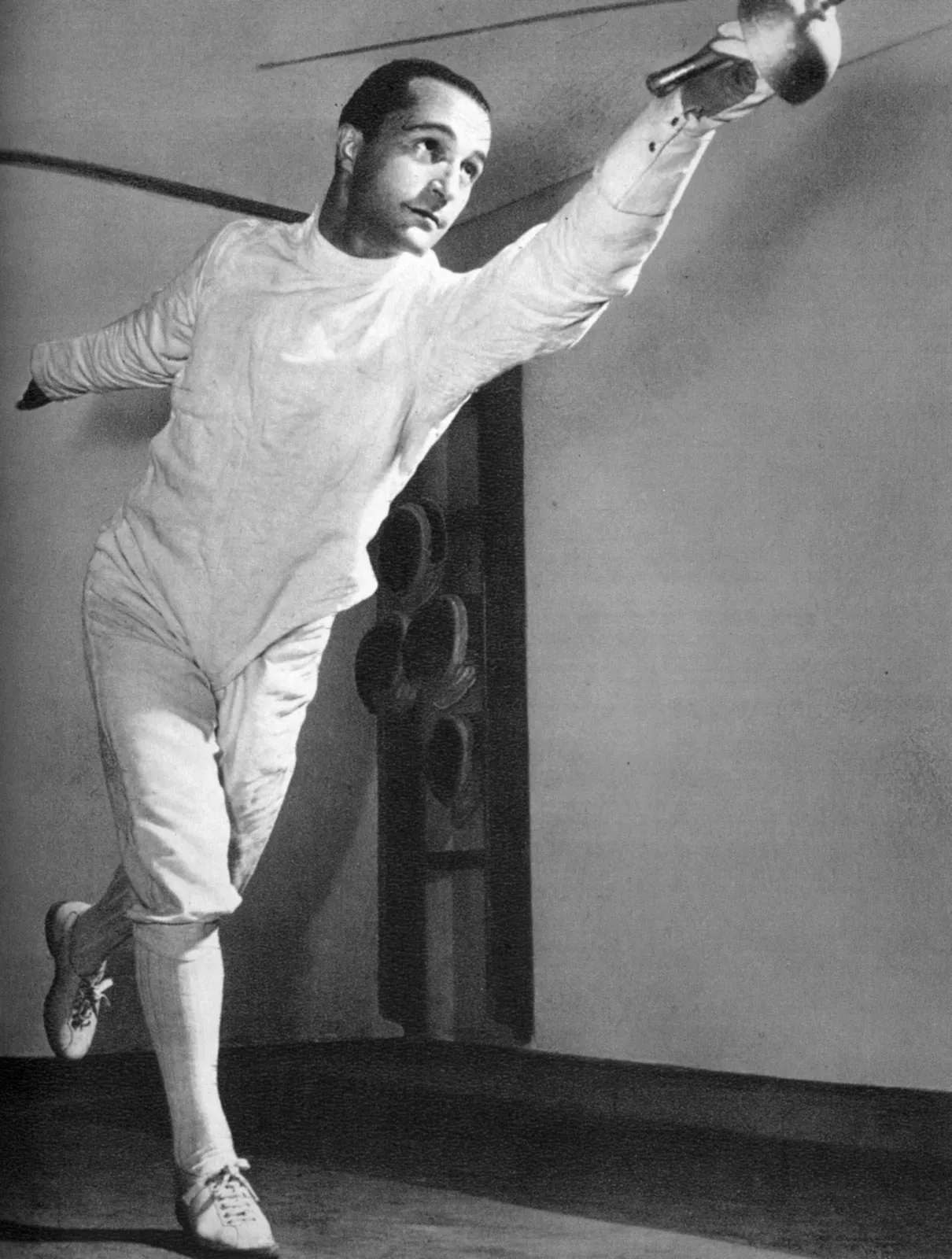
Edoardo Mangiarotti, born on April 7, 1919, in Renate, Lombardy, Italy, stands as one of the most iconic figures in the history of fencing. Known for his unparalleled success in both the Olympic Games and World Championships, Mangiarotti’s name is synonymous with excellence in the sport of fencing. With a career that spanned nearly three decades, he accumulated an astounding number of medals and left an indelible mark on the world of sports. His legacy is not just in his records, but also in his contributions to the sport as a mentor, journalist, and sports administrator.
Early Life and Family Background
Edoardo Mangiarotti was born into a family deeply entrenched in the tradition of fencing. His father, Giuseppe Mangiarotti, was a renowned fencing master who had an immense influence on Edoardo’s career. Giuseppe was instrumental in importing and popularizing French fencing techniques in Italy after World War I, and he founded the prestigious “Il Giardino” fencing club in Milan. Edoardo, along with his brothers Dario and Manlio, was trained rigorously by their father from a young age, developing the skills that would later make them formidable competitors.
Under Giuseppe’s tutelage, Edoardo was not just taught the technical aspects of fencing but was also molded into an all-around athlete. He participated in swimming, boxing, running, and cycling, which contributed to his overall physical conditioning. Additionally, Giuseppe made the strategic decision to train Edoardo, naturally right-handed, to fence with his left hand. This decision gave Edoardo a significant tactical advantage, as it allowed him to surprise his opponents with unconventional moves.
Early Career and First Olympic Appearance
Edoardo Mangiarotti’s professional fencing career began remarkably early. At the age of 14, he won his first major title at the Italian National Championships in Tripoli, signaling the arrival of a prodigious talent in the sport. By the time he was 17, Mangiarotti had qualified for the 1936 Berlin Olympics, making his debut on the international stage.
In Berlin, Mangiarotti was part of the Italian team that won the gold medal in team épée. This victory was the beginning of a long and illustrious career that would see Mangiarotti become the most decorated fencer in Olympic history. The 1936 Olympics marked the start of what would become a collection of 13 Olympic medals, including six golds, five silvers, and two bronzes, making him Italy’s most successful Olympic athlete of all time.
The War Years and Post-War Success
Mangiarotti’s career, like many of his contemporaries, was interrupted by World War II. The war led to the cancellation of the 1940 and 1944 Olympic Games, depriving Mangiarotti of the opportunity to compete during what could have been some of his peak years. However, he returned to competition with renewed vigor after the war.
The 1948 London Olympics marked Mangiarotti’s return to the international stage, where he continued to build on his legacy. In London, he won a silver medal in team foil, a bronze in individual épée, and another silver in team épée. These victories underscored his versatility across different fencing disciplines, a rare feat in a sport where athletes often specialize in a single weapon.
Mangiarotti’s success continued unabated into the 1950s. The 1952 Helsinki Olympics were particularly memorable, as he won gold in both individual and team épée, as well as silver in both individual and team foil. These accomplishments solidified his status as the preeminent fencer of his time.
The 1956 Melbourne Olympics and Continued Dominance
The 1956 Melbourne Olympics were another high point in Mangiarotti’s career. At these Games, he once again led the Italian team to victory in both the team foil and team épée events. Individually, he secured a bronze medal in the épée, adding to his already impressive tally of Olympic medals.
During the Melbourne Games, Mangiarotti had the honor of serving as Italy’s flag bearer at the opening ceremony, a role he would reprise four years later at the 1960 Rome Olympics. This distinction made him one of the few athletes to have served as flag bearer in multiple Olympic Games, highlighting his status as a national sports icon.
The Rome Olympics and Final Years of Competition
The 1960 Rome Olympics were Mangiarotti’s final appearance at the Games, and he made sure to leave on a high note. At the age of 41, he won his sixth and final Olympic gold medal in the team épée event. He also added another silver to his collection in the team foil competition. By the time he retired from Olympic competition in 1961, Mangiarotti had amassed 13 Olympic medals, a record that stood as the most by any fencer until it was equaled decades later.
In addition to his Olympic success, Mangiarotti was a dominant force at the World Fencing Championships. He won numerous individual and team titles throughout his career, further establishing himself as one of the greatest fencers in the history of the sport.
Life After Competitive Fencing
After retiring from competition, Mangiarotti remained deeply involved in the world of fencing and sports. He transitioned into a career as a journalist, working for “La Gazzetta dello Sport,” one of Italy’s leading sports newspapers. His insights and analyses were highly regarded, as they came from someone who had not only witnessed but also shaped the history of fencing.
Mangiarotti also took on various administrative roles within the Italian sports community. He served as President of the National Union of Veterans of Sport (Unione Nazionale Veterani dello Sport) and founded the AMOVA (Associazione Medaglie d’Oro al Valore Atletico), an organization dedicated to honoring Italy’s top athletes. His leadership extended to the international stage as well, where he held positions on the executive committee of the Fédération Internationale d’Escrime (FIE), the world governing body for fencing.
One of Mangiarotti’s most significant contributions outside of competition was his advocacy for the welfare of athletes. He successfully lobbied for the establishment of the “Giulio Onesti” lifetime allowance, which provides financial support to retired Italian athletes who have fallen on hard times. This initiative reflected Mangiarotti’s deep commitment to the well-being of his fellow athletes, even after their competitive careers had ended.
Recognition and Honors
Edoardo Mangiarotti’s achievements did not go unrecognized. In 2002, the International Olympic Committee (IOC) awarded him the prestigious Olympic Order, the highest honor the IOC can bestow. This recognition was a testament to his contributions to the Olympic movement and his status as one of the most accomplished athletes in the history of the Games.
Mangiarotti was also honored with numerous other awards throughout his life, including the Fair Play Career Award in 2009. These accolades celebrated not only his success as an athlete but also his sportsmanship, leadership, and dedication to the principles of fair play.
Legacy and Impact on Fencing
Edoardo Mangiarotti’s legacy in the world of fencing is unparalleled. His records, particularly in the Olympic Games, have set a benchmark for future generations of fencers. His ability to compete at the highest level for nearly three decades is a testament to his skill, determination, and adaptability.
Mangiarotti’s influence extends beyond his own achievements. As a mentor and coach, he helped train and inspire future champions, ensuring that his knowledge and experience were passed down to the next generation. His work as a journalist and sports administrator also helped to elevate the profile of fencing in Italy and around the world.
Moreover, Mangiarotti’s life story serves as an inspiration not only to athletes but to anyone striving for excellence in their field. His combination of talent, hard work, and sportsmanship embodies the values of the Olympic spirit.
Conclusion
Edoardo Mangiarotti’s life and career are a testament to the heights that can be reached through dedication, skill, and a deep passion for one’s craft. As the most decorated fencer in Olympic history, his legacy is secure, not just in the records he set but in the impact he had on the sport of fencing and the broader world of sports. Mangiarotti passed away on May 25, 2012, at the age of 93, leaving behind a legacy that continues to inspire athletes and sports enthusiasts around the globe.


