
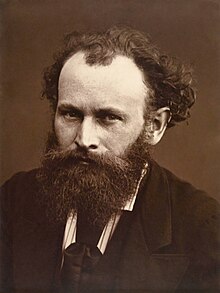
Edouard Manet, born on January 23, 1832, in Paris, France, is one of the most influential figures in the history of art. Known as a pivotal figure in the transition from Realism to Impressionism, Manet’s work challenged the conventions of his time and laid the groundwork for modern art. This article explores the life and career of Edouard Manet, focusing on his early years, rise to fame, significant contributions to the art world, and the lasting impact of his work.
Early Life and Artistic Aspirations
Edouard Manet was born into a wealthy and well-connected family. His father, Auguste Manet, was a prominent judge, and his mother was the daughter of a diplomat. Despite his privileged background, Manet’s early life was marked by a deep passion for art, a path that his father initially discouraged. In 1839, at the age of seven, Manet was enrolled in the Collège Saint-Roch, where his academic performance was less than stellar. His lack of interest in traditional schooling led his father to push him toward a career in the military.
In 1848, at the age of 16, Manet failed the entrance exam to the French Naval Academy. Undeterred, he embarked on a voyage to Brazil aboard the training ship Le Havre et Guadeloupe. This experience broadened his horizons and exposed him to new cultures and artistic influences. Upon his return to Paris, Manet finally convinced his father to allow him to pursue a career in art.
Artistic Education and Early Influences
In 1850, Edouard Manet began his formal art education under the tutelage of Thomas Couture, a renowned French painter known for his historical and genre paintings. Manet spent six years in Couture’s studio, where he honed his skills in drawing and painting. However, Manet soon grew disillusioned with Couture’s conservative and academic approach to art, which he found too rigid and uninspiring. This led him to seek out his own path, one that would eventually lead to a revolutionary break from traditional art forms.
During this period, Manet traveled extensively throughout Europe, visiting countries such as Italy, Germany, and the Netherlands. These travels allowed him to study the works of the Old Masters, including Diego Velázquez, Francisco Goya, Titian, and the Dutch painters of the 17th century. Manet was particularly influenced by the tonal variations and compositional techniques of these artists, which he would later incorporate into his own work. Additionally, Manet’s exposure to Japanese woodblock prints, which were gaining popularity in Europe at the time, had a significant impact on his artistic style.
The Birth of a New Artistic Vision
By the mid-1850s, Edouard Manet had begun to develop his own distinctive style, one that would challenge the established norms of the French art world. In 1856, he set up his own studio in Paris and began producing works that reflected his unique approach to painting. Unlike many of his contemporaries, Manet sought to depict modern life as he saw it, using bold brushstrokes, vivid contrasts, and a focus on the everyday scenes and people around him.
One of Manet’s earliest and most controversial works was “Le déjeuner sur l’herbe” (“The Luncheon on the Grass”), completed in 1863. The painting depicted a nude woman picnicking with two fully dressed men in a rural setting, a composition that was shocking to the sensibilities of the time. The painting was rejected by the Salon, the official art exhibition of the Académie des Beaux-Arts in Paris, but was later displayed in the Salon des Refusés, an alternative exhibition for rejected works. “Le déjeuner sur l’herbe” sparked widespread criticism and debate, with many accusing Manet of indecency and poor taste. However, it also established him as a daring and innovative artist willing to challenge the status quo.
Marriage and Personal Life
In 1863, the same year that “Le déjeuner sur l’herbe” was completed, Edouard Manet married Suzanne Leenhoff, a Dutch-born pianist who had been his piano teacher. The couple had a close and enduring relationship, and Suzanne was a significant source of support for Manet throughout his career. Their marriage also provided Manet with a stable personal life, allowing him to focus on his art despite the controversies and challenges he faced.
The Impact of “Olympia” and the Rise of Modern Art
Following the controversy of “Le déjeuner sur l’herbe,” Manet continued to push the boundaries of traditional art. In 1865, he completed another groundbreaking work, “Olympia,” which depicted a nude woman reclining on a bed, staring directly at the viewer with an air of defiance. The painting was a stark departure from the idealized nudes typically seen in academic art, and its confrontational gaze and modern setting scandalized the public when it was exhibited at the Salon.
“Olympia” was heavily criticized, with some viewers labeling it immoral and vulgar. However, it also garnered attention from avant-garde artists and intellectuals who recognized its significance. The painting’s bold composition and modern subject matter would later be seen as a precursor to the developments in modern art, particularly the rise of Impressionism.
Association with the Impressionists
Although Edouard Manet is often associated with the Impressionist movement, he maintained a complex relationship with the group. In the 1860s, Manet became friends with several key figures in the burgeoning Impressionist circle, including Edgar Degas, Claude Monet, Pierre-Auguste Renoir, and Berthe Morisot. He frequented the Café Guerbois and the Café de la Nouvelle-Athènes, where he engaged in lively discussions with these artists and other intellectuals of the time.
Despite his close ties to the Impressionists, Manet was reluctant to fully embrace the movement. He declined invitations to exhibit with the Impressionists in their independent exhibitions, preferring instead to submit his work to the official Salon. Manet’s reluctance stemmed from his desire to achieve recognition within the traditional art establishment while simultaneously pushing its boundaries. Nevertheless, his work, particularly his use of light, color, and loose brushwork, had a profound influence on the development of Impressionism.
Later Career and Recognition
In the latter part of his career, Edouard Manet’s work began to receive greater recognition. In 1869, he traveled to London, where he met his only formal student, Eva Gonzalès, who would go on to become a successful painter in her own right. During the Franco-Prussian War of 1870-1871, Manet served as a lieutenant in the National Guard, an experience that influenced some of his later works.
By the 1870s, the influence of Impressionism became more evident in Manet’s work, particularly in his use of lighter colors and more spontaneous brushstrokes. One of his most famous paintings from this period is “A Bar at the Folies-Bergère” (1882), which depicts a barmaid standing behind a marble counter at the Folies-Bergère, one of Paris’s most popular nightspots. The painting is notable for its complex composition, including a mirror reflection that creates a sense of depth and ambiguity.
In 1881, Manet received official recognition from the French government when he was awarded the Legion of Honor, one of the highest honors in France. This recognition marked a turning point in Manet’s career, as he began to gain the respect and admiration of the broader art community.
Health Decline and Final Years
Despite his growing fame and success, Edouard Manet’s later years were marked by declining health. In 1879, he was diagnosed with locomotor ataxia, a degenerative disease that affects the spinal cord and is often associated with syphilis. The disease progressively weakened him, and in 1883, his left foot had to be amputated due to gangrene.
Despite his illness, Manet continued to paint, producing some of his most poignant and intimate works during this period. On April 30, 1883, Edouard Manet passed away at the age of 51. He left behind a body of work that would influence generations of artists and shape the course of modern art.
Legacy and Influence
Edouard Manet’s legacy is profound, and his influence on the art world is undeniable. Often referred to as the father of modernism, Manet’s work bridged the gap between traditional academic art and the avant-garde movements that followed. His willingness to challenge societal norms and artistic conventions paved the way for the Impressionists and later movements, including Post-Impressionism and Modernism.
Manet’s use of contemporary subjects, his innovative approach to composition, and his bold use of color and light set him apart from his peers. His works, such as “Le déjeuner sur l’herbe,” “Olympia,” and “A Bar at the Folies-Bergère,” continue to be studied and admired for their revolutionary impact on the art world.
In conclusion, Edouard Manet was more than just a painter; he was a visionary who changed the course of art history. His life and work are a testament to the power of innovation and the enduring influence of a true artist. Today, Manet’s paintings are celebrated in museums and galleries worldwide, a lasting reminder of his contribution to the world of art.


