
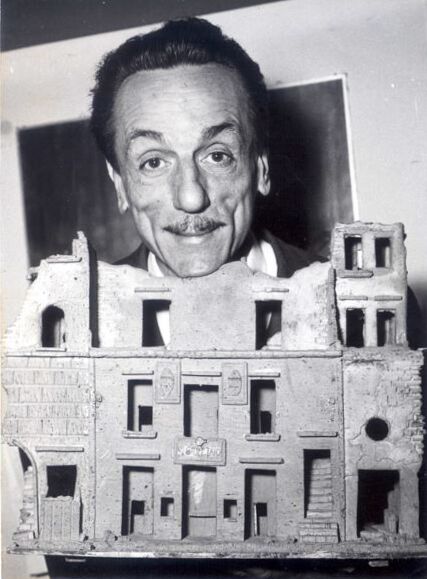
Eduardo De Filippo, born on May 24, 1900, in Naples, Italy, is one of the most significant figures in Italian theater. A prolific playwright, actor, and director, De Filippo is celebrated for his profound contributions to 20th-century Italian culture. His works, often infused with humor, pathos, and a deep understanding of human nature, have left an indelible mark on the world of theater and continue to be revered both in Italy and internationally.
Early Life and Family Background
Eduardo De Filippo was born into a family deeply entrenched in the world of theater. His father, Eduardo Scarpetta, was a renowned actor and playwright, widely considered the father of modern Neapolitan comedy. His mother, Luisa De Filippo, was also involved in the theatrical world. Eduardo was the second of three siblings; his brother, Peppino De Filippo, and sister, Titina De Filippo, would also go on to become prominent figures in Italian theater.
Eduardo’s early exposure to the theater was inevitable, given his family background. He made his stage debut at the tender age of four at the Teatro Valle in Rome, participating in the chorus of an operetta written by his father. This early experience set the stage for a lifetime dedicated to the performing arts.
Despite his early introduction to the stage, Eduardo’s childhood was not without its challenges. Known for his rebellious nature, Eduardo struggled in school and was eventually sent to the Chierchia boarding school in Naples at the age of 11. However, this did little to curb his disdain for formal education, and by the age of 13, he had left school altogether.
The Early Years in Theater
Eduardo’s education may have been unconventional, but his father ensured that his son was well-versed in the art of theater. Eduardo spent hours each day reading and copying theatrical texts, a discipline that honed his skills as both an actor and a writer. By the age of 14, Eduardo had joined the theater company of his uncle, Vincenzo Scarpetta, where he performed in various roles, from stagehand to prompter, and eventually as a leading actor.
For nearly a decade, Eduardo honed his craft with Scarpetta’s company, gaining valuable experience in every aspect of theatrical production. In 1920, he wrote his first one-act play, Farmacia di turno (“Pharmacy on Duty”), marking the beginning of his career as a playwright.
Even during his mandatory military service, Eduardo remained committed to his passion for theater, performing whenever he could. After completing his service in 1922, Eduardo left Scarpetta’s company to join the company of Francesco Corbinci. It was with Corbinci’s troupe that Eduardo first took on the role of director, staging Surriento gentile (“Gentle Sorrento”) by Enzo Lucio Murolo.
In 1922, Eduardo wrote and directed another play, Uomo e galantuomo (“Man and Gentleman”), which further established his reputation as a playwright and director. By 1930, after various stints with other theater companies, Eduardo had rejoined Scarpetta’s company, where he continued to refine his skills.
The Formation of the Teatro Umoristico
In 1931, Eduardo De Filippo made a pivotal decision that would shape the rest of his career. Along with his siblings Titina and Peppino, Eduardo founded the Teatro Umoristico, a theater company that would become legendary in Italian theater history. The company made its debut on December 25, 1931, at the Teatro Kursaal in Naples with Natale in casa Cupiello (“Christmas at the Cupiello House”), a play that began as a one-act but would later become one of Eduardo’s most famous works.
Natale in casa Cupiello is a quintessential example of Eduardo’s genius. The play, which revolves around the dysfunctional Cupiello family during the Christmas season, is a poignant exploration of family dynamics, social tensions, and the complexities of human relationships. Eduardo’s ability to blend humor with deep emotional resonance made the play an instant classic, and it remains one of his most beloved works.
The Teatro Umoristico quickly gained popularity, with Eduardo at the helm as the principal playwright, director, and actor. The company toured extensively, performing to enthusiastic audiences across Italy. Eduardo’s works during this period, characterized by their sharp wit, social commentary, and keen observations of Neapolitan life, solidified his reputation as a master of Italian theater.
The Golden Era: 1930s to 1950s
The 1930s through the 1950s marked the golden era of Eduardo De Filippo’s career. During this time, he produced a series of plays that have since become cornerstones of Italian theater. These works, often referred to as the Cantata dei giorni pari (“Cantata of the Even Days”) and Cantata dei giorni dispari (“Cantata of the Odd Days”), showcase Eduardo’s range as a playwright and his deep understanding of the human condition.
Some of the most notable plays from this period include:
-
Filumena Marturano (1946): Perhaps Eduardo’s most famous play, Filumena Marturano tells the story of a former prostitute who tricks a wealthy man into marrying her in order to legitimize her three children. The play is a powerful exploration of love, sacrifice, and the struggle for dignity. It has been adapted into numerous films and television productions, including the 1964 film Marriage Italian Style, starring Sophia Loren and Marcello Mastroianni.
-
Questi fantasmi! (1945): This play, which translates to “These Ghosts!,” is a dark comedy that explores the themes of illusion and reality. Set in a supposedly haunted apartment, the play delves into the absurdities of human behavior and the lengths people will go to deceive themselves and others.
-
Napoli milionaria! (1945): Set in Naples during and after World War II, this play is a poignant portrayal of the struggles faced by ordinary people in the aftermath of war. The play’s famous closing line, “Ha da passà ‘a nuttata” (“The night must pass”), has become an iconic expression of hope and resilience in the face of adversity.
-
Le voci di dentro (1948): This play, whose title translates to “Inner Voices,” is a psychological drama that explores themes of guilt, suspicion, and the search for truth. The play’s complex characters and intricate plot make it one of Eduardo’s most intellectually challenging works.
Eduardo’s plays during this period were not only successful in Italy but also gained international recognition. His works were translated into multiple languages and performed in theaters around the world. Eduardo himself became a cultural ambassador for Italian theater, bringing the rich traditions of Neapolitan drama to a global audience.
Legacy and Influence
Eduardo De Filippo’s influence on Italian theater and culture is immeasurable. His works have become an integral part of the Italian literary canon, studied in schools and universities and performed regularly in theaters across the country. Eduardo’s ability to capture the essence of Italian life, particularly the complexities of Neapolitan society, has made his plays timeless.
Eduardo’s impact extends beyond the stage. His works have been adapted into numerous films, television shows, and even operas. He was also an accomplished screenwriter and actor, appearing in several films and television productions based on his plays. His collaboration with renowned directors such as Vittorio De Sica and Roberto Rossellini further cemented his status as a towering figure in Italian culture.
In addition to his artistic achievements, Eduardo was also a dedicated public servant. In 1981, he was appointed as a Senator for Life in the Italian Parliament, a testament to his contributions to Italian culture and society. In this role, he continued to advocate for the arts and for the preservation of Italy’s cultural heritage.
Eduardo De Filippo passed away on October 31, 1984, in Rome. His death marked the end of an era, but his legacy lives on through his works and the countless artists he has inspired. Today, Eduardo is remembered not only as one of Italy’s greatest playwrights but also as a symbol of the resilience, humor, and humanity of the Italian people.
Eduardo’s Continued Relevance
Eduardo De Filippo’s plays continue to resonate with audiences today, decades after they were first written. His exploration of universal themes such as family, love, betrayal, and social justice ensures that his works remain relevant in the modern world. Eduardo’s unique ability to blend humor with tragedy, to create characters that are both deeply flawed and deeply human, makes his plays enduring masterpieces.
In the years since his death, Eduardo’s works have been revived in theaters across the world, from Italy to the United States, the United Kingdom, and beyond. His influence can be seen in the works of contemporary playwrights and directors who continue to draw inspiration from his unique approach to storytelling.
Eduardo De Filippo’s legacy is also preserved through the work of his son, Luca De Filippo, who followed in his father’s footsteps as an actor and director. Luca dedicated his career to preserving and promoting his father’s works, ensuring that Eduardo’s contributions to Italian theater will be remembered for generations to come.
In conclusion, Eduardo De Filippo was a playwright, actor, and director of unparalleled talent. His works, characterized by their deep humanity, sharp wit, and keen social commentary, have left an indelible mark on the world of theater. Eduardo’s legacy is one of creativity, resilience, and a profound love for the art of storytelling. His plays continue to inspire, entertain, and challenge audiences around the world, ensuring that his influence will be felt for many years to come.


