
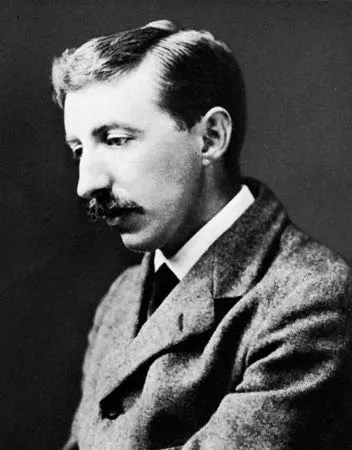
Edward Morgan Forster, commonly known as E.M. Forster, was born on January 1, 1879, in London, England. He is widely regarded as one of the most influential British novelists of the early 20th century. Forster’s works are renowned for their exploration of social class, human relationships, and the tensions between modernity and tradition. His literary legacy includes several acclaimed novels, short stories, and essays that continue to be studied and admired today.
Early Life and Education
Forster was born into a well-to-do family; his father, an architect, died when Edward was just a year old, leaving him to be raised by his mother, who came from a bourgeois background. This maternal influence had a profound impact on Forster’s development, both personally and intellectually. In 1883, Forster and his mother moved to Rooks Nest in Hertfordshire, a location that would later serve as the inspiration for his novel Howards End.
Forster’s formal education began at Tonbridge School in Kent, where he was exposed to the rigid social structures that would later inform much of his writing. In 1896, he went on to study at King’s College, Cambridge, where he found a more congenial environment that nurtured his intellectual and creative abilities. At Cambridge, Forster studied history and classics, graduating in 1901. During his time there, he joined the “Apostles,” a secretive society with a focus on intellectual discourse and which had a discreetly homosexual undertone. Notable members of this society included figures such as John Maynard Keynes and Lytton Strachey, who would later become central to the Bloomsbury Group, a collective of writers, intellectuals, and artists that Forster was associated with.
Early Writing Career and Literary Breakthrough
After completing his studies, Forster traveled extensively with his mother across Europe, visiting countries such as Switzerland, Austria, Italy, and France. These travels were pivotal in awakening his literary aspirations. Forster’s first novel, Where Angels Fear to Tread (1905), was inspired by his experiences in Italy and explores the clash of cultures between the English and the Italians. The novel was well-received and marked the beginning of Forster’s literary career.
In the years that followed, Forster published two more novels: The Longest Journey (1907) and A Room with a View (1908). A Room with a View is perhaps one of his most celebrated works, capturing the contrasts between the constraints of Edwardian society and the liberating possibilities of travel and love. The novel’s themes of personal growth, self-discovery, and the struggle between convention and freedom resonated with readers and established Forster as a significant voice in British literature.
Forster’s travels continued to influence his writing, particularly his repeated visits to Italy, which provided the backdrop for much of his early work. These experiences not only enriched his storytelling but also deepened his understanding of the complex interplay between culture, class, and individual identity—elements that would remain central to his later works.
Major Works and Themes
Forster’s major literary breakthrough came with the publication of Howards End in 1910. The novel is often regarded as his masterpiece and is a critical examination of the social, economic, and cultural tensions of Edwardian England. Howards End explores the lives of three families: the intellectual Schlegels, the wealthy Wilcoxes, and the struggling Basts. Through these characters, Forster delves into issues of class, property, and the pursuit of meaning in a rapidly changing world. The novel’s famous epigraph, “Only connect,” encapsulates Forster’s belief in the importance of human relationships and the need to bridge the divides that separate individuals and social classes.
In Howards End, Forster’s critique of the English class system is both subtle and profound. The novel reflects his concerns about the disintegration of traditional values in the face of modernity, as well as his advocacy for social cohesion and mutual understanding. The themes of connection and disconnection, both personal and societal, are woven throughout the narrative, making Howards End a timeless exploration of the human condition.
Following the success of Howards End, Forster continued to explore different literary forms and themes. He experimented with drama, writing the play The Heart of Bosnia in 1911, and published a collection of short stories titled The Celestial Omnibus. These works, while less well-known than his novels, showcase Forster’s versatility as a writer and his ability to capture the nuances of human experience in a variety of settings.
Travel and Influence: A Passage to India
One of the most significant influences on Forster’s later work was his travels to India. His first visit to the country was in 1912, and it left a lasting impression on him. During this time, Forster began to develop a deep interest in the cultural and social complexities of the British Empire, particularly in relation to its colonies. This interest culminated in the publication of his final novel, A Passage to India (1924), which is widely regarded as one of the most important works of 20th-century English literature.
A Passage to India is set against the backdrop of British colonial rule in India and explores the tensions between the British and Indian communities. The novel focuses on the relationship between an Englishwoman, Adela Quested, and an Indian doctor, Aziz, whose friendship is tested by the prejudices and misunderstandings that define the colonial experience. The novel’s exploration of racial and cultural conflicts, as well as its critique of the British Empire, resonated with readers and critics alike, cementing Forster’s reputation as a writer of international significance.
The success of A Passage to India was not just literary but also political. It highlighted the inherent injustices of colonialism and the difficulties of genuine cross-cultural understanding. Forster’s nuanced portrayal of the Indian characters, coupled with his critique of British arrogance and ignorance, earned him acclaim as a forward-thinking and empathetic observer of the human condition. The novel’s complex narrative structure, use of symbolism, and exploration of the spiritual and mystical dimensions of Indian culture further distinguished it as a work of profound depth and insight.
Personal Life and the Influence of Sexuality
Forster’s personal life was marked by his struggles with his sexual identity in a society that was largely intolerant of homosexuality. His time at Cambridge and his association with the Apostles provided him with a supportive environment where he could explore his sexuality, but he remained largely closeted for much of his life.
In 1913, Forster visited the commune of Edward Carpenter, a former priest and an advocate for civil rights, who encouraged him to fully accept his homosexuality. This visit had a profound impact on Forster and led to the writing of Maurice, a novel that deals openly with homosexual love. Written between 1913 and 1914, Maurice is one of the earliest works in English literature to portray same-sex relationships in a positive light. However, due to the conservative social attitudes of the time, Forster chose not to publish the novel during his lifetime. It was only published posthumously in 1971, a year after his death.
Maurice is a groundbreaking work that challenges the societal norms of its time. The novel’s depiction of homosexual love as natural and fulfilling was revolutionary, especially in an era when homosexuality was still criminalized in the United Kingdom. Forster’s decision to keep the novel unpublished during his lifetime reflects the deep-seated fears and pressures faced by LGBTQ+ individuals in the early 20th century. Nevertheless, Maurice stands as a testament to Forster’s courage and his commitment to portraying human relationships in all their complexity.
Later Life and Legacy
After the publication of A Passage to India, Forster largely withdrew from writing fiction, though he continued to contribute essays, reviews, and lectures on a variety of subjects. He became increasingly involved in social and political causes, particularly those related to civil liberties and human rights. His later years were spent at King’s College, Cambridge, where he served as a fellow and mentor to younger writers and students.
In 1947, Forster traveled to the United States to deliver a series of lectures and to work on the libretto for the opera Billy Budd, based on the novel by Herman Melville. This period marked a shift in his focus from fiction to other forms of writing and public engagement. Despite his retreat from novel writing, Forster remained a respected figure in literary circles, and his works continued to influence new generations of writers.
In 1969, just a year before his death, Forster was awarded the Order of Merit by Queen Elizabeth II, one of the highest honors that can be bestowed upon a British citizen. This recognition was a fitting tribute to his contributions to English literature and his influence on the cultural and intellectual life of the 20th century.
Edward Morgan Forster died on June 7, 1970, in Coventry, England, at the age of 91. His passing marked the end of an era in British literature, but his legacy endures through his novels, essays, and the many adaptations of his works for stage and screen.
The Enduring Impact of E.M. Forster
E.M. Forster’s work continues to be celebrated for its insightful exploration of human relationships, its critique of social conventions, and its advocacy for personal and social connectivity. His novels, particularly Howards End and A Passage to India, are considered cornerstones of modern English literature and are frequently studied in academic settings around the world.
The themes that Forster explored—such as the tension between tradition and progress, the complexities of social class, and the challenges of cross-cultural understanding—remain relevant today. His ability to weave these themes into compelling narratives that resonate with readers of all backgrounds is a testament to his skill as a writer and his deep understanding of the human condition.
Forster’s work has also had a lasting impact on the LGBTQ+ literary canon. Maurice, in particular, is regarded as a pioneering work that paved the way for more open and positive representations of same-sex relationships in literature. The novel’s posthumous publication has allowed it to reach a wide audience and has cemented Forster’s place as a key figure in the history of LGBTQ+ literature.
In addition to his literary achievements, Forster’s personal courage in addressing issues of sexuality, social justice, and human rights has inspired generations of writers and activists. His life and work continue to serve as a reminder of the power of literature to challenge societal norms and to foster empathy and understanding across cultural and social divides.


