
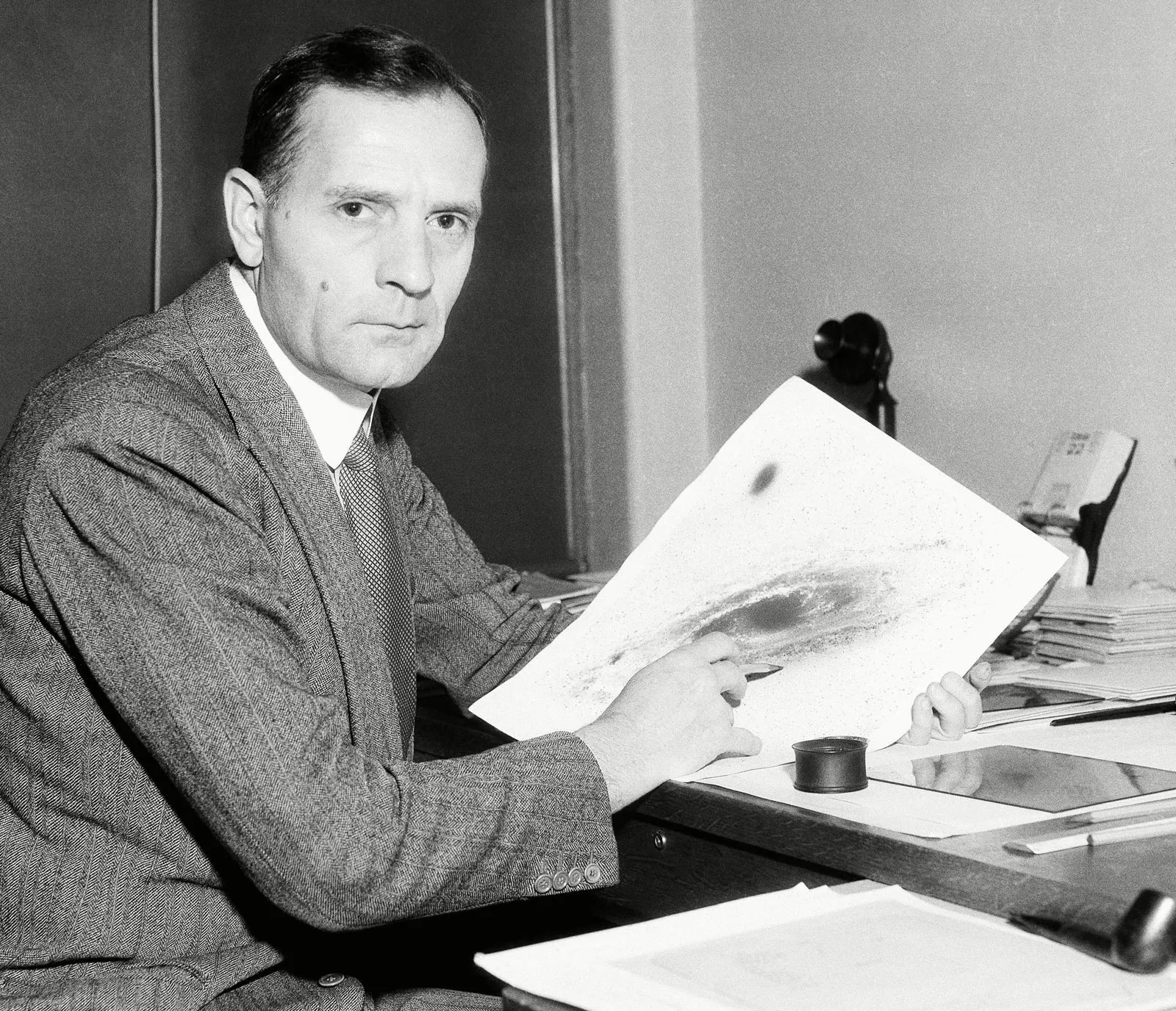
Edwin Powell Hubble, born on November 20, 1889, in Marshfield, Missouri, was a towering figure in the world of astronomy and astrophysics. His contributions to science have left an indelible mark on our understanding of the universe, so much so that his name is synonymous with some of the most groundbreaking discoveries of the 20th century. Hubble’s work not only transformed our view of the cosmos but also laid the foundation for future astronomical research.
Early Life and Education
Hubble’s early life was marked by academic excellence and a diverse range of interests. He began his higher education at the University of Chicago, where he focused on mathematics and astronomy, fields that would later define his career. After graduating in 1910, Hubble pursued further studies at Oxford University as a Rhodes Scholar, where he unexpectedly shifted his focus to law. However, his passion for astronomy remained undiminished, and he eventually returned to the United States to study at the Yerkes Observatory, part of the University of Chicago, where he earned his doctorate in 1917.
Career Beginnings and Major Discoveries
After completing his education, Hubble joined the staff at the Mount Wilson Observatory in Pasadena, California, which was then part of the Carnegie Institution. This was a pivotal moment in his career, as it allowed him to work with the Hooker Telescope, the most powerful telescope in the world at that time. Between 1923 and 1924, Hubble made a series of observations that would change the course of astronomy.
One of Hubble’s most significant contributions was his discovery that the so-called “nebulae,” previously thought to be part of our Milky Way galaxy, were in fact entire galaxies themselves, existing far beyond our own. This realization expanded the known universe exponentially, as it demonstrated that our galaxy was just one of many in the cosmos. The official announcement of this discovery came on December 30, 1924, and it marked a new era in our understanding of the universe.
The Hubble Law and Expanding Universe
Perhaps Hubble’s most famous achievement is the formulation of what is now known as the Hubble Law. In 1929, Hubble, working alongside Milton Humason, observed that the farther away a galaxy is, the faster it appears to be moving away from us. This observation was based on the measurement of “redshifts” – a phenomenon where light from distant galaxies is shifted toward the red end of the spectrum. This relationship between distance and velocity provided the first evidence that the universe is expanding, a concept that would later lead to the formulation of the Big Bang theory.
The Hubble Law established a linear relationship between the redshift of light from galaxies and their distance from Earth. This discovery was revolutionary because it suggested that the universe was not static, as had been previously thought, but was dynamic and ever-expanding. The implications of this were profound, leading to a major shift in the scientific community’s understanding of the cosmos.
The Hubble Classification Scheme
In addition to his work on the expanding universe, Hubble also developed a system for classifying galaxies. Known as the Hubble Sequence, this classification scheme grouped galaxies based on their appearance and structure. Hubble categorized galaxies into three main types: elliptical, spiral, and irregular. This system is still used by astronomers today and has been fundamental in the study of galactic evolution and formation.
Recognition and Legacy
Hubble’s contributions to astronomy were recognized during his lifetime, but his legacy has only grown in the years since his death. The Hubble Space Telescope, launched in 1990, was named in his honor and has been instrumental in furthering our understanding of the universe. Positioned approximately 600 kilometers above the Earth, the Hubble Space Telescope has provided stunning images and valuable data that have led to numerous scientific breakthroughs.
Hubble’s influence extends beyond his specific discoveries. His work fundamentally altered the way we perceive the universe and our place within it. Before Hubble, the Milky Way was thought to comprise the entirety of the universe. After Hubble, it became clear that our galaxy was just one of billions, each potentially harboring its own stars, planets, and possibly life.
Historical Context and Impact on Science
To truly appreciate Hubble’s contributions, it is essential to consider the historical context in which he worked. The early 20th century was a period of great scientific upheaval and discovery. Albert Einstein had recently published his theory of relativity, which challenged the classical Newtonian view of the universe. Hubble’s discovery of the expanding universe provided empirical support for the idea that space itself could stretch and grow, a concept that was crucial to the acceptance of Einstein’s theories.
Interestingly, Einstein initially introduced a “cosmological constant” into his equations to account for a static universe. However, when Hubble’s findings became known, Einstein famously referred to the cosmological constant as his “greatest blunder.” The realization that the universe was expanding, as Hubble had demonstrated, validated the dynamic nature of space-time as described by Einstein’s equations without the need for a cosmological constant.
Hubble’s work also had a profound impact on the philosophical and theological views of the time. The notion of an expanding universe suggested a beginning – a point in time when the universe was much smaller, denser, and hotter. This idea laid the groundwork for the Big Bang theory, which posits that the universe began as a singularity approximately 13.8 billion years ago. This concept has since become a cornerstone of modern cosmology.
Personal Life and Later Years
While Edwin Hubble is best known for his scientific achievements, his personal life was also marked by a deep intellectual curiosity and a love for exploration. Hubble was an avid reader and was known for his broad interests, which extended beyond astronomy to include philosophy, literature, and history. He married Grace Burke in 1924, and the couple remained together until his death.
In the later years of his life, Hubble continued his work at the Mount Wilson Observatory and later at the Palomar Observatory, where he was the first astronomer to use the newly completed 200-inch Hale Telescope. His work remained focused on the expansion of the universe and the study of distant galaxies.
Hubble passed away on September 28, 1953, from a heart attack. His death marked the end of an era in astronomy, but his legacy continues to inspire generations of scientists. The Hubble Space Telescope, in particular, serves as a fitting tribute to a man whose work expanded the boundaries of human knowledge and forever changed our understanding of the cosmos.
Conclusion
Edwin Hubble’s life and work are a testament to the power of scientific inquiry and the human spirit’s unyielding drive to understand the universe. From his early discoveries that expanded the known universe to his formulation of the Hubble Law and the classification of galaxies, Hubble’s contributions have had a lasting impact on the field of astronomy. His legacy is not only preserved in the telescope that bears his name but also in the countless scientific advancements that have been made possible by his pioneering work.
As we continue to explore the cosmos, Edwin Hubble’s work serves as a foundation upon which much of modern astronomy is built. His discoveries remind us of the vastness of the universe and the importance of curiosity and perseverance in the pursuit of knowledge.


