
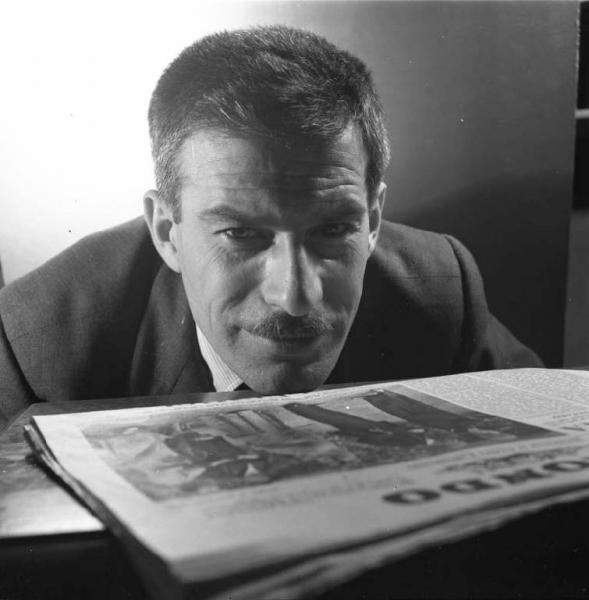
Elio Vittorini, a towering figure in 20th-century Italian literature, was born on July 23, 1908, in Syracuse, Sicily. Known for his complex relationship with the political and cultural milieu of his time, Vittorini’s work embodies the struggles and aspirations of a generation marked by war, fascism, and the quest for a new cultural identity. This article delves into the life of Elio Vittorini, exploring his age, rise to fame, and the significant highlights that shaped his extraordinary career, with a particular focus on the historical context that influenced his work.
Early Life and Formative Years
Born into a modest family, with his father working as a railway employee, Elio Vittorini’s early life was marked by constant movement. His family frequently relocated across Sicily, following his father’s work assignments. This nomadic childhood, coupled with the rugged and culturally rich environment of Sicily, deeply influenced Vittorini’s worldview and literary sensibility.
In 1924, at the age of 16, Vittorini made a bold decision to leave Sicily, using free railway passes available to railway workers’ families to flee to Friuli Venezia Giulia in northern Italy. Here, he found work as a construction laborer. This period of manual labor not only exposed him to the harsh realities of the working class but also fueled his burgeoning literary ambitions. By 1927, Vittorini had begun to contribute to various literary magazines, establishing himself as a promising young writer.
The Early Literary Career and Marriage
Vittorini’s early literary efforts were shaped by his connections with prominent literary figures, most notably Curzio Malaparte, a controversial writer and journalist. Through Malaparte, Vittorini gained access to the pages of La Stampa, one of Italy’s leading newspapers at the time. This exposure helped him carve out a niche in the Italian literary scene.
In 1927, Vittorini married Rosa Quasimodo, the sister of the future Nobel laureate poet Salvatore Quasimodo. Their marriage was marked by an intense, if somewhat turbulent, relationship. The couple’s first child, Giusto Curzio, was born in 1928, named in honor of Vittorini’s friend and mentor, Curzio Malaparte.
The Rise of an Intellectual: Antifascism and Literary Innovation
By the late 1920s, Vittorini had begun to articulate his literary and cultural vision, one that was distinctly modernist and internationalist. In a 1929 essay titled “Scarico di coscienza” (Discharge of Conscience), published in Italia Letteraria, Vittorini criticized the insularity of Italian literary traditions and advocated for a more cosmopolitan and forward-looking cultural outlook. This marked the beginning of his lifelong commitment to antifascism and his desire to break free from the cultural constraints imposed by the Fascist regime.
Vittorini’s early work included short stories and essays published in the influential literary magazine Solaria, which was a hub for young writers opposed to Fascism. His first significant publication, Piccola borghesia (Small Bourgeoisie), a collection of short stories, was released in 1931. This was followed by Viaggio in Sardegna (Journey in Sardinia) in 1932, which was later republished under the title Sardegna come infanzia (Sardinia as Childhood).
The American Influence and Literary Maturity
Vittorini’s fascination with American literature played a crucial role in shaping his writing. Although he never fully mastered spoken English, Vittorini became an avid reader and translator of American literature. His translations of works by D.H. Lawrence, Edgar Allan Poe, William Faulkner, and others helped introduce Italian readers to the vibrancy and modernity of American culture, which he saw as a counterpoint to the stultifying traditionalism of Fascist Italy.
This transatlantic cultural exchange culminated in his most important early novel, Il garofano rosso (The Red Carnation), which was serialized in Solaria between 1933 and 1934. However, the novel’s candid exploration of sexuality and its implicit critique of Fascist ideology led to its censorship. It was only published in book form in 1948, after the fall of the Fascist regime.
Conversazione in Sicilia and the “World Offended”
The late 1930s marked a turning point in Vittorini’s career. During this period, he wrote his most famous novel, Conversazione in Sicilia (Conversation in Sicily), which was serialized in the literary magazine Letteratura from 1938 to 1939 and published in book form in 1941. The novel, set against the backdrop of Fascist Italy, is a powerful exploration of the “world offended” by dictatorship and the moral responsibilities of the individual in the face of oppression.
Conversazione in Sicilia is notable for its innovative narrative style and its blending of personal and political themes. The novel’s protagonist, Silvestro, returns to his native Sicily, where he engages in a series of philosophical conversations with various characters, reflecting on the degradation of human values under Fascism. The novel was widely regarded as a landmark in Italian literature and solidified Vittorini’s reputation as one of the leading intellectuals of his time.
World War II and the Resistance
With the outbreak of World War II, Vittorini’s commitment to antifascism took on a more active and dangerous form. He became involved in the Italian Resistance, working clandestinely for the Italian Communist Party. In the summer of 1943, Vittorini was arrested by the Fascist authorities and imprisoned in San Vittore in Milan. He was released in September of the same year, following the fall of Mussolini’s regime.
After his release, Vittorini continued his Resistance activities, including participating in the production of underground publications and organizing strikes against the Fascists. During this period, he also wrote Uomini e no (Men and Not Men), a novel that directly addressed his experiences in the Resistance and the moral complexities of wartime. Published in 1945, the novel was one of the first works of Italian literature to tackle the subject of the Resistance and remains a seminal text in the canon of Italian neorealism.
Post-War Intellectual Leadership and Editorial Ventures
Following the war, Vittorini emerged as a leading figure in post-war Italian culture. In 1945, he briefly served as the editor of the Milan edition of the Communist Party’s newspaper L’Unità. However, his most significant contribution during this period was the founding of the literary magazine Il Politecnico in 1945, under the auspices of the Einaudi publishing house. Il Politecnico was conceived as a forum for the integration of scientific and humanistic culture, with the goal of fostering intellectual and social renewal in post-war Italy.
However, Vittorini’s editorial stance, which advocated for intellectual autonomy from political dogma, brought him into conflict with the leadership of the Communist Party, particularly with Mario Alicata and Palmiro Togliatti. The dispute ultimately led to the closure of Il Politecnico in 1947, but the magazine’s influence continued to resonate in Italian intellectual circles.
The Break with Communism and Later Career
Disillusioned with the Communist Party’s authoritarianism, Vittorini distanced himself from the party in the early 1950s. He formally left the party in 1951, a move that was met with harsh criticism from Communist leaders, including Togliatti. Vittorini’s departure from the party was a significant moment in post-war Italian culture, symbolizing the growing rift between intellectuals and the political left.
In the years that followed, Vittorini continued to pursue his editorial work, now with greater emphasis on promoting literary innovation and experimentalism. He played a pivotal role in discovering and nurturing new literary talents through the Einaudi series “I gettoni,” which became a launching pad for many of Italy’s most important post-war writers. He also edited works by classic Italian authors such as Ludovico Ariosto, Giovanni Boccaccio, and Carlo Goldoni, further cementing his reputation as a key figure in Italian literature.
Personal Tragedies and Final Years
The 1950s were a period of both professional achievement and personal tragedy for Vittorini. In 1955, his son Giusto, named after his friend Curzio Malaparte, passed away, a loss that profoundly affected him. Despite this, Vittorini remained active in the literary world, continuing to write, edit, and engage in public debates.
In 1957, Vittorini published Diario in pubblico (Public Diary), a collection of his political and cultural essays, which provided insights into his intellectual journey and the challenges he faced in navigating the complex cultural landscape of post-war Italy. In 1959, he co-founded and co-edited Il Menabò, a literary journal that played a crucial role in the development of literary experimentalism in the 1960s.
Legacy and Influence
Elio Vittorini passed away on February 12, 1966, at the age of 57, after a long battle with illness. His death marked the end of an era in Italian literature, but his influence continues to be felt to this day. Vittorini’s commitment to cultural renewal, his advocacy for intellectual independence, and his pioneering efforts in introducing modernist and internationalist perspectives to Italian literature have left an enduring legacy.
Posthumously, Vittorini’s unfinished novel Le città del mondo (The Cities of the World) was published in 1969, offering a glimpse into the direction his later work might have taken. His essays and critical writings, collected in Le due tensioni (The Two Tensions), published in 1967, remain essential reading for anyone interested in the intellectual history of 20th-century Italy.
Vittorini’s life and work reflect the tensions and contradictions of a period marked by profound social and political upheaval. His efforts to bridge the gap between literature and social engagement, and his role in shaping the cultural landscape of post-war Italy, make him a central figure in the history of modern Italian literature. His legacy is one of innovation, resistance, and an unyielding commitment to the transformative power of culture.


