
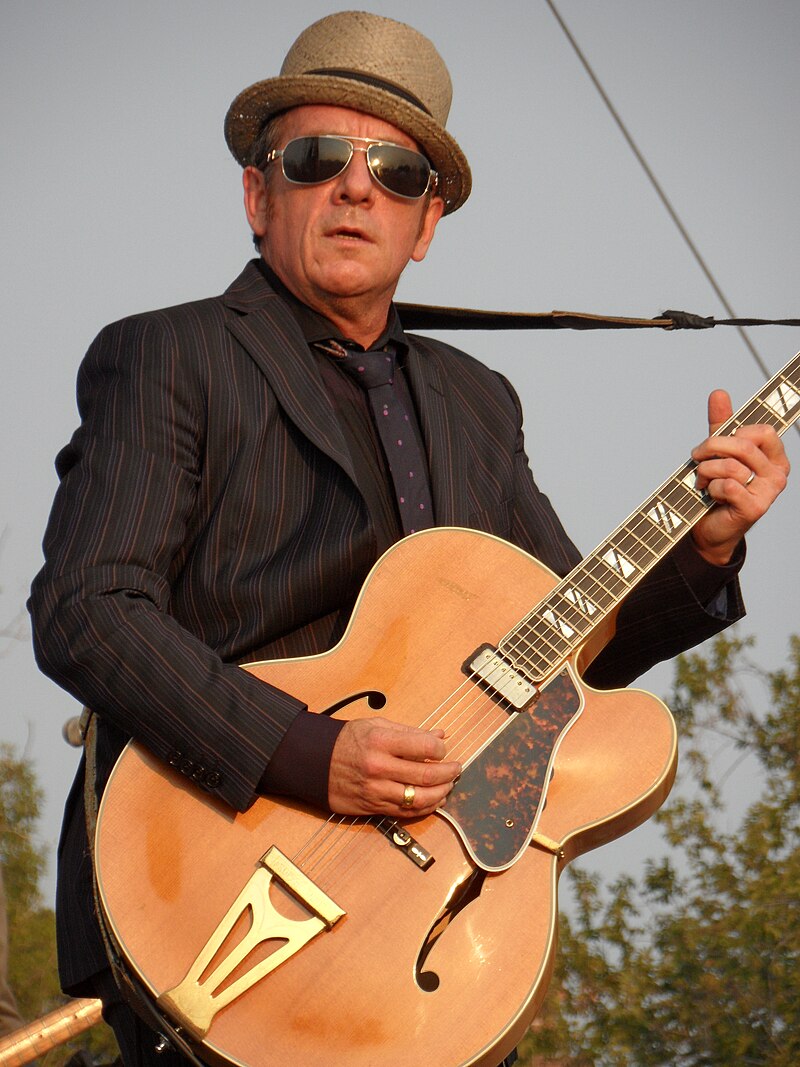
Early Life and Background
Elvis Costello, born Declan Patrick MacManus on August 25, 1954, in Paddington, London, is one of the most iconic and influential figures in modern music. He emerged during the late 1970s punk rock movement, but his career has spanned multiple genres, including rock, folk, country, and jazz. Costello’s ability to transcend musical boundaries has made him a unique and enduring figure in the music industry.
Growing up in a musically inclined family, Declan was surrounded by music from an early age. His father, Ronald “Ross” MacManus, was a trumpet player who performed with the Joe Loss Orchestra and even recorded a version of The Beatles’ “The Long and Winding Road” in Italian. His mother, Lillian MacManus, owned a record store, exposing young Declan to a wide array of musical styles. This eclectic musical environment laid the foundation for his diverse career.
The Birth of Elvis Costello
After his parents separated, Declan moved with his mother to Liverpool, where he finished high school. It was during this period that he began performing in local pubs and clubs, initially under the name DP Costello, a nod to his paternal grandmother. By the mid-1970s, he had formed several bands, including Flip City, but none of these early efforts gained significant traction.
In 1976, Declan’s fortunes changed when he responded to an advertisement from the independent label Stiff Records, seeking new talent. Recognizing his potential, the label’s management encouraged him to adopt a new stage name—Elvis Costello—combining the first name of the legendary Elvis Presley with his father’s stage name. This rebranding marked the beginning of a remarkable career.
Breakthrough with “My Aim Is True”
Elvis Costello’s debut album, My Aim Is True, was released in 1977 to critical acclaim. Produced by Nick Lowe and supported by the American band Clover, the album featured hits like “Alison,” “Less Than Zero,” and “Watching the Detectives.” These songs showcased Costello’s sharp wit, melodic prowess, and unique ability to blend rock with elements of punk, country, and pop.
Despite its success, Costello felt the need for a permanent backing band that could match his evolving sound. In July 1977, he formed The Attractions, consisting of Steve Nieve on keyboards, Bruce Thomas on bass, and Pete Thomas on drums. This lineup would become legendary, helping to define Costello’s sound over the next decade.
The Punk Era and Beyond: “This Year’s Model” and “Armed Forces”
In 1978, Elvis Costello and The Attractions released This Year’s Model, a seminal album that cemented Costello’s place in the pantheon of punk rock. The album was a sharp, incisive critique of contemporary society, with tracks like “Pump It Up” and “Radio, Radio” becoming anthems of the era. This Year’s Model also marked the beginning of Costello’s more overt political commentary, a theme that would recur throughout his career.
The following year, Costello released Armed Forces, an album that further expanded his sound and lyrical scope. Mixing new wave and power pop, the album featured hits like “Oliver’s Army” and “Accidents Will Happen.” Armed Forces was both a commercial and critical success, and it established Costello as a major force in music, capable of crafting catchy tunes with biting social commentary.
However, this period was not without controversy. In 1979, Costello was involved in a highly publicized altercation in Ohio, where he made derogatory remarks about American musicians, including Ray Charles. The incident resulted in accusations of racism and temporarily tarnished his reputation in the United States. Costello later apologized, attributing his comments to drunkenness and frustration, but the episode remains a blemish on his otherwise illustrious career.
The 1980s: Experimentation and Evolution
The 1980s saw Elvis Costello continuing to push the boundaries of his music. In 1980, he released Get Happy!!, an album that embraced soul and R&B influences. Despite its shift in style, the album was well-received, particularly in the UK, where it reached the top 10.
Costello’s prolific output during the 1980s included albums like Trust (1981), which blended rock and roll with punk and new wave, and Almost Blue (1981), a surprising foray into country music recorded in Nashville. Almost Blue was a departure from Costello’s usual sound, featuring covers of classic country songs. While it received mixed reviews, it showcased Costello’s willingness to experiment with different genres.
In 1982, Costello released Imperial Bedroom, often regarded as his masterpiece. The album was a sophisticated blend of pop and orchestral arrangements, with intricate lyrics that drew comparisons to the work of The Beatles and Cole Porter. Despite its critical acclaim, Imperial Bedroom did not achieve commercial success, but it solidified Costello’s reputation as one of the most innovative songwriters of his generation.
The mid-1980s saw Costello collaborating with other musical legends. In 1983, he released Punch the Clock, an album that featured the hit single “Everyday I Write the Book.” The song’s success brought Costello back into the mainstream, and the album also included a memorable trumpet solo by jazz icon Chet Baker on “Shipbuilding,” a poignant anti-war ballad.
In 1989, Costello teamed up with Paul McCartney to co-write several songs, including the hit “Veronica,” which appeared on his album Spike. The collaboration with McCartney was a significant moment in Costello’s career, blending his sharp lyrical wit with McCartney’s melodic genius.
The 1990s: Reinvention and Continued Success
The 1990s marked another phase of reinvention for Elvis Costello. In 1993, he released The Juliet Letters, a collaboration with the Brodsky Quartet that combined classical music with pop. Described by Costello as “chamber pop,” the album was a bold experiment that received mixed reviews but demonstrated his continued willingness to explore new musical territories.
Throughout the 1990s, Costello remained prolific, releasing albums that varied in style from rock and roll (Brutal Youth, 1994) to more introspective works (All This Useless Beauty, 1996). He also continued to collaborate with a diverse range of artists, including Burt Bacharach, with whom he recorded the critically acclaimed album Painted from Memory in 1998. The album featured lush, orchestral arrangements and was praised for its sophisticated songwriting.
In addition to his musical output, Costello began to make his mark in other areas of the entertainment industry. In 1999, he composed the score for the ballet Alice, further showcasing his versatility as a composer and musician.
The 2000s: A New Millennium and New Challenges
As the new millennium began, Elvis Costello continued to evolve as an artist. In 2002, he released When I Was Cruel, a return to his rock roots that was well-received by fans and critics alike. The album marked his first collaboration with a new band, The Imposters, which included members of The Attractions.
Costello’s work in the 2000s was characterized by a mix of new projects and retrospective works. In 2003, he released North, an album of ballads that reflected on themes of love and loss. The same year, he married jazz singer Diana Krall, with whom he had twin sons. This personal milestone coincided with a period of renewed creativity for Costello.
In 2004, Costello was inducted into the Rock and Roll Hall of Fame, a recognition of his significant contributions to the music industry. Despite this honor, he remained as active as ever, releasing a series of albums that included The Delivery Man (2004), a country-influenced record, and Momofuku (2008), a return to his punk rock roots.
During this period, Costello also expanded his influence into television, hosting the talk show Spectacle: Elvis Costello with…, which featured interviews and performances with a wide range of musical guests. The show was praised for its insightful discussions and unique format, further cementing Costello’s status as a cultural icon.
The 2010s and Beyond: Legacy and Influence
The 2010s saw Elvis Costello continuing to explore new musical landscapes while also reflecting on his extensive career. In 2010, he released National Ransom, an album that blended rock, country, and blues, and was recorded in Nashville, a city that had become closely associated with his music.
Costello’s work during this period was marked by a deepening of his collaborations with other artists. He continued to work with a diverse array of musicians, including jazz guitarist Bill Frisell and mezzo-soprano Anne Sofie von Otter. These collaborations highlighted Costello’s ability to cross genre boundaries and his enduring influence on both popular and classical music.
In 2018, Costello faced a significant health challenge when he was diagnosed with cancer. After undergoing surgery, he made a full recovery and returned to the stage with renewed vigor. His resilience in the face of adversity underscored his enduring passion for music and performance.
Elvis Costello’s influence on modern music cannot be overstated. His ability to blend genres, his sharp lyrical insights, and his willingness to take creative risks have inspired countless artists across multiple generations. From his early days as a punk rock provocateur to his later explorations of jazz, classical, and beyond, Costello’s career is a testament to the power of artistic innovation.
Historical Context and Nuances
Elvis Costello’s career is deeply intertwined with the cultural and musical shifts of the late 20th and early 21st centuries. Emerging from the punk rock movement of the late 1970s, Costello was part of a wave of artists who challenged the conventions of mainstream music. His work, characterized by its lyrical complexity and genre-blending, resonated with audiences looking for something beyond the formulaic pop of the time.
Costello’s collaborations with a wide range of artists, from Paul McCartney to Burt Bacharach, reflect the changing landscape of the music industry, where genres increasingly intersect, and artists draw from a broad palette of influences. His willingness to experiment with different styles, from punk to classical, has kept his work relevant across decades, appealing to both longtime fans and new listeners.
Conclusion: A Lasting Legacy
Elvis Costello’s career, spanning over four decades, is a testament to his enduring talent and versatility. From his early days as a punk rock icon to his later explorations of jazz, classical music, and beyond, Costello has continually reinvented himself, pushing the boundaries of what is possible in music. His influence can be seen in the work of countless artists who have followed in his footsteps, blending genres and challenging conventions in the same way that Costello has done throughout his career.
As he continues to perform and record, Elvis Costello remains a vital and innovative force in the music industry. His legacy is not just in the hits he has created but in the way he has consistently defied expectations, proving that true artistry knows no bounds.


