
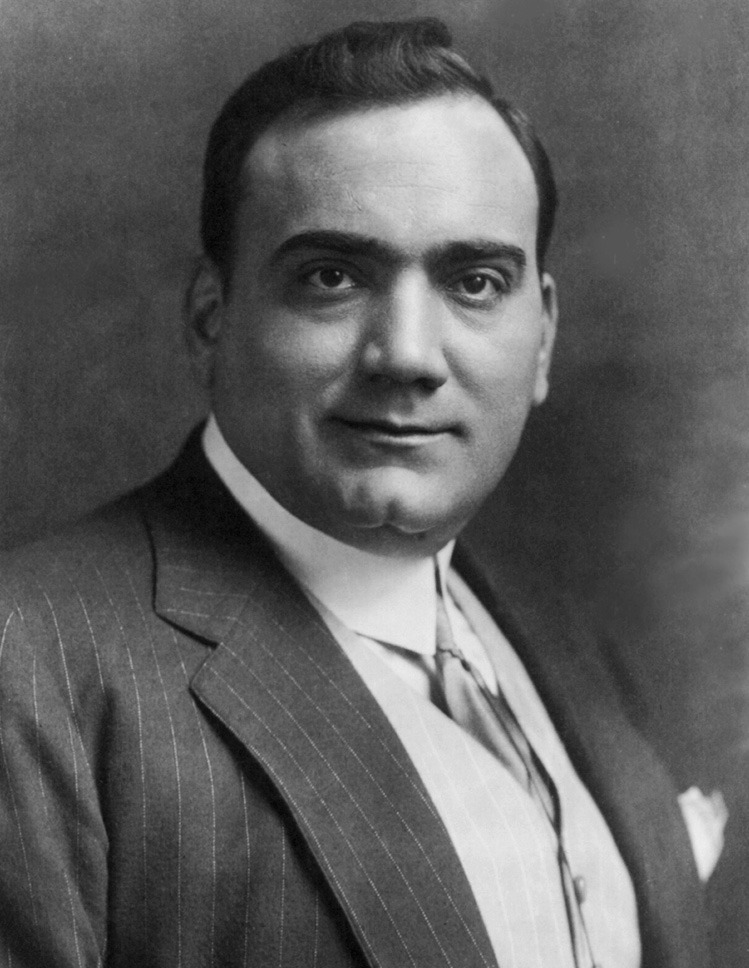
Enrico Caruso, born on February 25, 1873, in Naples, Italy, is one of the most celebrated opera tenors of all time. Known for his powerful voice, expressive style, and charismatic stage presence, Caruso’s career spanned the early 20th century, a period during which he became a global superstar and a pioneering figure in recorded music. His life story, marked by both triumphs and tragedies, reflects the complexities of a man who transcended his humble beginnings to become a legend in the world of opera.
Early Life and Musical Beginnings
Enrico Caruso was born into a modest family in Naples. His father, Marcello, was a mechanic, and his mother, Anna Baldini, was a homemaker. Caruso was one of seven children, and from an early age, he showed a natural talent for singing. His early musical education was informal; he sang in the church choir and received basic music lessons in the evenings after working as a mechanic during the day.
Caruso’s first foray into the world of performance came at the oratory of Giuseppe Bronzetti, where he sang as a contralto. Despite his lack of formal training, his voice stood out, and he quickly gained attention for its richness and emotional depth. His initial performances were in small venues such as private homes, cafes, and seaside pavilions in Naples, where he often sang Neapolitan songs—a genre that would remain close to his heart throughout his life.
It was during one of these performances that Caruso caught the attention of Eduardo Missiano, a baritone who recognized his potential. Missiano introduced Caruso to Guglielmo Vergine, a respected voice teacher who took the young singer under his wing. Under Vergine’s guidance, Caruso began to refine his technique and expand his repertoire. To pay for his lessons, Caruso struck a deal with Vergine, agreeing to repay him from his future earnings as a professional singer—a testament to the confidence both men had in Caruso’s potential.
The Early Struggles and First Successes
Caruso’s early career was not without its challenges. His first attempt to debut professionally at the Mercadante Theatre in Naples was met with failure, as the director refused to let him perform. However, this setback did not deter Caruso. He continued to perform in smaller venues, gradually building a reputation for himself in the provinces.
His first major break came in 1895 when he debuted at the Cimarosa Theatre in Caserta, performing in the opera Cavalleria Rusticana by Pietro Mascagni. This performance marked the beginning of Caruso’s rise in the Italian opera scene. He quickly followed this success with performances in Salerno and later in South America, where he began to gain international recognition.
Caruso’s early repertoire was diverse, including works by Italian composers like Giacomo Puccini, Giuseppe Verdi, and Vincenzo Bellini, as well as French composers like Georges Bizet and Charles Gounod. His ability to convey deep emotion through his voice, combined with his powerful delivery, made him a favorite among audiences.
Breakthrough and Global Fame
The turning point in Caruso’s career came in 1900 with his performance in Francesco Cilea’s L’Arlesiana. This role showcased Caruso’s exceptional vocal ability and his deep connection to the characters he portrayed. The success of L’Arlesiana opened doors for Caruso, leading to engagements in some of the world’s most prestigious opera houses.
In 1901, Caruso made his debut at La Scala in Milan, one of the most important opera houses in the world. His performance in La Bohème by Giacomo Puccini was particularly noteworthy, as it solidified his reputation as one of the leading tenors of his time. Despite initial setbacks, such as a less successful debut in Tosca at La Scala, Caruso’s persistence paid off, and he quickly became a favorite of both audiences and critics.
Caruso’s success in Italy was soon followed by triumphs abroad. He embarked on tours in Latin America and Russia, where he performed in cities like Buenos Aires, Montevideo, St. Petersburg, and Moscow. These international performances helped to establish Caruso as a global star, admired not only for his voice but also for his ability to connect with audiences regardless of language or culture.
The Metropolitan Opera and Recording Career
In 1903, Enrico Caruso made his debut at the Metropolitan Opera in New York City, performing the role of the Duke in Verdi’s Rigoletto. This performance marked the beginning of a long and successful relationship with the Met, where Caruso would perform for 17 seasons and give more than 600 performances. His presence at the Met helped to elevate the status of the opera house, attracting new audiences and setting high standards for opera performances in the United States.
Caruso’s time in New York also marked the beginning of his recording career. In 1902, he became one of the first major opera singers to make commercial recordings, initially for the Gramophone & Typewriter Company (later known as HMV). These recordings were revolutionary at the time, as they allowed audiences to experience Caruso’s voice outside the opera house. His recording of “Vesti la giubba” from Ruggero Leoncavallo’s Pagliacci became one of the first million-selling records in history.
Caruso’s recordings were instrumental in popularizing opera among the general public. His voice, preserved on wax cylinders and later on vinyl, reached people who might never have had the opportunity to attend an opera performance in person. This democratization of opera, made possible by Caruso’s recordings, helped to solidify his status as the first global music superstar.
Personal Life and Challenges
Despite his professional success, Caruso’s personal life was marked by difficulties and controversies. In 1897, he met and fell in love with Ada Giachetti, an opera singer who would become his partner for over a decade. The couple had two sons, Rodolfo and Enrico, but their relationship was tumultuous, marked by Giachetti’s eventual departure and accusations of infidelity.
Caruso faced several public scandals during his career, including an infamous incident in 1906 when he was accused of “disorderly conduct” in New York’s Central Park Zoo. The incident, in which Caruso was accused of inappropriately touching a woman, led to a trial that attracted widespread media attention. Although Caruso was fined, many believe the charges were part of an extortion attempt, and the case did little to tarnish his reputation.
Health problems also plagued Caruso in his later years. In 1911, he underwent surgery in Milan to remove nodules from his vocal cords, a condition likely exacerbated by the intense demands of his singing career. Despite these challenges, Caruso continued to perform, but by 1920, his health began to deteriorate rapidly due to pleurisy, which led to severe complications.
Final Years and Legacy
Enrico Caruso’s health continued to decline, and after a series of medical treatments in Italy and the United States, he was diagnosed with an abscess and empyema, which required multiple surgeries. Despite his weakened condition, Caruso continued to perform until December 1920, when he gave his final performance at the Metropolitan Opera in La Juive by Fromental Halévy.
In June 1921, Caruso returned to Italy with his wife, Dorothy Benjamin, whom he had married in 1918, and their daughter, Gloria. Caruso hoped to recover in his native Naples, but his condition worsened. On August 2, 1921, at the age of 48, Enrico Caruso passed away from complications related to his illness. His death marked the end of an era, but his legacy as one of the greatest opera singers in history was already firmly established.
Caruso’s influence on the world of opera and recorded music cannot be overstated. He was a pioneer in bringing opera to a global audience through recordings, and his voice set a standard for tenors that remains unmatched. Caruso’s ability to convey deep emotion, coupled with his technical mastery, made him a favorite of both critics and audiences.
In the years following his death, Caruso’s recordings continued to sell, and his influence on future generations of singers was profound. He remains a benchmark for tenors, and his recordings are still studied and admired by vocalists and music lovers alike.
Conclusion
Enrico Caruso’s life is a story of extraordinary talent, determination, and resilience. From his humble beginnings in Naples to his status as a global superstar, Caruso’s journey was marked by both triumphs and challenges. His voice, immortalized through his recordings, continues to captivate audiences nearly a century after his death.
Caruso’s impact on the world of opera and music is unparalleled. He brought opera to the masses, not only through his live performances but also through his pioneering work in recorded music. His legacy as one of the greatest tenors of all time is secure, and his influence on the art of singing remains as powerful today as it was during his lifetime.
As we reflect on the life and career of Enrico Caruso, we are reminded of the power of music to transcend time and place, to move the human spirit, and to connect us all through shared emotion and experience. Caruso’s voice may have been silenced nearly a century ago, but its echoes continue to inspire and resonate around the world.


