
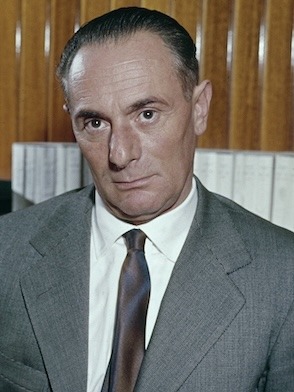
Enrico Mattei, born on April 29, 1906, in Acqualagna, Italy, is a name synonymous with Italy’s post-war economic resurgence and energy independence. He is best known as the architect behind the creation of ENI (Ente Nazionale Idrocarburi), a state-owned company that played a pivotal role in transforming Italy into a major player in the global energy market. Mattei’s life was marked by ambition, innovation, and a relentless pursuit of economic sovereignty for Italy. His untimely death in 1962 under mysterious circumstances only added to the myth surrounding his legacy.
Early Life and Career Beginnings
Enrico Mattei was born into a modest family; his father was a brigadier in the Carabinieri, Italy’s national gendarmerie. From an early age, Mattei displayed a strong work ethic and a keen interest in business. After completing his elementary education, he attended a technical school, which laid the foundation for his future endeavors. His early career was shaped by his experiences working in local industries, including a stint at the Scuriatti bed factory and later at the Conceria Fiore, a leather tanning company.
Mattei’s rapid rise within the Conceria Fiore was indicative of his ambition and business acumen. By the age of 20, he had progressed from a laborer to the position of laboratory director and eventually became the primary collaborator of the company’s owner. However, the economic downturn of the late 1920s, triggered by the global financial crisis, led to the closure of the Conceria Fiore. This event profoundly impacted Mattei, forcing him to reassess his career path.
The Move to Milan and Entrepreneurial Ventures
In 1929, Mattei moved to Milan, where he continued his industrial career with the same tenacity that had marked his early years. In 1934, he founded the Industria Chimica Lombarda, a chemical manufacturing company. The company grew rapidly under Mattei’s leadership, reflecting his ability to adapt and innovate in response to market demands. However, his ambition soon led him to explore opportunities for vertical integration, particularly in securing raw materials for his company.
One of Mattei’s most ambitious projects during this period involved the fishing industry in the Red Sea. He envisioned creating a fleet and establishing processing facilities to secure fats and oils needed for his chemical production. Despite his careful planning and initial support from the Italian government, the project was ultimately derailed due to technical difficulties and opposition from other Italian operators in the region.
Mattei’s Role in the Italian Resistance
As World War II unfolded, Mattei’s life took a dramatic turn. Deeply opposed to the fascist regime and the German occupation of Italy, he became actively involved in the Italian Resistance. In 1944, he joined the Comitato di Liberazione Nazionale Alta Italia (CLNAI), an organization committed to the liberation of Northern Italy from fascist control. His role within the CLNAI was crucial, particularly in securing resources and safeguarding industrial assets that would be vital for Italy’s post-war recovery.
During this period, Mattei demonstrated exceptional leadership and strategic thinking. He managed to keep his factories operational in secret, continuing to pay his workers and shielding them from Nazi raids. His actions during the war not only solidified his reputation as a patriot but also laid the groundwork for his post-war career.
The Birth of ENI and Italy’s Energy Independence
In the chaotic aftermath of World War II, Enrico Mattei was appointed to dismantle the Italian state-owned oil company AGIP, which was seen as a symbol of the failed fascist economic policies. However, Mattei had other plans. Recognizing the strategic importance of energy resources for Italy’s economic future, he defied the orders to liquidate AGIP and instead set about revitalizing the company.
In 1953, Mattei founded ENI, the Ente Nazionale Idrocarburi, with the goal of securing energy independence for Italy. Under his leadership, ENI expanded rapidly, not just within Italy but across the globe. Mattei was instrumental in negotiating favorable oil contracts with Middle Eastern and North African countries, offering them a more equitable share of profits compared to the exploitative terms offered by the major Western oil companies, known as the “Seven Sisters.”
Mattei’s innovative approach to the global energy market challenged the dominance of these multinational corporations. He promoted what became known as the “Mattei Formula,” which proposed a 75-25 profit-sharing model, favoring the oil-producing countries. This approach not only secured vital energy resources for Italy but also positioned ENI as a global leader in the industry.
Mattei’s Diplomatic and Cultural Influence
Enrico Mattei’s influence extended beyond the boardroom and the oil fields. He was a masterful diplomat who understood the importance of cultural sensitivity in international negotiations. He cultivated relationships with leaders in the developing world, many of whom were engaged in their own struggles for independence from colonial powers. Mattei’s respect for different cultures and his support for their economic sovereignty earned him widespread admiration.
Mattei also played a key role in shaping Italy’s post-war foreign policy. His efforts to secure energy resources were closely aligned with the broader goals of Italian diplomacy, which sought to assert Italy’s independence and influence on the global stage. ENI’s success under Mattei’s leadership became a symbol of Italy’s resurgence as a major economic power.
The Mysterious Death of Enrico Mattei
On October 27, 1962, Enrico Mattei’s life came to a sudden and tragic end when the plane he was traveling in crashed near Bascapè, a small town in the Lombardy region. Mattei was returning from a business trip to Sicily, where he had been overseeing ENI operations. The official investigation concluded that the crash was an accident, but over the years, numerous theories have emerged suggesting foul play.
Many believe that Mattei was the victim of a deliberate assassination, orchestrated by those who saw him as a threat to their interests. Among the suspects are the “Seven Sisters,” the Western oil conglomerates that were losing their grip on global oil markets due to Mattei’s actions, as well as the CIA and the Italian Mafia. Testimonies from repentant mafiosi in the 1990s further fueled these suspicions, with claims that a bomb had been planted on Mattei’s plane.
Despite the unresolved nature of the investigation, Mattei’s death did little to diminish his legacy. If anything, it solidified his status as a martyr for Italy’s quest for economic independence and energy security.
Mattei’s Legacy and Impact on the Global Energy Industry
Enrico Mattei’s impact on the global energy industry cannot be overstated. He was a visionary leader who understood the strategic importance of energy resources long before it became a central focus of international politics. His efforts to break the monopoly of the major oil companies and secure equitable agreements with oil-producing countries reshaped the global energy landscape.
Mattei’s legacy also includes his contributions to Italy’s economic development. Under his leadership, ENI became one of the world’s largest energy companies, driving Italy’s post-war industrialization and economic growth. His emphasis on innovation, strategic thinking, and social responsibility set a standard that continues to influence corporate practices today.
Moreover, Mattei’s approach to international relations—marked by respect for sovereignty and cultural sensitivity—remains relevant in today’s globalized world. His belief in the potential for cooperation and mutual benefit between nations, particularly in the energy sector, offers valuable lessons for contemporary leaders facing the complex challenges of the 21st century.
The Continuing Relevance of Enrico Mattei’s Vision
As the world grapples with the challenges of energy transition and climate change, Enrico Mattei’s vision for a fair and equitable global energy system remains as relevant as ever. His pioneering efforts to secure energy independence for Italy laid the groundwork for the modern energy strategies that prioritize sustainability, innovation, and international cooperation.
Mattei’s life story is a testament to the power of visionary leadership in shaping not only a nation’s economic future but also its role in the world. His legacy continues to inspire new generations of leaders in the energy sector and beyond, reminding us of the enduring importance of integrity, innovation, and the relentless pursuit of progress.
In conclusion, Enrico Mattei was more than just a businessman or an industrialist; he was a patriot, a visionary, and a pioneer who fundamentally changed the course of Italian and global history. His life and legacy continue to resonate, offering a powerful example of how one individual’s determination and foresight can transform an entire industry and, by extension, the world.


